
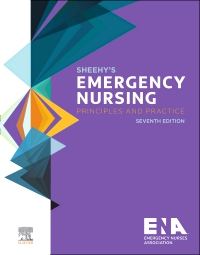

Sheehy's Emergency Nursing - Elsevier eBook on VitalSource, 7th Edition
Elsevier eBook on VitalSource
Now $94.15
**Selected for Doody’s Core Titles® 2024 in Emergency Care**
Written by emergency nurses for emergency nurses, Sheehy's Emergency Nursing: Principles and Practice, 7th Edition covers the issues and procedures unique to the emergency department. This comprehensive, evidence-based resource is written by the Emergency Nurses Association and includes developments and changes in clinical practice that are incorporated throughout the text. Considered the go-to guide for issues and procedures unique to the emergency department, the user-friendly format features more than 150 high-quality illustrations and tables that highlight essential concepts and offer quick access to vital information. New to this edition is updated key coverage including clinical fundamentals, treatment for trauma and medical-surgical emergencies, the foundations of emergency nursing practice, special populations, and more!
-
- Written by the Emergency Nurses Association, ensuring this is the most accurate information on the market.
- Most comprehensive and authoritative text available on emergency nursing.
- Logically organized, chapters are grouped into six sections for quick access to important content: Foundations of Emergency Nursing, Professional Practice, Clinical Foundations of Emergency Nursing, Major Trauma Emergencies, Medical and Surgical Emergencies, and Special Patient Populations.
- Tables and boxes highlight and summarize critical and essential information, while 150 illustrations help you to quickly identify and treat frequently encountered conditions.
- A separate unit on special patient populations covers topics such as child abuse, elder abuse, intimate partner violence, sexual assault, substance abuse and behavioral/pediatric/obstetrical emergencies.
-
- NEW! Coverage includes the latest on topical issues such as ethics, workplace violence, and geriatric trauma.
- UPDATED pain guidelines feature the latest pain indicators.
- UPDATED sepsis guidelines provide essential information on pathophysiology and diagnosis, with valuable guidelines for managing these patients.
- NEW! Fully revised information on communicable diseases.
- UPDATED Information on non-narcotic use for treatment of pain and increasing rates of addiction.
- NEW! Discussion of transgender patients covers how to work with this unique population.
- NEW! Full color photo insert
-
Unit I: Foundations of Emergency Nursing
1. Emergency Nursing Practice
2. Legal and Regulatory Considerations
3. Approaching DiversityUnit II: Professional Practice
4. Evidence-Based Practice
5. Research
6. Ethical Considerations
7. Workplace Violence
Unit III: Clinical Foundations of Emergency Nursing
8. Triage
9. Patient Assessment
10. Pain
11. Wound Management
12. Family Presence During Resuscitation
13. Management of the Critical Care Patient in the Emergency Department
14. Palliative and End-of-Life Care in the Emergency Department
15. Organ and Tissue Donation
16. Air and Surface Patient Transport
17. Emergency Preparedness
18. Chemical, Biological, Radiological, Nuclear (CBRN) ThreatsUnit IV: Medical and Surgical Emergencies
19. Communicable Diseases
20. Fluids and Electrolytes
21. Shock Emergencies
22. Respiratory Emergencies
23. Cardiovascular Emergencies
24. Neurologic Emergencies
25. Gastrointestinal Emergencies
26. Renal and Genitourinary Emergencies
27. Gynecologic Emergencies
28. Endocrine Emergencies
29. Hematologic and Oncologic Emergencies
30. Environmental Emergencies
31. Toxicologic Emergencies
32. Dental, Ear, Nose, Throat, and Facial Emergencies
33. Ocular Emergencies
Unit V: Trauma Emergencies
34. Epidemiology and Mechanisms of Injury
35. Head Trauma
36. Maxillofacial Trauma
37. Spinal Trauma
38. Thoracic Trauma
39. Abdominal and Genitourinary Trauma
40. Orthopedic and Neurovascular Trauma
41. Burn Trauma
42. Pediatric Trauma
43. Obstetric Trauma
44. Geriatric Trauma
Unit VI: Special Populations
45. Pediatric Emergencies
46. Geriatric Emergencies
47. Behavioral Health Emergencies
48. Emergency Forensic Considerations
49. Abuse and Neglect
50. Substance Abuse
51. Sexual Assault -
-
Ways of Reading
- The appearance of the text and page layout can be modified according to the capabilities of the reading system (font family and font size, spaces between paragraphs, sentences, words, and letters, as well as color of background and text)
- This e-publication is accessible to the full extent that the file format and types of content allow, on a specific reading device, by default, without necessarily including any additions such as textual descriptions of images or enhanced navigation
- No information about nonvisual reading is available
-
Conformance
- No information is available
-
Navigation
- Table of contents to all chapters of the text via links
- Page list to go to pages from the print source version
-
Rich Content
- No information is available
-
Hazards
- No information is available
-
Product Content
- No information is available
-
Legal Considerations
- No information is available
-
Additional Accessibility Information
- Page breaks included from the original print source
- For readers with color vision deficiency, use of color (e.g., in diagrams, graphics and charts, in prompts, or on buttons inviting a response) is not the sole means of graphical distinction or of conveying information
- E-publication includes basic navigation (usually less detailed than TOC-based navigation)
- Where links, controls or buttons are included in the content, the purpose or functionality of each link, control or button is apparent from the associated text alone - or where it is unclear, separate link, control or button descriptions are provided
- All (or substantially all) textual matter is arranged in a single logical reading order (including text that is visually presented as separate from the main text flow, e.g., in boxouts, captions, tables, footnotes, endnotes, citations, etc.). Non-textual content is also linked from within this logical reading order. (Purely decorative non-text content can be ignored).
- The language of the text has been specified (e.g., via the HTML or XML lang attribute) to optimise text-to-speech (and other alternative renderings), both at the whole document level and, where appropriate, for individual words, phrases or passages in a different language.
-
Ways of Reading

 as described in our