
ISBN:
9780323497732
Copyright:
2019
Publication Date:
10-16-2018
Page Count:
296
Imprint:
Mosby
List Price:
$38.99

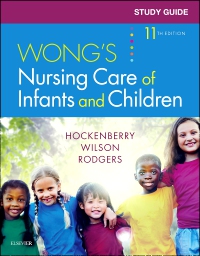
Study Guide for Wong's Nursing Care of Infants and Children - Elsevier eBook on VitalSource, 11th Edition
by Marilyn J. Hockenberry, PhD, RN, PPCNP-BC, FAAN, David Wilson, MS, RN, C, (NIC) and Linda McCampbell, MSN, APRN, BC
Elsevier eBook on VitalSource
ISBN:
9780323497732
Copyright:
2019
Publication Date:
10-16-2018
Page Count:
296
Imprint:
Mosby
List Price:
$38.99
Was
$38.99
Now $34.31
Or $0.00 with a valid access code
Corresponding chapter by chapter to the completely reorganized and revised Wong's Nursing Care of Infants and Children, 11th Edition, this study guide helps you apply pediatric nursing concepts to real-world practice. It assesses, reinforces, and strengthens your understanding of pediatric nursing with learning activities, review questions, and case studies with critical thinking questions. Learning Key Terms — consisting of matching and fill-in-the-blank questions — test your ability to define all key terms highlighted in each textbook chapter. An answer key for the review questions and learning activities is included in the back of the study guide. Pages are perforated, so submitting assignments is easy.
-
-
 Wong's Nursing Care of Infants and Children - Elsevier eBook on VitalSourceElsevier eBook on VitalSource
-
-
- Reviewing Key Concepts and Content includes questions in various formats to provide you ample opportunity to assess your knowledge and comprehension of information covered in the text. Activities include matching, fill-in-the-blank, true/false, short answer, and multiple choice to help you identify the core content of the chapter — and test your understanding upon completion of reading the chapter.
- Thinking Critically case-based activities require you to apply the concepts found in the chapters to solve problems, make decisions concerning care management, and provide responses to patient questions and concerns.
- Learning Key Terms consists of matching and fill-in-the-blank questions that let you test your ability to define all key terms highlighted in the corresponding textbook chapter.
- An answer key is included at the end of the Study Guide.
- Perforated pages allow you to submit assignments to your instructor.
-
- NEW! Updated chapter organization and content matches revised and reorganized text.
-
Section I: Children, Their Families, and the Nurse
1. Perspectives of Pediatric Nursing
2. Social, Cultural, Religious, and Family Influences on Child Health Promotion
3. Hereditary Influences on Health Promotion of the Child and Family
Section II: Childhood and Family Assessment
4. Communication, Physical, and Developmental Assessment of the Child and Family
5. Pain in Children: Significance, Assessment, and Management Strategies
6. Childhood Communicable and Infectious Diseases
Section III: Family-Centered Care of the Newborn
7. Health Promotion of the Newborn and Family
8. Health Problems of the Newborn
9. The High-Risk Newborn and Family
Section IV: Family-Centered Care of the Infant
10. Health Promotion of the Infant and Family
11. Health Problems of the Infant
Section V: Family-Centered Care of the Toddler and Preschooler
12. Health Promotion of the Toddler and Family
13. Health Promotion of the Preschooler and Family
14. Health Problems of Early Childhood
Section VI: Family-Centered Care of the School-Age Child
15. Health Promotion of the School-Age Child and Family
16. Health Problems of the School-Age Child
Section VII: Family-Centered Care of the Adolescent
17. Health Promotion of the Adolescent and Family
18. Health Problems of the Adolescent
Section VIII: Family-Centered Care of the Child with Special Needs
19. Impact of Chronic Illness, Disability, or End of Life Care for the Child and Family
20. The Child with Cognitive, Sensory, or Communication Impairment
Section IX: The Child Who is Hospitalized
21. Family-Centered Care of the Child During Illness and Hospitalization
22. Pediatric Nursing Interventions and Skills
Section X: Childhood Nutrition and Elimination Problems
23. The Child with Fluid and Electrolyte Imbalance
24. The Child with Renal Dysfunction
25. The Child with Gastrointestinal Dysfunction
Section XI: Childhood Oxygenation Problems
26. The Child with Respiratory Dysfunction
Section XII: Childhood Blood Production and Circulation Problems
27. The Child with Cardiovascular Dysfunction
28. The Child with Hematologic or Immunologic Dysfunction
Section XIII: Childhood Regulatory Problems
29. The Child with Cancer
30. The Child with Cerebral Dysfunction
31. The Child with Endocrine Dysfunction
Section XIV: Childhood Physical Mobility Problems
32. The Child with Integumentary Dysfunction
33. The Child with Musculoskeletal or Articular Dysfunction
34. The Child with Neuromuscular or Muscular Dysfunction -
-
Ways of Reading
- The appearance of the text and page layout can be modified according to the capabilities of the reading system (font family and font size, spaces between paragraphs, sentences, words, and letters, as well as color of background and text)
- This e-publication is accessible to the full extent that the file format and types of content allow, on a specific reading device, by default, without necessarily including any additions such as textual descriptions of images or enhanced navigation
- No information about nonvisual reading is available
-
Conformance
- No information is available
-
Navigation
- Table of contents to all chapters of the text via links
- Page list to go to pages from the print source version
-
Rich Content
- No information is available
-
Hazards
- No information is available
-
Product Content
- No information is available
-
Legal Considerations
- No information is available
-
Additional Accessibility Information
- Page breaks included from the original print source
- For readers with color vision deficiency, use of color (e.g., in diagrams, graphics and charts, in prompts, or on buttons inviting a response) is not the sole means of graphical distinction or of conveying information
- E-publication includes basic navigation (usually less detailed than TOC-based navigation)
- Where links, controls or buttons are included in the content, the purpose or functionality of each link, control or button is apparent from the associated text alone - or where it is unclear, separate link, control or button descriptions are provided
- All (or substantially all) textual matter is arranged in a single logical reading order (including text that is visually presented as separate from the main text flow, e.g., in boxouts, captions, tables, footnotes, endnotes, citations, etc.). Non-textual content is also linked from within this logical reading order. (Purely decorative non-text content can be ignored).
- The language of the text has been specified (e.g., via the HTML or XML lang attribute) to optimise text-to-speech (and other alternative renderings), both at the whole document level and, where appropriate, for individual words, phrases or passages in a different language.
-
Ways of Reading
Was
$38.99
Now $34.31
Or $0.00 with a valid access code

 as described in our