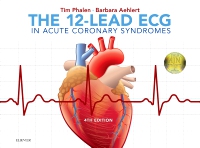

The 12-Lead ECG in Acute Coronary Syndromes - Elsevier eBook on VitalSource, 4th Edition
Elsevier eBook on VitalSource
Now $61.74
Awarded first place in the 2019 AJN Book of the Year Awards in the Critical Care-Emergency Nursing category. Simplify ECGs! Using an easy-to-understand, step-by-step approach and conversational tone, The 12-Lead ECG in Acute Coronary Syndromes, 4th Edition describes the process of 12-lead ECG interpretation for accurate recognition and effective treatment of ACS. This new edition has been streamlined to emphasize practice and explanation. It shows you how to determine the likelihood of ST elevation myocardial infarction (STEMI) versus other causes of ST elevation. It covers innovative technology and evolving paradigms in ECG interpretation, such as the Cabrera format, which sequences impulse generation in a logical anatomic progression. In addition, over 100 practice ECGs—more than 25 of which are new—help test your knowledge. Written by two well-known educators—Tim Phalen, a paramedic, and Barbara Aehlert, an experienced nurse and popular ACLS instructor, this guide incorporates the latest American Heart Association Emergency Cardiac Care (ECC) Guidelines, as well as new research and information on recognizing and treating ACS in both hospital and prehospital environments.
New Edition Expected Availability: 09-05-2024

The 12-Lead ECG in Acute Coronary Syndromes - Elsevier eBook on VitalSource
-
- NEW! More than 100 practice ECGs offer plenty of opportunity to test your knowledge.
- NEW! Covers innovative technology and evolving paradigms in ECG interpretation.
- NEW! Review questions reinforce the content.
- NEW! Reorganized and simplified table of contents facilitates study and quick reference.
- NEW! Straightforward writing style offers need-to-know information up front, making this complex subject matter easy to understand and apply.
-
- NEW! Nora AI - an AI-powered learning assistant exclusive to Elsevier ebooks on VitalSource's Bookshelf® platform - offers built-in AI learning support that provides personalized answers based on content from the Elsevier ebook
- Updated Case studies promote early recognition and treatment of ACS
- Outlines efficient strategies for identifying STEMI, allowing quick initiation of patient care
- Contains more than 200 colorful illustrations, including a large number of ECGs
- Offers practical advice for recognizing noninfarct causes of ST elevation, including left ventricular hypertrophy, bundle branch block, ventricular rhythms, benign early repolarization, and pericarditis
- Features a lay-flat spiral binding, making the book easy to use in any setting
- Chapter objectives help you identify key concepts
- Updated Consider This boxes highlight important tips
-
Chapter 1: Reviewing the Basics
Chapter 2: Leads, Axis, and Acquisition of the 12-Lead ECG
Chapter 3: Acute Coronary Syndromes
Chapter 4: ST Elevation Variants
Chapter 5: Practice ECGs -
-
Ways of Reading
- The appearance of the text and page layout can be modified according to the capabilities of the reading system (font family and font size, spaces between paragraphs, sentences, words, and letters, as well as color of background and text)
- This e-publication is accessible to the full extent that the file format and types of content allow, on a specific reading device, by default, without necessarily including any additions such as textual descriptions of images or enhanced navigation
- No information about nonvisual reading is available
-
Conformance
- No information is available
-
Navigation
- Table of contents to all chapters of the text via links
- Page list to go to pages from the print source version
-
Rich Content
- No information is available
-
Hazards
- No information is available
-
Product Content
- No information is available
-
Legal Considerations
- No information is available
-
Additional Accessibility Information
- Page breaks included from the original print source
- For readers with color vision deficiency, use of color (e.g., in diagrams, graphics and charts, in prompts, or on buttons inviting a response) is not the sole means of graphical distinction or of conveying information
- E-publication includes basic navigation (usually less detailed than TOC-based navigation)
- Where links, controls or buttons are included in the content, the purpose or functionality of each link, control or button is apparent from the associated text alone - or where it is unclear, separate link, control or button descriptions are provided
- All (or substantially all) textual matter is arranged in a single logical reading order (including text that is visually presented as separate from the main text flow, e.g., in boxouts, captions, tables, footnotes, endnotes, citations, etc.). Non-textual content is also linked from within this logical reading order. (Purely decorative non-text content can be ignored).
- The language of the text has been specified (e.g., via the HTML or XML lang attribute) to optimise text-to-speech (and other alternative renderings), both at the whole document level and, where appropriate, for individual words, phrases or passages in a different language.
-
Ways of Reading


 as described in our