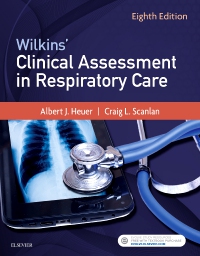

Wilkins' Clinical Assessment in Respiratory Care - Elsevier eBook on VitalSource, 8th Edition
Elsevier eBook on VitalSource
Now $79.19
Wilkin’s Clinical Assessment in Respiratory Care, 8th Edition, is the world-leading respiratory care text devoted exclusively to patient assessment. This comprehensive book prepares you to assist physicians in the decision-making process regarding treatment, evaluation of the treatment’s effectiveness, and determining if changes in the treatment need to be made. Written by Dr. Albert Heuer, and Dr. Craig Scanlan, it emphasizes learning objectives through well-organized need-to-know information and tips. Plus, this streamlined edition helps you focus on key content and prepare for the CRT credentialing exam by aligning material within the book to the NBRC exam matrices.
New Edition Expected Availability: 09-15-2021

Wilkins' Clinical Assessment in Respiratory Care - Elsevier eBook on VitalSource
-
- NEW! Thoroughly updated content reflects the most recent changes to the NBRC exam.
- NEW! Inclusion of the latest technological advancements relates to the assessment of critical care and non-critical care patients.
- NEW! Full-color design enhances learning and understanding by making key concepts easy to find.
-
- Case studies offer real-life clinical scenarios challenging you to interpret data and make accurate patient assessments.
- Questions to Ask boxes identify what practitioners should ask patients (i.e., coughing, sputum, shortness of breath) or questions to ask themselves on various subjects (i.e., lung sounds they are hearing, blood pressure, respiratory rate) in order to provide effective patient care.
- Learning objectives, chapter outlines, chapter overviews, and key terms lists in each chapter, help you focus on key content.
- Key Point summaries emphasize the learning objectives and provide an overview of important material.
- Simply Stated boxes highlight and promote understanding of important concepts.
- A comprehensive approach provides you with the important information you need to know in order to effectively assess patients.
-
1. Preparing for the Patient Encounter
2. The Medical History and the Interview
3. Cardiopulmonary Symptoms
4. Vital Signs
5. Fundamentals of Physical Examination
6. Neurological Assessment of the Respiratory Care Patient
7. Clinical Laboratory Studies
8. Interpretation of Blood Gases
9. Pulmonary Function Testing
10. Clinical Application of the Chest Radiograph
11. Interpretation of the Electrocardiogram
12. Assessment of the Neonatal and Pediatric Patient
13. Assessment of the Older Patient
14. Respiratory Monitoring in the Intensive Care Unit
15. Assessment of Cardiac Output
16. Assessment of Hemodynamic Pressures
17. Flexible Fiberoptic Bronchoscopy
18. Nutritional Assessment of Patients with Respiratory Disease
19. Assessment of Sleep and Breathing
20. Assessment of the Home Care Patient
21. Documentation of the Patient AssessmentAnswer Appendix
Glossary
Index -
-
Ways of Reading
- The appearance of the text and page layout can be modified according to the capabilities of the reading system (font family and font size, spaces between paragraphs, sentences, words, and letters, as well as color of background and text)
- This e-publication is accessible to the full extent that the file format and types of content allow, on a specific reading device, by default, without necessarily including any additions such as textual descriptions of images or enhanced navigation
- No information about nonvisual reading is available
-
Conformance
- The publication was certified on 27-05-2026
-
Navigation
- Table of contents to all chapters of the text via links
- Page list to go to pages from the print source version
-
Rich Content
- No information is available
-
Hazards
- No information is available
-
Product Content
- No information is available
-
Legal Considerations
- No information is available
-
Additional Accessibility Information
- Page breaks included from the original print source
- For readers with color vision deficiency, use of color (e.g., in diagrams, graphics and charts, in prompts, or on buttons inviting a response) is not the sole means of graphical distinction or of conveying information
- E-publication includes basic navigation (usually less detailed than TOC-based navigation)
- Where links, controls or buttons are included in the content, the purpose or functionality of each link, control or button is apparent from the associated text alone - or where it is unclear, separate link, control or button descriptions are provided
- All (or substantially all) textual matter is arranged in a single logical reading order (including text that is visually presented as separate from the main text flow, e.g., in boxouts, captions, tables, footnotes, endnotes, citations, etc.). Non-textual content is also linked from within this logical reading order. (Purely decorative non-text content can be ignored).
- The language of the text has been specified (e.g., via the HTML or XML lang attribute) to optimise text-to-speech (and other alternative renderings), both at the whole document level and, where appropriate, for individual words, phrases or passages in a different language.
-
Ways of Reading

 as described in our