ISBN:
9780323511780
Copyright:
2015
Publication Date:
11-15-2014
Page Count:
272
Imprint:
Saunders
List Price:
$34.99

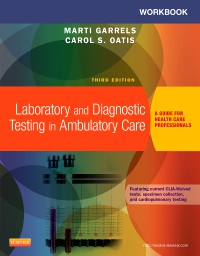
Workbook for Laboratory and Diagnostic Testing in Ambulatory Care - Elsevier eBook on VitalSource, 3rd Edition
by Martha (Marti) Garrels, MSA, MT(ASCP), CMA (AAMA)
Elsevier eBook on VitalSource
ISBN:
9780323511780
Copyright:
2015
Publication Date:
11-15-2014
Page Count:
272
Imprint:
Saunders
List Price:
$34.99
Most review copies are eBooks – how fast!
A review copy request is most likely to be fulfilled as an eBook on VitalSource rather than a print product, unless no eBook is available. eBooks become available in as little as a few hours. Print products will take between 7 and 10 days to arrive. To request a print copy, please contact us through the Evolve Support Center for further assistance or contact your Elsevier Sales Rep.
Corresponding to the chapters in Laboratory and Diagnostic Testing in Ambulatory Care, 3rd Edition, this workbook provides activities and exercises to reinforce student understanding of laboratory concepts, terminology, and procedures. Skills check-off sheets track students’ progress as they become competent with laboratory and diagnostic procedures, and are designed to meet government standards for good laboratory practice.
New Edition Expected Availability: 10-16-2018

Workbook for Laboratory and Diagnostic Testing in Ambulatory Care Elsevier eBook on VitalSource
Elsevier eBook on VitalSource
ISBN: 9780323532976
-
- NEW practice exercises match the text with a focus on new technology and significant advances made in recent years, including the latest CLIA waived test methods.
- NEW Electrocardiography and Spirometry chapter includes review exercises, questions, and skills checklists for these diagnostic tests.
-
- Chapters are organized into five sections: 1) terminology exercises, 2) review questions for fundamental concepts, 3) procedures, 4) advanced concepts, and 5) check-off procedure sheets for all the procedures presented in the textbook chapter.
- Review exercises test student knowledge of terminology, including matching vocabulary terms with their definitions and identifying common acronyms.
- Skills checklists ask students to read, perform, and check off each step on the sheet to track their progress as they perform the chapter’s lab procedures and analytical tests.
- NEW practice exercises match the text with a focus on new technology and significant advances made in recent years, including the latest CLIA waived test methods.
- NEW exercises in Electrocardiography and Spirometry chapter include review questions and skills checklists for these diagnostic tests.
- A useful appendix includes forms for documenting safety, quality assurance, and CLIA compliance.
- NEW! TEACH 2.0 Instructor’s Resource Manual on the Evolve companion website makes teaching easier with detailed lesson plans including suggestions for in-class activities as well as lecture outlines and annotated, illustrated PowerPoint® presentations, as well as answer keys for the book and workbook.
-
-
 Laboratory and Diagnostic Testing for Ambulatory Settings - Elsevier eBook on VitalSourceElsevier eBook on VitalSource
-
-
1. Introduction to the Laboratory and Safety Training
2. Regulations, Microscope Setup, and Quality Assurance
3. Urinalysis
4. Blood Collection
5. Hematology
6. Chemistry
7. Immunology
8. Microbiology
9. Toxicology
10. Electrocardiography and Spirometry NEW!
Appendix: Forms for Documenting Safety, Quality Assurance, and CLIA Compliance -
-
Ways of Reading
- The appearance of the text and page layout can be modified according to the capabilities of the reading system (font family and font size, spaces between paragraphs, sentences, words, and letters, as well as color of background and text)
- This e-publication is accessible to the full extent that the file format and types of content allow, on a specific reading device, by default, without necessarily including any additions such as textual descriptions of images or enhanced navigation
- No information about nonvisual reading is available
-
Conformance
- The publication was certified on 27-05-2026
-
Navigation
- Table of contents to all chapters of the text via links
- Page list to go to pages from the print source version
-
Rich Content
- No information is available
-
Hazards
- No information is available
-
Product Content
- No information is available
-
Legal Considerations
- No information is available
-
Additional Accessibility Information
- Page breaks included from the original print source
- For readers with color vision deficiency, use of color (e.g., in diagrams, graphics and charts, in prompts, or on buttons inviting a response) is not the sole means of graphical distinction or of conveying information
- E-publication includes basic navigation (usually less detailed than TOC-based navigation)
- Where links, controls or buttons are included in the content, the purpose or functionality of each link, control or button is apparent from the associated text alone - or where it is unclear, separate link, control or button descriptions are provided
- All (or substantially all) textual matter is arranged in a single logical reading order (including text that is visually presented as separate from the main text flow, e.g., in boxouts, captions, tables, footnotes, endnotes, citations, etc.). Non-textual content is also linked from within this logical reading order. (Purely decorative non-text content can be ignored).
- The language of the text has been specified (e.g., via the HTML or XML lang attribute) to optimise text-to-speech (and other alternative renderings), both at the whole document level and, where appropriate, for individual words, phrases or passages in a different language.
-
Ways of Reading
Most review copies are eBooks – how fast!
A review copy request is most likely to be fulfilled as an eBook on VitalSource rather than a print product, unless no eBook is available. eBooks become available in as little as a few hours. Print products will take between 7 and 10 days to arrive. To request a print copy, please contact us through the Evolve Support Center for further assistance or contact your Elsevier Sales Rep.

 as described in our