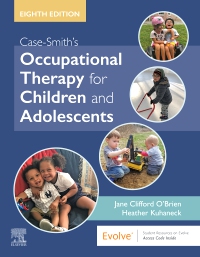

Case-Smith's Occupational Therapy for Children and Adolescents - Elsevier eBook on VitalSource, 8th Edition
Elsevier eBook on VitalSource
Now $107.99
**Selected for Doody’s Core Titles® 2024 with "Essential Purchase" designation in Occupational Therapy**
The number one book in pediatric OT is back! Focusing on children from infancy to adolescence, Case-Smith's Occupational Therapy for Children and Adolescents, 8th Edition provides comprehensive, full-color coverage of pediatric conditions and treatment techniques in all settings. Its emphasis on application of evidence-based practice includes: eight new chapters, a focus on clinical reasoning, updated references, research notes, and explanations of the evidentiary basis for specific interventions. Coverage of new research and theories, new techniques, and current trends, with additional case studies, keeps you in-step with the latest advances in the field. Developmental milestone tables serve as a quick reference throughout the book!
New Edition Expected Availability: 04-17-2025

Case-Smith's Occupational Therapy for Children and Adolescents - Elsevier eBook on VitalSource
-
- NEW! Eight completely new chapters cover Theory and Practice Models for Occupational Therapy With Children, Development of Occupations and Skills From Infancy Through Adolescence, Therapeutic Use of Self, Observational Assessment and Activity Analysis, Evaluation Interpretation, and Goal Writing, Documenting Outcomes, Neonatal Intensive Care Unit, and Vision Impairment
- NEW! A focus on theory and principles Practice Models promote clinical reasoning
- NEW! Emphasis on application of theory and frames of reference in practice appear throughout chapters in book
- NEW! Developmental milestone tables serve as quick reference guides
- NEW! Online materials included to help facilitate your understanding of what’s covered in the text
- NEW! Textbook is organized into six sections to fully describe the occupational therapy process and follow OTPF
-
- Full-color, contemporary design throughout text includes high-quality photos and illustrations
- Case-based video clips on the Evolve website demonstrate important concepts and rehabilitation techniques
- Research Notes boxes and evidence-based summary tables help you learn to interpret evidence and strengthen clinical decision-making skills
- Coverage of OT for children from infancy through adolescence includes the latest research, techniques and trends
- Case studies help you apply concepts to actual situations you may encounter in practice
- Learning objectives indicate what you will be learning in each chapter and serve as checkpoints when studying for examinations
- A glossary makes it easy for you to look up key terms
-
Section I: Foundational Knowledge for Occupational Therapy for Children and Youth
1. An Overview of the Occupational Therapy Process for Children
2. Theory and Practice Models for Occupational Therapy With Children
3. Working With Families and Interprofessional Teams
4. Development of Occupations and Skills From Infancy Through Adolescence
5. Therapeutic Use of Self
Section II: Occupational Therapy Assessment and Evaluation Methods and Process
6. Observational Assessment and Activity Analysis
7. Use of Standardized Tests and Pediatric Practice
8. Evaluation Interpretation, and Goal Writing
9. Documenting Outcomes
Section III: Assessment and Treatment of Occupations
10. Assessment and Treatment of Feeding
11. Assessment and Treatment of Play
12. Assessment and Treatment of Activities of Daily Living: Sleep, Rest, and Sexuality
13. Assessment and Treatment of Instrumental Activities of Daily Living and Leisure
14. Assessment and Treatment of Social Participation and Social Skills
15. Assessment and Treatment of Educational Performance
Section IV: Occupational Therapy Approaches
16. Motor Control/Motor Learning
17. Cognitive Interventions
18. Mobility
19. Assistive Technology
20. Sensory Integration
21. Behavioral Approaches
Section V: Pediatric Occupational Therapy Services
22. Neonatal Intensive Care Unit
23. Early Intervention Services
24. School-Based Occupational Therapy
25. Transition Services
26. Hospital and Pediatric Rehabilitation Services
27. Pediatric Hand Therapy
Section VI: Occupational Therapy for Specific Conditions
28. Mental Health Conditions
29. Neuromotor Conditions: Cerebral Palsy
30. Autism Spectrum Disorder
31. Trauma-Induced Conditions
32. Vision Impairment -
-
Ways of Reading
- The appearance of the text and page layout can be modified according to the capabilities of the reading system (font family and font size, spaces between paragraphs, sentences, words, and letters, as well as color of background and text)
- This e-publication is accessible to the full extent that the file format and types of content allow, on a specific reading device, by default, without necessarily including any additions such as textual descriptions of images or enhanced navigation
- No information about nonvisual reading is available
-
Conformance
- No information is available
-
Navigation
- Table of contents to all chapters of the text via links
- Page list to go to pages from the print source version
-
Rich Content
- No information is available
-
Hazards
- No information is available
-
Product Content
- No information is available
-
Legal Considerations
- No information is available
-
Additional Accessibility Information
- Page breaks included from the original print source
- For readers with color vision deficiency, use of color (e.g., in diagrams, graphics and charts, in prompts, or on buttons inviting a response) is not the sole means of graphical distinction or of conveying information
- E-publication includes basic navigation (usually less detailed than TOC-based navigation)
- Where links, controls or buttons are included in the content, the purpose or functionality of each link, control or button is apparent from the associated text alone - or where it is unclear, separate link, control or button descriptions are provided
- All (or substantially all) textual matter is arranged in a single logical reading order (including text that is visually presented as separate from the main text flow, e.g., in boxouts, captions, tables, footnotes, endnotes, citations, etc.). Non-textual content is also linked from within this logical reading order. (Purely decorative non-text content can be ignored).
- The language of the text has been specified (e.g., via the HTML or XML lang attribute) to optimise text-to-speech (and other alternative renderings), both at the whole document level and, where appropriate, for individual words, phrases or passages in a different language.
-
Ways of Reading


 as described in our