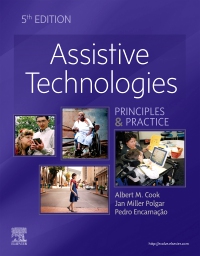

Assistive Technologies - Elsevier eBook on VitalSource, 5th Edition
Elsevier eBook on VitalSource
Now $76.29
Master the assistive strategies you need to make confident clinical decisions and help improve the quality of life for people with disabilities. Based on the Human Activity Assistive Technology (HAAT) model developed by Al Cook, Sue Hussey and Jan Polgar, Assistive Technologies: Principles & Practice, 5th Edition, provides detailed coverage of the broad range of devices, services, and practices that comprise assistive technology. This new text offers a systematic process for ensuring the effective application of assistive technologies — and focuses on the relationship between the human user and the assisted activity within specific contexts. It features over 30 new photos and illustrations, as well as, updated chapters and case studies that reflect current technology.
New Edition Expected Availability: 10-24-2024

Assistive Technologies - Elsevier eBook on VitalSource
-
- New! Thoroughly updated chapters to reflect current technology and practice
- New! Expanded discussion on assistive robotics and smart technologies
- New! Review of global initiatives on Assistive Technology
- New! Updated art program with 30+ new photos and illustrations
- New! Updated case studies to reflect changes in technology and practice since last edition
-
- Human Activity Assistive Technology (HAAT) framework locates assistive technology within common, everyday contexts for more relevant application
- Focus on clinical application guides application of concepts to real-world situations
- Study questions and chapter summaries in each chapter help assessment of understanding and identification of areas where more study is needed
- Coverage of changing AT needs throughout the lifespan emphasizes how AT fits into people’s lives and contributes to their full participation in society
- Principles and practice of assistive technology provide the foundation for effective reasoning
- Ethical issues content provides vital information to guide AT service delivery
- Explicit applications of the HAAT model in each of the chapters on specific technologies and more emphasis on the interactions among the elements make content even easier to understand
-
1. Principles of Assistive Technology
2. Technologies that Assist People Who Have Disabilities
3. Activity, Human, and Context
4. Global Perspective on Assistive Technology
5. Ethical Issues in Assistive Technology
6. Delivering Assistive Technology Services to the Client
7. User Input
8. Control Interfaces for Assistive Technologies
9. Input Accessibility for Mainstream Information and Communication Technologies
10. Enabling Function and Participation with Seating Technologies
11. Technologies that Enable Mobility
12. Technologies That Aid Transportation
13. Enabling Manipulation with Low-Technology Assistive Devices
14. Electronic Aids to Daily Living
15. Robotic Assistive Technologies that Aid Manipulation
16. Sensory Aids for Persons with Visual Impairments
17. Assistive Technologies for Cognitive Augmentation
18. Augmentative and Alternative Communication Systems -
-
Ways of Reading
- The appearance of the text and page layout can be modified according to the capabilities of the reading system (font family and font size, spaces between paragraphs, sentences, words, and letters, as well as color of background and text)
- This e-publication is accessible to the full extent that the file format and types of content allow, on a specific reading device, by default, without necessarily including any additions such as textual descriptions of images or enhanced navigation
- No information about nonvisual reading is available
-
Conformance
- No information is available
-
Navigation
- Table of contents to all chapters of the text via links
- Page list to go to pages from the print source version
-
Rich Content
- No information is available
-
Hazards
- No information is available
-
Product Content
- No information is available
-
Legal Considerations
- No information is available
-
Additional Accessibility Information
- Page breaks included from the original print source
- For readers with color vision deficiency, use of color (e.g., in diagrams, graphics and charts, in prompts, or on buttons inviting a response) is not the sole means of graphical distinction or of conveying information
- E-publication includes basic navigation (usually less detailed than TOC-based navigation)
- Where links, controls or buttons are included in the content, the purpose or functionality of each link, control or button is apparent from the associated text alone - or where it is unclear, separate link, control or button descriptions are provided
- All (or substantially all) textual matter is arranged in a single logical reading order (including text that is visually presented as separate from the main text flow, e.g., in boxouts, captions, tables, footnotes, endnotes, citations, etc.). Non-textual content is also linked from within this logical reading order. (Purely decorative non-text content can be ignored).
- The language of the text has been specified (e.g., via the HTML or XML lang attribute) to optimise text-to-speech (and other alternative renderings), both at the whole document level and, where appropriate, for individual words, phrases or passages in a different language.
-
Ways of Reading


 as described in our