ISBN:
9780323528733
Copyright:
2019
Publication Date:
06-27-2018
Page Count:
520
Imprint:
Mosby
List Price:
$97.99

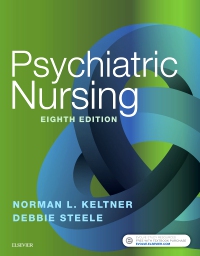
Psychiatric Nursing - Elsevier eBook on VitalSource, 8th Edition
by Norman L. Keltner, EdD, RN, CRNP and Debbie Steele
Elsevier eBook on VitalSource
ISBN:
9780323528733
Copyright:
2019
Publication Date:
06-27-2018
Page Count:
520
Imprint:
Mosby
List Price:
$97.99
Was
$97.99
Now $88.19
Or $0.00 with a valid access code
Covering the field’s latest trends and treatments, Psychiatric Nursing, 8th Edition provides you with the solid, therapeutic skills you need to deliver safe and effective psychiatric nursing care. This new edition features a unique, three-pronged approach to psychotherapeutic management which emphasizes the nurse’s three primary tools: themselves and their relationship with patients, medications, and the environment. Written in a friendly, approachable style, this text clearly defines the nurse’s role in caring for individuals with psychiatric disorders like no other book on the market!
New Edition Expected Availability: 06-14-2022

Keltner’s Psychiatric Nursing - Elsevier eBook on VitalSource
Elsevier eBook on VitalSource
ISBN: 9780323791984
-
- NEW! Chapter on Models for Working with Psychiatric Patients revised as new chapter on Emotional Focused Model of Behavior
- NEW! Update to various chapters within Unit III: Medication: Psychopharmacology, include the latest drugs used for managing psychiatric disorders
- NEW! Update to Communicate Professionally chapter includes methods of communication including social media and other current forms of technology
- NEW! Update to Variables Affecting The Therapeutic Environment: Violence and Suicide chapter reorganizes how the five-phase assault cycle is presented so it flows better and is easier to comprehend
- NEW! Several of the clinical disorders chapters such as the Schizophrenia, Depressive Disorders, and Anxiety Disorders updated with the latest information on treatments and drugs
-
- Unique! A practical, three-pronged approach to psychotherapeutic management includes: 1) the therapeutic nurse-patient relationship, 2) psychopharmacology, and 3) milieu management
- Unique! Norm’s Notes offer helpful tips from the lead author, Norman Keltner, at the beginning of each chapter, making it easier to understand difficult topics
- DSM-5 information is integrated throughout the text, along with updated content and NANDA content
- Patient and Family Education boxes highlight information that the nurse should provide to patients and families
- Nursing care plans highlight the nurse’s role in psychiatric care, emphasizing assessment, planning, nursing diagnoses, implementation, and evaluation for specific disorders
- Case studies depict psychiatric disorders and show the development of effective nursing care strategies
-
Unit I: The Basics
1. You, Medication, Environment: 3 Tools of the Psychiatric Nurse
2. Historical Issues
3. Legal Issues
4. Psychobiologic Bases of Behavior
5. Cultural Issues
6. Spiritual Issues
Unit II: You (Therapeutic Nurse-Patient Relationship)
7. Models for Working with Psychiatric Patients
8. Learning to Communicate Professionally
9. Working With an Individual Patient
10. Working With Groups of Patients
11. Working With the Family
Unit III: Medication (Psychopharmacology)
12. Introduction to Psychotropic Drugs
13. Antiparkinsonian Drugs
14. Antipsychotic Drugs
15. Antidepressant Drugs
16. Antimanic Drugs
17. Antianxiety Drugs
18. Antidementia Drugs
19. Over-the-counter Drugs
Unit IV: Environment: Milieu Management
20. Introduction to Milieu Management
21. Variables Affecting the Therapeutic Environment: Violence and Suicide
22. Therapeutic Environment in Various Treatment Settings
Unit V: Putting It All Together (Psychopathology)
23. Introduction to Psychopathology
24. Schizophrenia Spectrum and Other Psychotic Disorders
25. Depressive Disorders
26. Bipolar Disorders
27. Anxiety-Related, Obsessive-Compulsive, Trauma- and Stressor-Related, Somatic, and Dissociative Disorders
28. Cognitive Disorders
29. Personality Disorders
30. Sexual Disorders
31. Substance Abuse Disorders
32. Eating Disorders
Unit VI: Special Populations
33. Survivors of Violence and Trauma
34. Children and Adolescents
35. Older Adults
36. Soldiers and Veterans -
-
Ways of Reading
- The appearance of the text and page layout can be modified according to the capabilities of the reading system (font family and font size, spaces between paragraphs, sentences, words, and letters, as well as color of background and text)
- This e-publication is accessible to the full extent that the file format and types of content allow, on a specific reading device, by default, without necessarily including any additions such as textual descriptions of images or enhanced navigation
- No information about nonvisual reading is available
-
Conformance
- The publication was certified on 27-05-2026
-
Navigation
- Table of contents to all chapters of the text via links
- Page list to go to pages from the print source version
-
Rich Content
- No information is available
-
Hazards
- No information is available
-
Product Content
- No information is available
-
Legal Considerations
- No information is available
-
Additional Accessibility Information
- Page breaks included from the original print source
- For readers with color vision deficiency, use of color (e.g., in diagrams, graphics and charts, in prompts, or on buttons inviting a response) is not the sole means of graphical distinction or of conveying information
- E-publication includes basic navigation (usually less detailed than TOC-based navigation)
- Where links, controls or buttons are included in the content, the purpose or functionality of each link, control or button is apparent from the associated text alone - or where it is unclear, separate link, control or button descriptions are provided
- All (or substantially all) textual matter is arranged in a single logical reading order (including text that is visually presented as separate from the main text flow, e.g., in boxouts, captions, tables, footnotes, endnotes, citations, etc.). Non-textual content is also linked from within this logical reading order. (Purely decorative non-text content can be ignored).
- The language of the text has been specified (e.g., via the HTML or XML lang attribute) to optimise text-to-speech (and other alternative renderings), both at the whole document level and, where appropriate, for individual words, phrases or passages in a different language.
-
Ways of Reading
Was
$97.99
Now $88.19
Or $0.00 with a valid access code

 as described in our