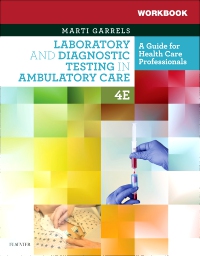

Workbook for Laboratory and Diagnostic Testing in Ambulatory Care Elsevier eBook on VitalSource, 4th Edition
Elsevier eBook on VitalSource
Now $27.29
Corresponding to the chapters in Laboratory and Diagnostic Testing in Ambulatory Care, 4th Edition, this workbook provides practice designed to reinforce your understanding of laboratory concepts, terminology, and procedures. Each chapter includes exercises to help you master fundamental concepts, specific procedures, and advanced skills. Competency evaluation sheets designed to meet government standards for good laboratory practice are included for all procedures to help you track your competence with laboratory and diagnostic procedures. With focused coverage on the latest advancements and technologies in the field, this practical workbook gives you the hands-on practice you need to succeed.
New Edition Expected Availability: 09-01-2027

Workbook for Laboratory and Diagnostic Testing in Ambulatory Care Elsevier eBook on VitalSource
-
- NEW! Increased content coverage includes new CLIA-waived and moderately complex testing (including automated CBCs and automated chemistries) as well as technological advancements
-
- Enhanced coverage of CLIA-waived tests includes new phlebotomy equipment used in ambulatory care
- Terminology exercises test knowledge and recall
- Review and labeling questions for fundamental concepts, procedures, and advanced concepts assess comprehension and promote critical thinking
- Skills checklists track your progress in performing laboratory procedures and analytical tests
- An appendix includes forms that you can use to document safety, quality assurance, and CLIA compliance
-
-
 Laboratory and Diagnostic Testing in Ambulatory Settings Elsevier E-Book on VitalSourceElsevier eBook on VitalSource
 -

-

-
-
1. Introduction to the Laboratory and Safety Training
2. Regulations, Microscope Setup, and Quality Assurance
3. Urinalysis
4. Blood Collection
5. Hematology
6. Chemistry
7. Immunology
8. Microbiology
9. Toxicology
10. Electrocardiography
11. SpirometryAppendix: Forms for Documenting Safety, Quality Assurance, CLIA Compliance, Sample Health Assessment Form, and Professional Evaluation Form
-
-
Ways of Reading
- The appearance of the text and page layout can be modified according to the capabilities of the reading system (font family and font size, spaces between paragraphs, sentences, words, and letters, as well as color of background and text)
- This e-publication is accessible to the full extent that the file format and types of content allow, on a specific reading device, by default, without necessarily including any additions such as textual descriptions of images or enhanced navigation
- No information about nonvisual reading is available
-
Conformance
- No information is available
-
Navigation
- Table of contents to all chapters of the text via links
- Page list to go to pages from the print source version
-
Rich Content
- No information is available
-
Hazards
- No information is available
-
Product Content
- No information is available
-
Legal Considerations
- No information is available
-
Additional Accessibility Information
- Page breaks included from the original print source
- For readers with color vision deficiency, use of color (e.g., in diagrams, graphics and charts, in prompts, or on buttons inviting a response) is not the sole means of graphical distinction or of conveying information
- E-publication includes basic navigation (usually less detailed than TOC-based navigation)
- Where links, controls or buttons are included in the content, the purpose or functionality of each link, control or button is apparent from the associated text alone - or where it is unclear, separate link, control or button descriptions are provided
- All (or substantially all) textual matter is arranged in a single logical reading order (including text that is visually presented as separate from the main text flow, e.g., in boxouts, captions, tables, footnotes, endnotes, citations, etc.). Non-textual content is also linked from within this logical reading order. (Purely decorative non-text content can be ignored).
- The language of the text has been specified (e.g., via the HTML or XML lang attribute) to optimise text-to-speech (and other alternative renderings), both at the whole document level and, where appropriate, for individual words, phrases or passages in a different language.
-
Ways of Reading

 as described in our