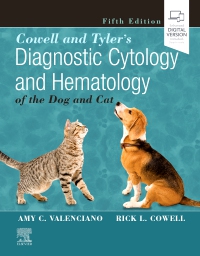

Diagnostic Cytology and Hematology of the Dog and Cat - Elsevier E-Book on VitalSource, 5th Edition
Elsevier eBook on VitalSource
Now $119.69
Long-trusted in the field, Cowell & Tyler’s Diagnostic Cytology and Hematology of the Dog and Cat, 5th Edition is the complete resource for helping you learn the necessary skills to diagnosis and treat dogs and cats. This essential clinical reference includes detailed illustrations to help you quickly and accurately build a treatment plan for hundreds of medical diagnoses. Microscopic evaluation techniques and interpretation guidelines for organ tissue, blood, and other body fluid specimens provide a basic understanding of sample collection and specimen preparation. In addition, algorithms are generously distributed throughout the text, helping you evaluate various cytologic preparations. Written by a team of experts, this fifth edition includes over 150 new, high-resolution photomicrographs and histopathology images, and a new chapter covering the Female Reproductive Tract. Additionally, an Expert Consult website features the entire text plus an electronic atlas with more than 1,000 full-color photomicrographs depicting abnormalities within each blood cell line!
New Edition Expected Availability: 03-24-2027

Cowell and Tyler's Diagnostic Cytology and Hematology of the Dog and Cat
-
- NEW and UNIQUE! Expert Consult website has entire text plus an electronic atlas including the Zoomify feature which allows you to zoom in and out of more than 1,000 full-color photomicrographs depicting abnormalities within each blood cell line
- NEW! Female Reproductive Tract chapter provides updated coverage of vaginal cytology and includes all-new information on uterine and ovarian aspirates
- NEW! More than 150 high-resolution photomicrographs and histopathology images help you identify normal vs. abnormal cells, tissues, and lesions
- NEW! Enhanced section on urinalysis with all-new images helps you to identify various types of crystals in urine sediment
-
- UPDATED! Revised chapters throughout the text give you the most complete and up-to-date coverage of recently recognized conditions, new terminology, and new procedures
- Coverage of the basics of specimen collection, preparation, microscopic evaluation, and interpretation for organ tissues, blood, and other body fluids saves you time by having comprehensive information in one all-inclusive resource
- Detailed instructions for submission and transport of samples as well as culture and commercial laboratory interpretation guide you through in-house laboratory evaluation
- User-friendly, easy-to-follow algorithms and tables facilitate quick access to necessary information and guide you to the most accurate cytologic diagnosis
- Over 1,300 vivid, high-resolution images let users zoom in to help identify normal vs. abnormal cells, enabling you to make accurate diagnoses
- Contributions from nearly 50 academic and diagnostic laboratory experts provide you with the best and most current information available
-
1. Sample Collection and Preparation
2. Cell Types and Criteria of Malignancy
3. Selected Infectious Agents
4. Round Cells
5. Cutaneous and Subcutaneous Lesions
6. Subcutaneous Glandular Tissue: Mammary, Salivary, Thyroid, and Parathyroid
7. Nasal Exudates and Masses
8. Oropharynx and Tonsils
9. Eyes and Associated Structures
10. External Ear Canal
11. The Lymph Nodes
12. Synovial Fluid Analysis
13. The Musculoskeletal System
14. Cerebrospinal Fluid and Central Nervous System Cytology
15. Effusions: Abdominal, Thoracic, and Pericardial
16. Transtracheal and Bronchoalveolar Washes
17. The Lung and Intrathoracic Structures
18. The Gastrointestinal Tract
19. The Pancreas
20. The Liver
21. The Spleen
22. The Kidneys
23. Examination of Urinary Sediment
24. The Male Reproductive Tract: Prostate, Testes, Penis, and Semen
25. The Female Reproductive Tract
26. Peripheral Blood Smears
27. The Bone Marrow
28. The Adrenal Gland
29. Immunocytochemistry
30. Flow Cytometry
31. Molecular Methods in Lymphoid Malignancies -
-
Ways of Reading
- The appearance of the text and page layout can be modified according to the capabilities of the reading system (font family and font size, spaces between paragraphs, sentences, words, and letters, as well as color of background and text)
- This e-publication is accessible to the full extent that the file format and types of content allow, on a specific reading device, by default, without necessarily including any additions such as textual descriptions of images or enhanced navigation
- No information about nonvisual reading is available
-
Conformance
- No information is available
-
Navigation
- Table of contents to all chapters of the text via links
- Page list to go to pages from the print source version
-
Rich Content
- No information is available
-
Hazards
- No information is available
-
Product Content
- No information is available
-
Legal Considerations
- No information is available
-
Additional Accessibility Information
- Page breaks included from the original print source
- For readers with color vision deficiency, use of color (e.g., in diagrams, graphics and charts, in prompts, or on buttons inviting a response) is not the sole means of graphical distinction or of conveying information
- E-publication includes basic navigation (usually less detailed than TOC-based navigation)
- Where links, controls or buttons are included in the content, the purpose or functionality of each link, control or button is apparent from the associated text alone - or where it is unclear, separate link, control or button descriptions are provided
- All (or substantially all) textual matter is arranged in a single logical reading order (including text that is visually presented as separate from the main text flow, e.g., in boxouts, captions, tables, footnotes, endnotes, citations, etc.). Non-textual content is also linked from within this logical reading order. (Purely decorative non-text content can be ignored).
- The language of the text has been specified (e.g., via the HTML or XML lang attribute) to optimise text-to-speech (and other alternative renderings), both at the whole document level and, where appropriate, for individual words, phrases or passages in a different language.
-
Ways of Reading


 as described in our