

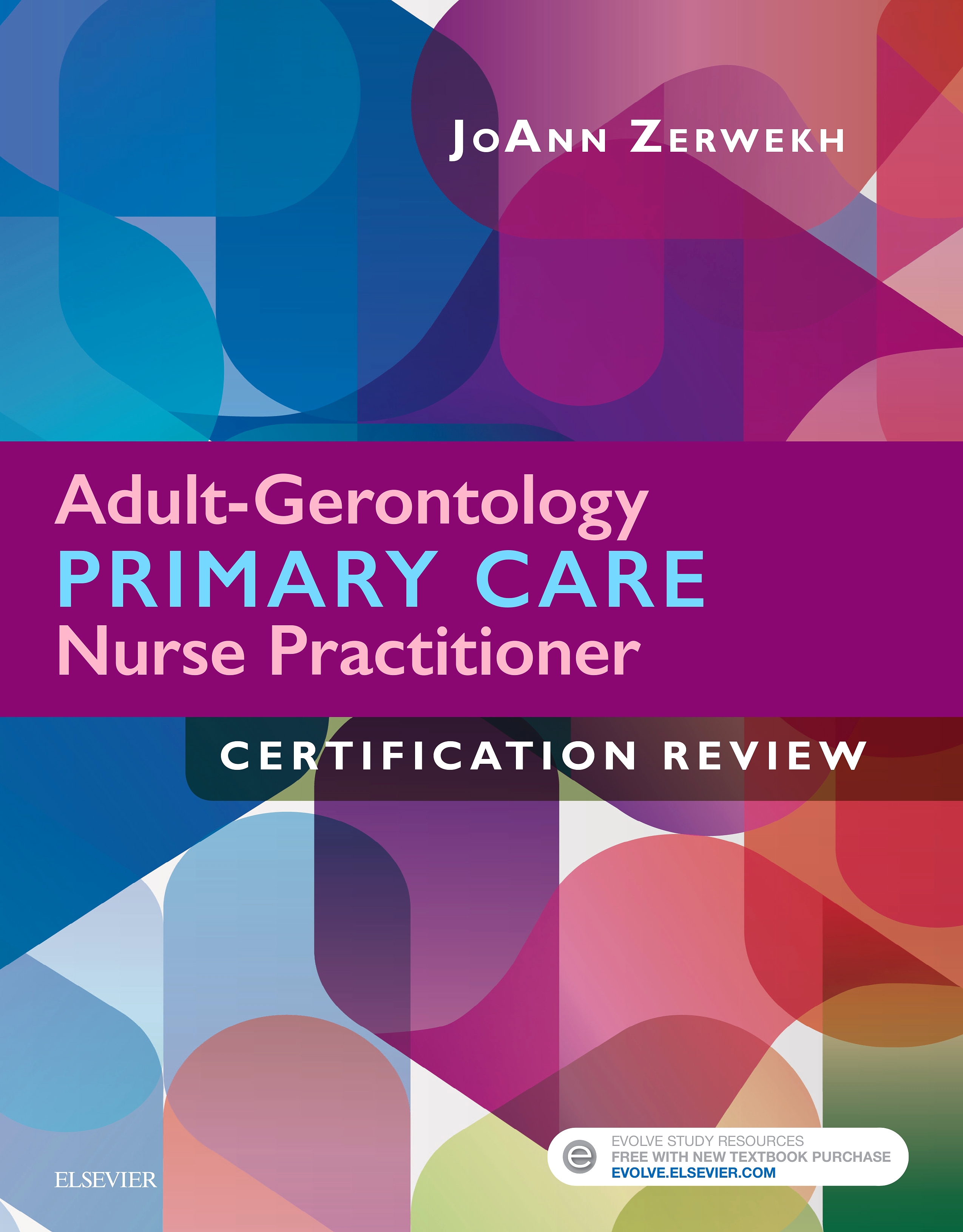
Adult-Gerontology Primary Care Nurse Practitioner Certification Review - Elsevier eBook on VitalSource, 1st Edition
Elsevier eBook on VitalSource
Now $57.59
Get the expert study tools you need to prepare for Adult-Gerontology Primary Care Nurse Practitioner certification! New from best-selling author JoAnn Zerwekh, Adult-Gerontology Primary Care Nurse Practitioner Certification Review has been carefully written and organized to mirror the AANP and ANCC test blueprints. The first edition of this robust study tool includes more than 1,400 multiple-choice questions that reflect the latest evidence-based clinical practice and national treatment guidelines and protocols. At the end of every chapter you’ll find an Answers and Rationales section for instant remediation. Additionally, you can study anytime and anywhere with a mobile-optimized website that generates exams with questions taken from the book, plus new illustration-based and ordered-response questions.
-
- NEW! Expert exam prep matching the latest AANP and ANCC exam blueprints and item formats, including multiple-choice questions in print and ordered-response and image-based questions online.
- NEW! More than 1,400 practice questions with answers and detailed rationales for correct answers
- NEW! Questions mirroring the Primary Care AGPCNP certification exams cover the latest information on assessment, diagnosis, patient education, planning and intervention, evaluation of response to health care, health promotion strategies, scope of practice, and ethics.
- NEW! Up-to-date clinical content reflects the very latest evidence-based clinical practice and national treatment guidelines and protocols.
- NEW! Randomly generated practice exams online deliver an unlimited number of practice exams with automated grading and feedback.
- NEW! Chapter on Test-Taking Strategies guides you through techniques to increase clinical reasoning skills, improve testing skills, learn strategies for decreasing anxiety, and employ tips to improve study habits.
- NEW! QSEN-focused questions highlight the graduate-level safety competency of the Quality & Safety Education for Nurses (QSEN) initiative.
- NEW! Clinical chapters are divided into three areas to make it easy to locate specific information within each body system.
-
- NEW! Nora AI - an AI-powered learning assistant exclusive to Elsevier ebooks on VitalSource's Bookshelf® platform - offers built-in AI learning support that provides personalized answers based on content from the Elsevier ebook
-
1. Test-Taking Strategies
2. Growth and Development
3. Health Promotion and Maintenance
4. Cardiovascular
5. Respiratory
6. Immune and Allergy
7. Head, Eyes, Ears, Nose, and Throat (HEENT)
8. Integumentary
9. Endocrine
10. Musculoskeletal
11. Neurology
12. Gastrointestinal and Liver
13. Hematology
14. Urinary
15. Male Reproductive
16. Female Reproductive
17. Mental Health
18. Research and Theory
19. Professional Issues -
-
Ways of Reading
- The appearance of the text and page layout can be modified according to the capabilities of the reading system (font family and font size, spaces between paragraphs, sentences, words, and letters, as well as color of background and text)
- This e-publication is accessible to the full extent that the file format and types of content allow, on a specific reading device, by default, without necessarily including any additions such as textual descriptions of images or enhanced navigation
- No information about nonvisual reading is available
-
Conformance
- No information is available
-
Navigation
- Table of contents to all chapters of the text via links
- Page list to go to pages from the print source version
-
Rich Content
- No information is available
-
Hazards
- No information is available
-
Product Content
- No information is available
-
Legal Considerations
- No information is available
-
Additional Accessibility Information
- Page breaks included from the original print source
- For readers with color vision deficiency, use of color (e.g., in diagrams, graphics and charts, in prompts, or on buttons inviting a response) is not the sole means of graphical distinction or of conveying information
- E-publication includes basic navigation (usually less detailed than TOC-based navigation)
- Where links, controls or buttons are included in the content, the purpose or functionality of each link, control or button is apparent from the associated text alone - or where it is unclear, separate link, control or button descriptions are provided
- All (or substantially all) textual matter is arranged in a single logical reading order (including text that is visually presented as separate from the main text flow, e.g., in boxouts, captions, tables, footnotes, endnotes, citations, etc.). Non-textual content is also linked from within this logical reading order. (Purely decorative non-text content can be ignored).
- The language of the text has been specified (e.g., via the HTML or XML lang attribute) to optimise text-to-speech (and other alternative renderings), both at the whole document level and, where appropriate, for individual words, phrases or passages in a different language.
-
Ways of Reading


 as described in our