ISBN:
9780323543989
Copyright:
2021
Publication Date:
11-18-2020
Page Count:
528
Imprint:
Saunders
List Price:
$100.99

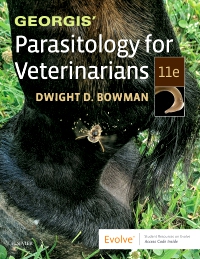
Georgis' Parasitology for Veterinarians Elsevier eBook on VitalSource, 11th Edition
by Dwight D. Bowman
Elsevier eBook on VitalSource
ISBN:
9780323543989
Copyright:
2021
Publication Date:
11-18-2020
Page Count:
528
Imprint:
Saunders
List Price:
$100.99
Was
$100.99
Now $90.89
Or $0.00 with a valid access code
**Selected for 2026 Doody's Core Titles as an Essential Purchase in Veterinary Medicine**
Georgis’ Parasitology for Veterinarians, 11th Edition provides the most current information on all parasites commonly encountered in veterinary medicine, including minor or rare parasites to assist in the diagnosis of difficult cases. While primarily focused on parasites that infect ruminants, horses, pigs, dogs, and cats, this comprehensive text also covers organisms that commonly infect laboratory animals and exotic species. More than 600 high-quality, color photographs and illustrations help you learn how to easily identify and treat parasites of every kind.
-
- NEW! Updated vaccines chapter keeps you up to date with what’s currently happening in the field, as well as future prospects.
- NEW! Sections on new compounds in antiparasitic drugs provide coverage of the latest developments.
- NEW! Updated chapter on vector-borne diseases offers more in-depth detail on this topic.
- NEW! Enhanced eBook on Student Consult contains chapter review questions and answers, flashcards, and canine and feline parasite posters to help increase your retention of difficult subject matter.
- NEW! Updated chapter on parasite diagnostics includes new pictures and plates.
- NEW! Updated drug tables offer the most current information on drugs, vaccinations, and parasiticides.
-
- The most comprehensive parasitology content available, written specifically for veterinarians, provides complete information on all parasites commonly encountered in veterinary medicine, as well as information about minor or rare parasites
- High-quality color photographs and illustrations make the process of identifying and treating parasites more accurate and efficient
-
1. Introduction
2. Arthropods
3. Protozoans
4. Helminths
5. Vector-Borne Diseases
6. Antiparasitic Drugs
7. Diagnostic Parasitology
8. Histopathologic Diagnosis
9. Vaccinations -
-
Ways of Reading
- The appearance of the text and page layout can be modified according to the capabilities of the reading system (font family and font size, spaces between paragraphs, sentences, words, and letters, as well as color of background and text)
- This e-publication is accessible to the full extent that the file format and types of content allow, on a specific reading device, by default, without necessarily including any additions such as textual descriptions of images or enhanced navigation
- No information about nonvisual reading is available
-
Conformance
- No information is available
-
Navigation
- Table of contents to all chapters of the text via links
- Page list to go to pages from the print source version
-
Rich Content
- No information is available
-
Hazards
- No information is available
-
Product Content
- No information is available
-
Legal Considerations
- No information is available
-
Additional Accessibility Information
- Page breaks included from the original print source
- For readers with color vision deficiency, use of color (e.g., in diagrams, graphics and charts, in prompts, or on buttons inviting a response) is not the sole means of graphical distinction or of conveying information
- E-publication includes basic navigation (usually less detailed than TOC-based navigation)
- Where links, controls or buttons are included in the content, the purpose or functionality of each link, control or button is apparent from the associated text alone - or where it is unclear, separate link, control or button descriptions are provided
- All (or substantially all) textual matter is arranged in a single logical reading order (including text that is visually presented as separate from the main text flow, e.g., in boxouts, captions, tables, footnotes, endnotes, citations, etc.). Non-textual content is also linked from within this logical reading order. (Purely decorative non-text content can be ignored).
- The language of the text has been specified (e.g., via the HTML or XML lang attribute) to optimise text-to-speech (and other alternative renderings), both at the whole document level and, where appropriate, for individual words, phrases or passages in a different language.
-
Ways of Reading


Was
$100.99
Now $90.89
Or $0.00 with a valid access code

 as described in our