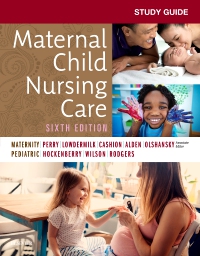

Study Guide for Maternal Child Nursing Care - Elsevier eBook on VitalSource, 6th Edition
Elsevier eBook on VitalSource
Now $37.79
Master content and apply knowledge from Maternal Child Nursing Care, 6th Edition with this corresponding Study Guide. In addition to reviewing content from the text, it encourages you to think critically and use the text more effectively. This comprehensive workbook is filled with case-based activities, as well as review questions that provide you with plenty of opportunities to assess your knowledge. Updated content throughout corresponds to new features and chapters of the text.
New Edition Expected Availability: 03-21-2022

Study Guide for Maternal Child Nursing Care - Elsevier eBook on VitalSource
-
NEW! Updated content throughout corresponds to new features and chapters of the text
-
- Reviewing Key Concepts and Content questions in various formats give you ample opportunities to assess your knowledge and comprehension of information covered in the text. Activities, including matching, fill-in-the-blank, true/false, short answer, and multiple choice, help you identify the core content of the chapter and test your understanding upon completion of reading the chapter.
- Learning Key Terms matching and fill-in-the-blank questions let you test your ability to define all key terms highlighted in the corresponding textbook chapter.
- Thinking Critically case-based activities require you to apply the concepts found in the chapters to solve problems, make decisions concerning care management, and provide responses to patient questions and concerns.
- Answer key at the end of the book includes answers to all questions.
-
-
 Maternal Child Nursing Care - Elsevier eBook on VitalSourceElsevier eBook on VitalSource
-
-
PART 1: MATERNITY NURSING
UNIT 1: INTRODUCTION TO MATERNITY NURSING
1. 21st Century Maternity Nursing
2. Community Care: The Family and Culture
UNIT 2: REPRODUCTIVE YEARS
3. Assessment and Health Promotion
4. Reproductive System Concerns
5. Infertility, Contraception, and Abortion
UNIT 3: PREGNANCY
6. Genetics, Conception, and Fetal Development
7. Anatomy and Physiology of Pregnancy
8. Nursing Care of the Family During Pregnancy
9. Maternal and Fetal Nutrition
10. Assessment of High Risk Pregnancy
11. High Risk Perinatal Care: Preexisting Conditions
12. High Risk Perinatal Care: Gestational Conditions
UNIT 4: CHILDBIRTH
13. Labor and Birth Processes
14. Pain Management
15. Fetal Assessment During Labor
16. Nursing Care of the Family During Labor and Birth
17. Labor and Birth Complications
UNIT 5: POSTPARTUM PERIOD
18. Maternal Physiologic Changes
19. Nursing Care of the Family During the Postpartum Period
20. Transition to Parenthood
21. Postpartum Complications
UNIT 6: NEWBORN
22. Physiologic and Behavioral Adaptations of the Newborn
23. Nursing Care of the Newborn and Family
24. Newborn Nutrition and Feeding
25. The High Risk Newborn
PART 2: PEDIATRIC NURSING
UNIT 7: CHILDREN, THEIR FAMILIES, AND THE NURSE
26. 21st Century Pediatric Nursing
27. Family, Social, Cultural, and Religious Influences on Child Health Promotion
28. Developmental and Genetic Influences on Child Health Promotion
UNIT 8 ASSESSMENT OF THE CHILD AND FAMILY
29. Communication, History, and Physical Assessment
30. Pain Assessment and Management in Children
UNIT 9 HEALTH PROMOTION AND SPECIAL HEALTH PROBLEMS
31. The Infant and Family
32. The Toddler and Family
33. The Preschooler and Family
34. The School-Age Child and Family
35. The Adolescent and Family
UNIT 10: SPECIAL NEEDS, ILLNESS, AND HOSPITALIZATION
36. Impact of Chronic Illness, Disability, or End-of-Life Care for the Child and Family
37. Impact of Cognitive or Sensory Impairment on the Child and Family
38. Family-Centered Care of the Child During Illness and Hospitalization
39. Pediatric Variations of Nursing Interventions
UNIT 11: HEALTH PROBLEMS OF CHILDREN
40. Respiratory Dysfunction
41. Gastrointestinal Dysfunction
42. Cardiovascular Dysfunction
43. Hematologic and Immunologic Dysfunction
44. NEW! Cancer
45. Genitourinary Dysfunction
46. Cerebral Dysfunction
47. Endocrine Dysfunction
48. Musculoskeletal or Articular Dysfunction
49. Neuromuscular or Muscular Dysfunction -
-
Ways of Reading
- The appearance of the text and page layout can be modified according to the capabilities of the reading system (font family and font size, spaces between paragraphs, sentences, words, and letters, as well as color of background and text)
- This e-publication is accessible to the full extent that the file format and types of content allow, on a specific reading device, by default, without necessarily including any additions such as textual descriptions of images or enhanced navigation
- No information about nonvisual reading is available
-
Conformance
- The publication was certified on 27-05-2026
-
Navigation
- Table of contents to all chapters of the text via links
- Page list to go to pages from the print source version
-
Rich Content
- No information is available
-
Hazards
- No information is available
-
Product Content
- No information is available
-
Legal Considerations
- No information is available
-
Additional Accessibility Information
- Page breaks included from the original print source
- For readers with color vision deficiency, use of color (e.g., in diagrams, graphics and charts, in prompts, or on buttons inviting a response) is not the sole means of graphical distinction or of conveying information
- E-publication includes basic navigation (usually less detailed than TOC-based navigation)
- Where links, controls or buttons are included in the content, the purpose or functionality of each link, control or button is apparent from the associated text alone - or where it is unclear, separate link, control or button descriptions are provided
- All (or substantially all) textual matter is arranged in a single logical reading order (including text that is visually presented as separate from the main text flow, e.g., in boxouts, captions, tables, footnotes, endnotes, citations, etc.). Non-textual content is also linked from within this logical reading order. (Purely decorative non-text content can be ignored).
- The language of the text has been specified (e.g., via the HTML or XML lang attribute) to optimise text-to-speech (and other alternative renderings), both at the whole document level and, where appropriate, for individual words, phrases or passages in a different language.
-
Ways of Reading

 as described in our