ISBN:
9780323547123
Copyright:
2019
Publication Date:
02-02-2018
Page Count:
416
Imprint:
Elsevier
List Price:
$67.99

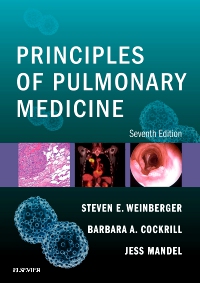
Principles of Pulmonary Medicine Elsevier eBook on VitalSource, 7th Edition
by Steven E. Weinberger, MD, MACP, FRCP, Barbara A. Cockrill, MD and Jess Mandel, MD, FACP
Elsevier eBook on VitalSource
ISBN:
9780323547123
Copyright:
2019
Publication Date:
02-02-2018
Page Count:
416
Imprint:
Elsevier
List Price:
$67.99
Was
$67.99
Now $61.19
Or $0.00 with a valid access code
With an emphasis on the pathophysiologic basis of pulmonary disease, Principles of Pulmonary Medicine, 7th Edition, by Drs. Steven E Weinberger, Barbara A Cockrill, and Jess Mandel, provides a superbly illustrated introduction to this fast-changing field. This essential text employs a concise and understandable approach, integrating clinical topics with underlying physiologic, pathophysiologic, and basic science concepts critical for medical students, trainees, and those looking for a practical update on both acute and chronic pulmonary diseases
New Edition Expected Availability: 07-18-2023

Principles of Pulmonary Medicine - Elsevier eBook on VitalSource
Elsevier eBook on VitalSource
ISBN: 9780323881364
-
- Offers access to extensive online resources, including author commentaries, video clips, audio recordings of lung sounds, and 200 case-based self-assessment questions – covering topics including pulmonary function tests, physiologic data, and arterial blood gas testing and modeled after the USMLE exam
- Discusses therapeutic strategies, including the available evidence for assessing relative benefits, harms, and costs, where appropriate
- Provides an excellent visual basis for understanding and interpreting pulmonary disease with easy-to-understand anatomic illustrations and accompanying radiologic and pathophysiologic images
-
1. Pulmonary Anatomy and Physiology
2. Presentation of the Patient with Pulmonary Disease
3. Evaluation of the Patient With Pulmonary Disease
4. Anatomic and Physiologic Aspects of Airways
5. Asthma
6. Chronic Obstructive Pulmonary Disease
7. Miscellaneous Airway Diseases
8. Anatomic and Physiologic Aspects of the Pulmonary Parenchyma
9. Overview of Diffuse Parenchymal Lung Diseases
10. Diffuse Parenchymal Lung Diseases Associated With Known Etiologic Agents
11. Diffuse Parenchymal Lung Diseases of Unknown Etiology
12. Anatomic and Physiologic Aspects of the Pulmonary Vasculature
13. Pulmonary Embolism
14. Pulmonary Hypertension
15. Pleural Disease
16. Mediastinal Disease
17. Anatomic and Physiologic Aspects of Neural, Muscular, and Chest Wall Interactions with the Lungs
18. Disorders of Ventilatory Control
19. Disorders of the Respiratory Pump
20. Lung Cancer: Etiologic and Pathologic Aspects
21. Lung Cancer : Clinical Aspects
22. Lung Defense Mechanisms
23. Pneumonia
24. Tuberculosis and Nontuberculous Mycobacteria
25. Miscellaneous Infections Caused by Fungi and Pneumocystis
26. Pulmonary Complications in the Immunocompromised Host
27. Classification and Pathophysiologic Aspects of Respiratory Failure
28. Acute Respiratory Distress Syndrome
29. Management of Respiratory Failure
Appendix
A: Sample Problems Using Respiratory Equations
B: Pulmonary Function Tests: Guidelines for Interpretation and Sample Problems
C: Arterial Blood Gases: Guidelines for Interpretation and Sample Problems -
-
Ways of Reading
- The appearance of the text and page layout can be modified according to the capabilities of the reading system (font family and font size, spaces between paragraphs, sentences, words, and letters, as well as color of background and text)
- This e-publication is accessible to the full extent that the file format and types of content allow, on a specific reading device, by default, without necessarily including any additions such as textual descriptions of images or enhanced navigation
- No information about nonvisual reading is available
-
Conformance
- No information is available
-
Navigation
- Table of contents to all chapters of the text via links
- Page list to go to pages from the print source version
-
Rich Content
- No information is available
-
Hazards
- No information is available
-
Product Content
- No information is available
-
Legal Considerations
- No information is available
-
Additional Accessibility Information
- Page breaks included from the original print source
- For readers with color vision deficiency, use of color (e.g., in diagrams, graphics and charts, in prompts, or on buttons inviting a response) is not the sole means of graphical distinction or of conveying information
- E-publication includes basic navigation (usually less detailed than TOC-based navigation)
- Where links, controls or buttons are included in the content, the purpose or functionality of each link, control or button is apparent from the associated text alone - or where it is unclear, separate link, control or button descriptions are provided
- All (or substantially all) textual matter is arranged in a single logical reading order (including text that is visually presented as separate from the main text flow, e.g., in boxouts, captions, tables, footnotes, endnotes, citations, etc.). Non-textual content is also linked from within this logical reading order. (Purely decorative non-text content can be ignored).
- The language of the text has been specified (e.g., via the HTML or XML lang attribute) to optimise text-to-speech (and other alternative renderings), both at the whole document level and, where appropriate, for individual words, phrases or passages in a different language.
-
Ways of Reading
Was
$67.99
Now $61.19
Or $0.00 with a valid access code

 as described in our