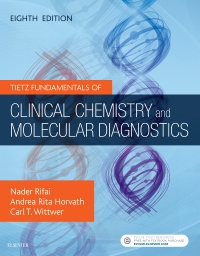

Tietz Fundamentals of Clinical Chemistry and Molecular Diagnostics Elsevier eBook on VitalSource, 8th Edition
Elsevier eBook on VitalSource
Now $113.39
Get the foundational knowledge you need to successfully work in a real-world, clinical lab with Tietz Fundamentals of Clinical Chemistry and Molecular Diagnostics, 8th Edition. From highly respected clinical chemistry expert Nader Rifai, this condensed, easier-to-understand version of the acclaimed Tietz Textbook of Clinical Chemistry and Molecular Diagnostics uses a laboratory perspective to guide you through selecting and performing diagnostic lab tests and accurately evaluating the results. Coverage includes laboratory principles, analytical techniques, instrumentation, analytes, pathophysiology, and more. This eighth edition features new content throughout the text to ensure you stay ahead of all the latest techniques, instrumentation, and technologies.
New Edition Expected Availability: 11-17-2023

Tietz Fundamentals of Clinical Chemistry and Molecular Diagnostics - Elsevier EBook on VitalSource
-
- NEW! Clinical Cases from The Coakley Collection use real-life scenarios to demonstrate how concepts from the text will come in to play in real life practice
- NEW! Questions from The Deacon’s Challenge of Biochemical Calculations Collection help reinforce concepts and help readers’ critical thinking skills
- NEW! Updated content throughout the text keeps readers up to date on the latest techniques, instrumentation, and technologies
- NEW! New lead author Nader Rifai lends his expertise as the Director of Clinical Chemistry at Children’s Hospital in Boston, the Editor-in-Chief of the journal Clinical Chemistry, and a Professor of Pathology at Harvard University
-
- Condensed version of the clinical chemistry "bible" offers the same authoritative and well-presented content in a much more focused and streamlined manner.
- Coverage of analytical techniques and instrumentation includes optical techniques, electrochemistry, electrophoresis, chromatography, mass spectrometry, enzymology, immunochemical techniques, microchips, automation, and point of care testing.
- Updated chapters on molecular diagnostics cover the principles of molecular biology, nucleic acid techniques and applications, and genomes and nucleic acid alterations, reflecting the changes in this rapidly evolving field.
- Learning objectives, key words, and review questions are included in each chapter to support learning.
- More than 500 illustrations plus easy-to-read tables help readers better understand and remember key concepts.
-
PART I: PRINCIPLES OF LABORATORY MEDICINE
1. Clinical Chemistry, Molecular Diagnostics, and Laboratory Medicine
2. Analytical and Clinical Evaluation of Methods
3. Preanalytical Variation
4. Biological Variation
5. Establishment and Use of Reference Values
6. Specimen Collection, Processing, and Other Preanalytical Variables
7. Quality Management
8. Principles of Basic Techniques and Laboratory Safety
PART II: ANALYTICAL TECHNIQUES AND INSTRUMENTATION
9. Optical Techniques
10. Electrochemistry and Chemical Sensors
11. Electrophoresis
12. Chromatography
13. Mass Spectrometry
14. Enzyme and Rate Analyses
15. Immunochemical Techniques
16. Automation
17. Point-of-Care Testing
PART III: ANALYTES
18. Amino Acids, Peptides, and Proteins
19. Serum Enzymes
20. Tumor Markers
21. Kidney Function Tests - Creatinine, GFR, Urea, and Uric Acid
22. Carbohydrates
23. Lipids, Lipoproteins, Apolipoproteins, and Other Cardiac Risk Factors
24. Electrolytes and Blood Gases
25. Hormones
26. Catecholamines and Serotonin
27. Vitaminsand Trace Elements,
28. Hemoglobin, Iron, and Bilirubin
29. Porphyrins and Porphyrias
30. Therapeutic Drug Monitoring
31. Clinical Toxicology
32. ToxicElements
PART IV: PATHOPHYSIOLOGY
33. Diabetes Mellitus
34. Cardiovascular Disease
35. Kidney Disease
36. Physiology and Disorders of Water, Electrolyte, and Acid-Base Metabolism
37. Liver Disease
38. Gastrointestinal and Pancreatic Diseases
39. Disorders of Bone and Mineral Metabolism
40. Disorders of the Pituitary Gland
41. Disorders of the Adrenal Cortex
42. Thyroid Disorders
43. Reproduction-Related Disorders
44. Pregnancy and Prenatal Testing
45. Newborn Screening and Inborn Errors of Metabolism
46. Pharmacogenetics
PART V: MOLECULAR DIAGNOSTICS
47. Molecular Principles
48. Molecular Techniques
49. Molecular Applications -
-
Ways of Reading
- The appearance of the text and page layout can be modified according to the capabilities of the reading system (font family and font size, spaces between paragraphs, sentences, words, and letters, as well as color of background and text)
- This e-publication is accessible to the full extent that the file format and types of content allow, on a specific reading device, by default, without necessarily including any additions such as textual descriptions of images or enhanced navigation
- No information about nonvisual reading is available
-
Conformance
- No information is available
-
Navigation
- Table of contents to all chapters of the text via links
- Page list to go to pages from the print source version
-
Rich Content
- No information is available
-
Hazards
- No information is available
-
Product Content
- No information is available
-
Legal Considerations
- No information is available
-
Additional Accessibility Information
- Page breaks included from the original print source
- For readers with color vision deficiency, use of color (e.g., in diagrams, graphics and charts, in prompts, or on buttons inviting a response) is not the sole means of graphical distinction or of conveying information
- E-publication includes basic navigation (usually less detailed than TOC-based navigation)
- Where links, controls or buttons are included in the content, the purpose or functionality of each link, control or button is apparent from the associated text alone - or where it is unclear, separate link, control or button descriptions are provided
- All (or substantially all) textual matter is arranged in a single logical reading order (including text that is visually presented as separate from the main text flow, e.g., in boxouts, captions, tables, footnotes, endnotes, citations, etc.). Non-textual content is also linked from within this logical reading order. (Purely decorative non-text content can be ignored).
- The language of the text has been specified (e.g., via the HTML or XML lang attribute) to optimise text-to-speech (and other alternative renderings), both at the whole document level and, where appropriate, for individual words, phrases or passages in a different language.
-
Ways of Reading

 as described in our