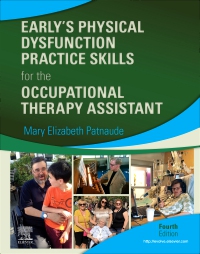

Early’s Physical Dysfunction Practice Skills for the Occupational Therapy Assistant - Elsevier eBook on VitalSource, 4th Edition
Elsevier eBook on VitalSource
Now $81.89
Master the role and skills of the OTA in caring for adults with physical disabilities! Early’s Physical Dysfunction Practice Skills for the Occupational Therapy Assistant, 4th Edition is the only textbook on the rehabilitation process written specifically for OTA students and practitioners. It takes a client-centered approach, following the latest Occupational Therapy Practice Framework in addressing topics such as assessment, intervention principles, and clinical applications. New to this edition is an Intervention Principles for Feeding and Eating chapter plus the latest advances in OT technology. From a team of expert contributors led by Mary Elizabeth Patnaude, this book shows how you can succeed in the OTA role and help clients learn to perform functional tasks.
-
- NEW! Intervention Principles for Feeding and Eating chapter is added to this edition
- NEW! Reorganization of all chapters aligns content more closely with the Occupational Therapy Practice Framework
- NEW! Combined chapters make the material more concise and easier to navigate
-
- Coverage of advances in OT assessment and intervention includes prosthetics and assistive technologies, along with the assessment and interventions of TBI (traumatic brain injury) problems related to cognitive and visual perception
- Case studies offer snapshots of real-life situations and solutions, with many cases threaded through an entire chapter
- Client-centered approach shows how to include the client when making decisions about planning and treatment, using the terminology and abbreviations from the Occupational Therapy Practice Framework
- Evidence-based content includes clinical trials and outcome studies, especially those relating to intervention
- Cultural diversity and cultural sensitivity information helps you understand the beliefs and customs of other cultures so you can provide appropriate care
- Information on prevention addresses safety and the prevention of accidents and injury
- Key terms, chapter outlines, and chapter objectives introduce the essential information in each chapter
- Reading guide questions and summaries in each chapter make it easier to measure your comprehension of the material
-
PART 1: FOUNDATIONS
1. Occupational Therapy and Physical Disabilities
2. The Disability Experience and the Therapeutic Process
3. Infection Control and Safety Issues in the Clinic
PART II: PROCESS
4. Occupational Therapy Process: Evaluation and Intervention in Physical Dysfunction
5. Documentation of Occupational Therapy Services
PART III: ASSESSMENT
6. Assessment of Motor Control and Functional Movement
7. Assessment of Joint Range of Motion
8. Assessment of Muscle Strength
9. Evaluation and Observation of Deficits in Sensation, Perception and Cognition
PART IV: INTERVENTION PRINCIPLES
10. Teaching and Learning in Motor Performance in Occupational Therapy
11. Intervention Principles for Feeding and Eating NEW!
12. Occupations, Purposeful Activities, and Preparatory Activities
PART V: PERFORMANCE IN AREAS OF OCCUPATION
13. Activities of Daily Living
14. Assistive Technology
15. Moving in the Environment
16. Work
17. Promoting Engagement in Leisure and Social Participation
PART VI: INTERVENTIONS FOR PERFORMANCE SKILLS AND CLIENT FACTORS
18. The Older Adult
19. Principles of Orthotic Intervention
20. Neurotherapeutic Approaches to Treatment
21. Interventions for Visual and Other Sensory Dysfunction
22. Interventions for People with Cognitive and Perceptual Deficits
PART VII: CLINICAL APPLICATIONS
23. Cerebrovascular Accident
24. Traumatic Brain Injury
25. Degenerative Diseases of the Central Nervous System
26. Spinal Cord Injury
27. Neurogenic and Myopathic Dysfunction
28. Arthritic Diseases
29. Upper Extremity Rehabilitation
30. Burns
31. Amputation and Prosthetics
32. Cardiac Dysfunction and Chronic Obstructive Pulmonary Disease
33. Oncology
34. HIV Infection and AIDS -
-
Ways of Reading
- The appearance of the text and page layout can be modified according to the capabilities of the reading system (font family and font size, spaces between paragraphs, sentences, words, and letters, as well as color of background and text)
- This e-publication is accessible to the full extent that the file format and types of content allow, on a specific reading device, by default, without necessarily including any additions such as textual descriptions of images or enhanced navigation
- All content can be read as read aloud speech or dynamic braille
- Has alternative text descriptions for images
-
Conformance
- The publication contains a conformance statement that it meets the EPUB Accessibility 1.1, WCAG 2.1, Level AA standard. Please see https://bornaccessible.benetech.org/certified-publishers/ for further details of our compatibility testing.
- The certifier's credential is https://bornaccessible.benetech.org/certified-publishers/
- For detailed accessibility information, see Elsevier's website at https://www.elsevier.com/about/accessibility
- For queries regarding accessibility information, contact [email protected]
- The publication was certified on 06-02-2026
-
Navigation
- Table of contents to all chapters of the text via links
- Index with links to referenced entries
- Elements such as headings, tables, etc. for structured navigation
- Page list to go to pages from the print source version
-
Rich Content
- Information-rich images are described by extended descriptions
-
Hazards
- The publication contains no hazards
-
Product Content
- Content includes any type of illustrations.
- The primary content is text.
- Content includes a significant number of actionable (clickable) web links to external content, downloadable resources, supplementary material, etc.
- Content includes a significant number of actionable (clickable) cross-references, hyperlinked notes and annotations, or with other actionable links between largely textual elements (e.g., quiz/test questions, 'choose your own ending', etc.).
- Content includes figures, diagrams, charts and/or graphs, including other 'mechanical' (i.e. non-photographic) illustrations.
- Content includes a significant number of web links (printed URLs, QR codes etc.).
- Content includes text within images, including text-as-text embedded in diagrams, charts, or within images containing speech balloons, thought bubbles, captions, etc.
- Content includes visual content that is purely decorative and is not necessary to understanding of the content.
-
Legal Considerations
- No information is available
-
Additional Accessibility Information
- Content is enhanced with ARIA roles to optimize organization and facilitate navigation
- Page breaks included from the original print source
- For readers with color vision deficiency, use of color (e.g., in diagrams, graphics and charts, in prompts, or on buttons inviting a response) is not the sole means of graphical distinction or of conveying information
- The body text is presented with a contrast ratio of at least 4.5:1 (or 3:1 for large/heading text)
- Ultra-high contrast between text and background
- E-publication includes basic navigation (usually less detailed than TOC-based navigation)
- Where links, controls or buttons are included in the content, the purpose or functionality of each link, control or button is apparent from the associated text alone - or where it is unclear, separate link, control or button descriptions are provided
- All (or substantially all) textual matter is arranged in a single logical reading order (including text that is visually presented as separate from the main text flow, e.g., in boxouts, captions, tables, footnotes, endnotes, citations, etc.). Non-textual content is also linked from within this logical reading order. (Purely decorative non-text content can be ignored).
- Where interactive content is included in the product, controls are provided (e.g., for speed, pause and resume, reset) and labelled to make their use clear.
- The language of the text has been specified (e.g., via the HTML or XML lang attribute) to optimise text-to-speech (and other alternative renderings), both at the whole document level and, where appropriate, for individual words, phrases or passages in a different language.
-
Ways of Reading



 as described in our