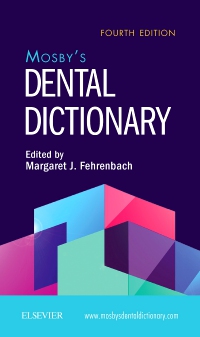

Mosby's Dental Dictionary Elsevier eBook on VitalSource, 4th Edition
Elsevier eBook on VitalSource
Now $46.89
**Selected for Doody’s Core Titles® 2024 with "Essential Purchase" designation in Dictionaries/Terminology**
An essential dental resource that goes beyond education! Mosby's Dental Dictionary, 4th Edition is the must-have, pocket-sized reference covering all areas of dentistry that’s designed for both students and practitioners. This new edition defines over 10,000 terms on dynamic areas of dentistry, including materials, imaging, surgery, orthodontics, pain control, and more. Throughout the text, over 300 illustrations address new innovations, research, technology, and products in the field, and extensive appendices provide quick access to the information you will use every day. Plus, a free companion website contains more than 5,000 audio pronunciations, 500 additional images, videos, and animations to help illustrate key concepts.
-
- NEW! Terms on dynamic areas of dentistry, include materials, imaging, surgery, orthodontics, pain control, and more!
- NEW! Artwork, includes photos of the latest equipment, clinical techniques and modern illustrations to bring key concepts to life.
- NEW! Expanded audio pronunciations on the companion website ensures you’re using the correct pronunciations of complex terms.
- NEW! Who’s-who of dentistry Editorial Board features expert editor Margaret Fehrenbach – Dental Hygienist, Oral Biologist, Educational Consultant, Dental Science Writer, and Dental Hygiene Instructor.
-
- Portable size offers convenience as a chair-side or computer-side reference.
- Companion website includes over 5,000 audio pronunciations, an expanded image collection, and videos and animations.
- Bolded pronunciations indicate terms that may be heard on the companion website.
- Practical appendices (in print and online) provide a reference to abbreviations, clinical oral structures, anesthesia color codes, implants, and more.
- Colored thumb tabs make it easy to locate definitions quickly.
-
-
 Mosby's Dental DictionaryPaperback
-
-
Pronunciation GuideAlphabetic Listing of TermsAppendicesPronunciation GuideIllustration Credits
-
-
Ways of Reading
- The appearance of the text and page layout can be modified according to the capabilities of the reading system (font family and font size, spaces between paragraphs, sentences, words, and letters, as well as color of background and text)
- This e-publication is accessible to the full extent that the file format and types of content allow, on a specific reading device, by default, without necessarily including any additions such as textual descriptions of images or enhanced navigation
- No information about nonvisual reading is available
-
Conformance
- No information is available
-
Navigation
- Table of contents to all chapters of the text via links
- Page list to go to pages from the print source version
-
Rich Content
- No information is available
-
Hazards
- No information is available
-
Product Content
- No information is available
-
Legal Considerations
- No information is available
-
Additional Accessibility Information
- Page breaks included from the original print source
- For readers with color vision deficiency, use of color (e.g., in diagrams, graphics and charts, in prompts, or on buttons inviting a response) is not the sole means of graphical distinction or of conveying information
- E-publication includes basic navigation (usually less detailed than TOC-based navigation)
- Where links, controls or buttons are included in the content, the purpose or functionality of each link, control or button is apparent from the associated text alone - or where it is unclear, separate link, control or button descriptions are provided
- All (or substantially all) textual matter is arranged in a single logical reading order (including text that is visually presented as separate from the main text flow, e.g., in boxouts, captions, tables, footnotes, endnotes, citations, etc.). Non-textual content is also linked from within this logical reading order. (Purely decorative non-text content can be ignored).
- The language of the text has been specified (e.g., via the HTML or XML lang attribute) to optimise text-to-speech (and other alternative renderings), both at the whole document level and, where appropriate, for individual words, phrases or passages in a different language.
-
Ways of Reading

 as described in our