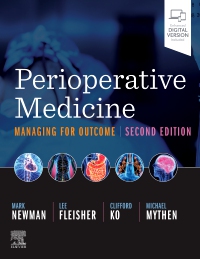

Perioperative Medicine Elsevier eBook on VitalSource, 2nd Edition
Elsevier eBook on VitalSource
Now $137.89
**Selected for 2026 Doody's Core Titles in Anesthesiology & Pain Medicine**
Based on the most current evidence and best practices, Perioperative Medicine: Managing for Outcome, 2nd Edition, is an easy-to-follow, authoritative guide to achieving optimal outcomes in perioperative care. Written and edited by recognized authorities in anesthesiology and surgical critical care, this fully updated edition helps you think critically about complex, long-term issues surrounding the care of the surgical patient, providing decision trees that define strategies to enhance the medical outcome of care.
-
- Focuses on what anesthesiologists, surgeons, and intensivists need to know in order to improve outcomes through evidence- and outcome-based approaches
- Provides practical guidance on potential risks to all major organ systems, the etiology of particular organ dysfunctions, preoperative and intraoperative risk factors, and perioperative protection strategies to minimize potential complications
- Features a consistent chapter format - with even more color-coded algorithms, summary tables, and boxes – that enables you to quickly explore and determine the best management approaches
- Includes six all-new chapters: Perioperative Fluid Management; Delirium and POCD; Role of Palliative Care/ICU; Value-Based Care: The UK Model; CFO Perspective on Value; Hospital to Home (Perioperative Transitions of Care)
- Discusses timely topics such as quality improvement, pay-for-performance, preexisting disease and comorbid conditions in anesthesiology, and the team-based model of care
- Features two new editors, surgeon Clifford Ko, MD, and Perioperative Summit leader, Michael (Monty) Mythen, MD
- Enhanced eBook version included with purchase. Your enhanced eBook allows you to access all of the text, figures, and references from the book on a variety of devices
-
-
 Perioperative MedicineHardcover
-
-
Part I: INTRODUCTION AND BACKGROUND
1. Implications of Perioperative Morbidity for Long-Term Outcomes
2. The Inflammatory Response to Surgery
3. The Coagulation Cascade in Perioperative Organ Injury
Part II: PREOPERATIVE ASSESSMENT
4. The Value of Preoperative Assessment
5. Perioperative Cardiac Risk Assessment in Noncardiac Surgery
6. Cardiovascular Risk Assessment in Cardiac Surgery
7. Central Nervous System Risk Assessment: Preventing Postoperative Brain Injury
8. Risk Assessment and Perioperative Renal Dysfunction
9. Pulmonary Risk Assessment
10. Hematologic Risk Assessment
Part III: PRESERVATION OF ORGAN FUNCTION AND PREVENTION AND MANAGEMENT OF PERIOPERATIVE ORGAN DYSFUNCTION
SECTION 1 Cardiovascular System
11. Prevention of Ischemic Injury in Cardiac Surgery
12. Prevention of Ischemic Injury in Noncardiac Surgery
13. Treatment of Perioperative Ischemia, Infarction, and Ventricular Failure in Cardiac Surgery
14. Perioperative Management of Valvular Heart Disease
15. Prevention and Management of Perioperative Dysrhythmias
SECTION 2 Renal System
16. Perioperative Fluid Management
17. Preservation of Renal Function
18. Evaluation and Treatment of Acute Oliguria
19. Perioperative Management of Renal Failure and Renal Transplant
SECTION 3 Pulmonary System
20. Prevention and Treatment of Postoperative Pulmonary Complications
SECTION 4 Central Nervous System
21. Carotid and Intracranial Surgery
22. Protecting the Central Nervous System During Cardiac Surgery
23. Preservation of Spinal Cord Function
24. Perioperative Management of Acute Central Nervous System Injury
SECTION 5 Gastrointestinal System
25. Prevention and Treatment of Gastrointestinal Morbidity
SECTION 6 Hematology and Coagulation
26. Prevention and Management of Deep Vein Thrombosis and Pulmonary Embolism
27. Perioperative Management of Bleeding and Transfusion
SECTION 7 Infections
28. Prevention of Perioperative Surgical Site Infection
29. Perioperative Protection of the Pregnant Woman
30. Preservation of Fetal Viability During Noncardiac Surgery
Part IV EARLY POSTOPERATIVE CARE
SECTION 9 Specific Operations
31. Cardiac Surgery
32. General Thoracic Surgery
33. Major Abdominal Surgery
34. Major Orthopedic Surgery
35. Solid Organ Transplantation
36. Multisystem Trauma
37. Neurosurgery
SECTION 10 Specific Problems
38. Sepsis and Septic Shock
39. Acute Respiratory Failure
40. Endocrine and Electrolyte Disorders
41. Improving Pain and Outcomes in the Perioperative Setting
42. Postoperative Cognitive Dysfunction and Delirium
43. Role of Palliative Care
Part V CONFLICTING OUTCOMES VALUE BASED CARE
44. Economic Analysis of Perioperative Optimization
45. Improving Health-Care Quality Through Measurement
46. Delivering Value Based Care: The UK Perspective
47. Transitions From Hospital to Home -
-
Ways of Reading
- The appearance of the text and page layout can be modified according to the capabilities of the reading system (font family and font size, spaces between paragraphs, sentences, words, and letters, as well as color of background and text)
- This e-publication is accessible to the full extent that the file format and types of content allow, on a specific reading device, by default, without necessarily including any additions such as textual descriptions of images or enhanced navigation
- No information about nonvisual reading is available
-
Conformance
- No information is available
-
Navigation
- Table of contents to all chapters of the text via links
- Page list to go to pages from the print source version
-
Rich Content
- No information is available
-
Hazards
- No information is available
-
Product Content
- No information is available
-
Legal Considerations
- No information is available
-
Additional Accessibility Information
- Page breaks included from the original print source
- For readers with color vision deficiency, use of color (e.g., in diagrams, graphics and charts, in prompts, or on buttons inviting a response) is not the sole means of graphical distinction or of conveying information
- E-publication includes basic navigation (usually less detailed than TOC-based navigation)
- Where links, controls or buttons are included in the content, the purpose or functionality of each link, control or button is apparent from the associated text alone - or where it is unclear, separate link, control or button descriptions are provided
- All (or substantially all) textual matter is arranged in a single logical reading order (including text that is visually presented as separate from the main text flow, e.g., in boxouts, captions, tables, footnotes, endnotes, citations, etc.). Non-textual content is also linked from within this logical reading order. (Purely decorative non-text content can be ignored).
- The language of the text has been specified (e.g., via the HTML or XML lang attribute) to optimise text-to-speech (and other alternative renderings), both at the whole document level and, where appropriate, for individual words, phrases or passages in a different language.
-
Ways of Reading

 as described in our