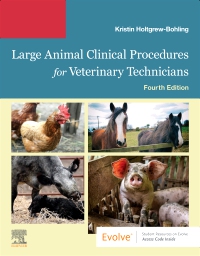

Large Animal Clinical Procedures for Veterinary Technicians Elsevier eBook on VitalSource, 4th Edition
Elsevier eBook on VitalSource
Equip students with the skills they need to master the role of the veterinary technician in large animal care! Large Animal Clinical Procedures for Veterinary Technicians, 4th Edition teaches students to set up, assist, and follow through on medical procedures and treatment regimens for large domestic animals. A comprehensive guide, this text not only defines the veterinary technician’s responsibilities in daily livestock care and hospital management, but includes separate sections on horses, cattle, sheep and goats, pigs, and llamas and alpacas - covering husbandry, clinical procedures, surgical procedures, and common diseases for each. This new edition includes information on safety and handling, livestock nutrition, vaccine scheduling, and diagnostic imaging, plus four new chapters with detailed care of poultry. Written by noted veterinary technician educator Kristin Holtgrew-Bohling, it is the ideal text for preparing for certification exams and everyday practice!
New Edition Expected Availability: 10-10-2023

Large Animal Clinical Procedures for Veterinary Technicians - Elsevier eBook on VitalSource
-
- NEW! Tables on Temperature, Pulse, Respiration (TPR) data and vaccine schedules provide a quick, at-a-glance reference for important information
- NEW! Expanded regulatory information for livestock provides details on OCV vaccination, Health Certificate forms, Brucellosis and Tuberculosis testing, and Scrapies tags
- NEW! Four new chapters on Poultry provide detailed coverage of the breed
-
- NEW! Tables on Temperature, Pulse, Respiration (TPR) data and vaccine schedules provide a quick, at-a-glance reference for important information
- NEW! Expanded regulatory information for livestock provides details on OCV vaccination, Health Certificate forms, Brucellosis and Tuberculosis testing, and Scrapies tags
- NEW! Four new chapters on Poultry provide detailed coverage of the breed.
- The most comprehensive large animal book specifically written for veterinary technician students
- A practical approach makes this text useful in classes and in clinical situations, so veterinary technicians, acting under instructions of veterinarians, can plan and follow through on procedures and treatment regimens for large animals
- A focus on the veterinary technician’s responsibilities explains why and how a procedure is performed, and the roles that vet techs fill in preparing for, assisting in, and following up the procedure
- Coverage of the essential large animal-related tasks in the CVTEA Manual of Accreditation for Veterinary Technology Programs addresses AVMA accreditation and prepares students to pass the Veterinary Technology National Exam
- Full-color photographs and line drawings show step-by-step procedures in areas such as restraint, bandaging, physical examination techniques, and diagnostic procedures
- Coverage of husbandry and breeds demonstrates how day-to-day housing and feeding affect the care of many large animal diseases, and also helps students learn to provide quality client education
- A section on the livestock industry provides comprehensive coverage of safety and handling, reproduction, and nutrition, so students can better understand the practices, procedures, and decisions in large animal veterinary medicine
- A section on llamas and alpacas helps students understand the health and maintenance of these increasingly popular domestic animals — in the U.S., there are more than 12,000 alpaca herds and 25,000 llama owners
- Proper medical terminology is included in a comprehensive glossary, facilitating effective communication with clients and with other professionals
- Learning features enhance critical thinking and decision making with case studies, clinical applications, key terms, chapter outlines, learning objectives, and Technician Notes
-
Part 1: The Livestock Industry
1. The Importance of Livestock
2. Livestock Safety and Handling
3. Livestock Reproduction
4. Livestock Nutrition
Part 2: Large Animal Hospital Management
5. Daily Hospital Responsibilities
6. Admissions, Medical Records, and Physical Examinations
7. Diagnostic Imaging for Large Animals
Part 3: Horses in Veterinary Practice
8. Equine Husbandry
9. Equine Clinical Procedures
10. Equine Surgical Procedures
11. Common Equine Disease
Part 4: Cattle in Veterinary Practice
12. Bovine Husbandry
13. Bovine Clinical Procedures
14. Bovine Surgical Procedures
15. Common Bovine Diseases
Part 5: Sheep and Goats in Veterinary Practice
16. Ovine and Caprine Husbandry
17. Ovine and Caprine Clinical Procedures
18. Ovine and Caprine Surgical Procedures
19. Common Ovine and Caprine Diseases
Part 6: Llamas and Alpacas in Veterinary Practice
20. Camelid Husbandry
21. Camelid Clinical Procedures
22. Camelid Surgical Procedures
23. Common Camelid Diseases
Part 7: Swine in Veterinary Practice
24. Porcine Husbandry
25. Porcine Clinical Procedures
26. Porcine Surgical Procedures
27. Common Porcine Diseases
Part 8: Poultry in Veterinary Practice
28. Poultry Husbandry
29. Poultry Clinical Procedures
30. Poultry Surgical Procedures
31. Common Poultry Diseases -
-
Ways of Reading
- The appearance of the text and page layout can be modified according to the capabilities of the reading system (font family and font size, spaces between paragraphs, sentences, words, and letters, as well as color of background and text)
- This e-publication is accessible to the full extent that the file format and types of content allow, on a specific reading device, by default, without necessarily including any additions such as textual descriptions of images or enhanced navigation
- No information about nonvisual reading is available
-
Conformance
- No information is available
-
Navigation
- Table of contents to all chapters of the text via links
- Page list to go to pages from the print source version
-
Rich Content
- No information is available
-
Hazards
- No information is available
-
Product Content
- No information is available
-
Legal Considerations
- No information is available
-
Additional Accessibility Information
- Page breaks included from the original print source
- For readers with color vision deficiency, use of color (e.g., in diagrams, graphics and charts, in prompts, or on buttons inviting a response) is not the sole means of graphical distinction or of conveying information
- E-publication includes basic navigation (usually less detailed than TOC-based navigation)
- Where links, controls or buttons are included in the content, the purpose or functionality of each link, control or button is apparent from the associated text alone - or where it is unclear, separate link, control or button descriptions are provided
- All (or substantially all) textual matter is arranged in a single logical reading order (including text that is visually presented as separate from the main text flow, e.g., in boxouts, captions, tables, footnotes, endnotes, citations, etc.). Non-textual content is also linked from within this logical reading order. (Purely decorative non-text content can be ignored).
- The language of the text has been specified (e.g., via the HTML or XML lang attribute) to optimise text-to-speech (and other alternative renderings), both at the whole document level and, where appropriate, for individual words, phrases or passages in a different language.
-
Ways of Reading

 as described in our