ISBN:
9780323569545
Copyright:
2018
Publication Date:
12-12-2017
Page Count:
416
Imprint:
Saunders
List Price:
$62.99

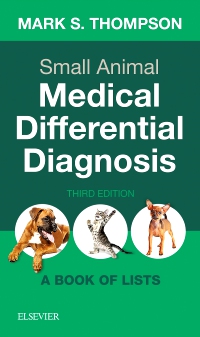
Small Animal Medical Differential Diagnosis Elsevier eBook on VitalSource, 3rd Edition
by Mark Thompson, DVM, DABVP(Canine and Feline)
Elsevier eBook on VitalSource
ISBN:
9780323569545
Copyright:
2018
Publication Date:
12-12-2017
Page Count:
416
Imprint:
Saunders
List Price:
$62.99
Was
$62.99
Now $44.09
Or $0.00 with a valid access code
Get instant access to the critical data you need to make accurate diagnoses and effectively plan treatment. Small Animal Medical Differential Diagnosis, 3rd Edition combines over 400 expert resources and boils them down into one easy-to-use reference covering the differential diagnosis, etiology, clinical signs, and relevant laboratory abnormalities of the most common conditions you will encounter in dogs and cats. And because of its pocket size and intuitive organization, you can have it on hand as a quick consultative device throughout the day to make reliable on-the-scene decisions.
New Edition Expected Availability: 02-12-2024
Small Animal Medical Differential Diagnosis - Elsevier eBook on VitalSource
Elsevier eBook on VitalSource
ISBN: 9780323875943
-
- NEW! Coverage of FAST ultrasound examinations is found in the section on Focused Assessment with Sonography for Trauma, Triage, and Tracking.
- NEW! Overall content update includes substantial revisions to the disorders, syndromes, and diagnostic and laboratory tests that are listed in this guide.
-
- More than 400 lists bring the most important medical diagnostic information from multiple resources into a single quick reference.
- Easy identification of the likeliest diagnosis is attributed by the possibilities being listed in order of incidence.
- Intuitive organization presents differential diagnosis by sign, symptom, and disorder to facilitate quick access to information.
- Alphabetical listing of all relevant laboratory tests makes information easy to find.
- Pocket size makes this guide portable, practical, and simple to use.
-
Part One – Clinical Signs Approach to Differential Diagnosis
Part Two – Systemic Approach to Differential Diagnosis
1. Cardiopulmonary Disorders
2. Dermatologic Disorders
3. Endocrinologic and Metabolic Disorders
4. Gastroenterologic Disorders
5. Hematologic Disorders
6. Immunologic and Immune-Mediated Disorders
7. Infectious Disease
8. Joint and Bone Disorders
9. Liver and Exocrine Pancreatic Disorders
10. Neoplasia
11. Neurologic and Neuromuscular Disorders
12. Ocular Disorders
13. Toxicology
14. Urogenital Disorder
15. Pain Diagnosis
Part Three – Laboratory Values and Interpretation of Results -
-
Ways of Reading
- The appearance of the text and page layout can be modified according to the capabilities of the reading system (font family and font size, spaces between paragraphs, sentences, words, and letters, as well as color of background and text)
- This e-publication is accessible to the full extent that the file format and types of content allow, on a specific reading device, by default, without necessarily including any additions such as textual descriptions of images or enhanced navigation
- No information about nonvisual reading is available
-
Conformance
- No information is available
-
Navigation
- Table of contents to all chapters of the text via links
- Page list to go to pages from the print source version
-
Rich Content
- No information is available
-
Hazards
- No information is available
-
Product Content
- No information is available
-
Legal Considerations
- No information is available
-
Additional Accessibility Information
- Page breaks included from the original print source
- For readers with color vision deficiency, use of color (e.g., in diagrams, graphics and charts, in prompts, or on buttons inviting a response) is not the sole means of graphical distinction or of conveying information
- E-publication includes basic navigation (usually less detailed than TOC-based navigation)
- Where links, controls or buttons are included in the content, the purpose or functionality of each link, control or button is apparent from the associated text alone - or where it is unclear, separate link, control or button descriptions are provided
- All (or substantially all) textual matter is arranged in a single logical reading order (including text that is visually presented as separate from the main text flow, e.g., in boxouts, captions, tables, footnotes, endnotes, citations, etc.). Non-textual content is also linked from within this logical reading order. (Purely decorative non-text content can be ignored).
- The language of the text has been specified (e.g., via the HTML or XML lang attribute) to optimise text-to-speech (and other alternative renderings), both at the whole document level and, where appropriate, for individual words, phrases or passages in a different language.
-
Ways of Reading
Was
$62.99
Now $44.09
Or $0.00 with a valid access code

 as described in our