ISBN:
9780323570268
Copyright:
2019
Publication Date:
04-01-2018
Page Count:
272
Imprint:
Mosby
List Price:
$36.99

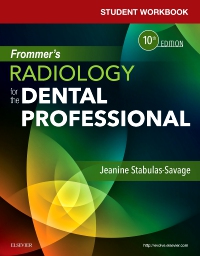
Student Workbook for Frommer's Radiology for the Dental Professional - Elsevier eBook on VitalSource, 10th Edition
by Jeanine J. Stabulas-Savage, RDH, BS, MPH
Elsevier eBook on VitalSource
ISBN:
9780323570268
Copyright:
2019
Publication Date:
04-01-2018
Page Count:
272
Imprint:
Mosby
List Price:
$36.99
Was
$36.99
Now $25.89
Or $0.00 with a valid access code
Hone your understanding of imaging concepts and techniques with the Student Workbook for Frommer’s Radiology for the Dental Professional, 10th Edition. Coordinating step-by-step with the main text, this workbook offers the essential practice and review you need to master radiography concepts and learn to capture high-quality images. Activities and exercises — including new laboratory workshop activities and new ordering sequence questions — cover application, image assessment, image labeling, vocabulary, information recall, and more. It’s the perfect hands-on practice tool to help you successfully support oral diagnosis and treatment planning.
-
- NEW! Content on digital imaging, radiation protection, and infection prevention has been added throughout the workbook.
- NEW! Practice questions and exercises aid in content recall and understanding.
- NEW! Clinical and radiographic images hone your interpretation and evaluation skills.
- NEW! Laboratory workshop activities promote assessment and skill-building.
- NEW! Ordering sequence questions reinforce your understanding of key skills and techniques.
-
- Correlation with the textbook makes your workbook experience seamless.
- Additional illustrations not found in the text provide practice with identification and interpretation.
- Perforated pages provie for on-the-go study or turn-in assignments.
-
-
 Frommer's Radiology for the Dental Professional - Elsevier eBook on VitalSourceElsevier eBook on VitalSource
 -

-

-
-
1. The History of Ionizing Radiation and Basic Principles of X-Ray Generation
2. The Dental X-Ray Machine
3. Image Formation
4. Image Receptors
5. Biologic Effects of Radiation
6. Patient Protection
7. Operator Protection
8. Infection Control in Dental Radiography
9. Intraoral Radiographic Technique: The Paralleling Method
10. Accessory Radiographic Techniques: Bisecting Technique and Occlusal Projections
11. Film Processing Techniques
12. Panoramic Radiography
13. Extraoral Techniques
14. Radiography of the Temporomandibular Joint
15. Digital Imaging
16. Advanced Imaging Systems
17. Quality Assurance
18. Patient Management and Special Problems
19. Film Mounting and Radiographic Anatomy
20. Principles of Radiographic Interpretation
21. Caries and Periodontal Disease
22. Pulpal and Periapical Lesions
23. Developmental Disturbances of Teeth and Bone
24. Bone and Other Lesions
25. Legal Considerations
Laboratory Workshop Activities -
-
Ways of Reading
- The appearance of the text and page layout can be modified according to the capabilities of the reading system (font family and font size, spaces between paragraphs, sentences, words, and letters, as well as color of background and text)
- This e-publication is accessible to the full extent that the file format and types of content allow, on a specific reading device, by default, without necessarily including any additions such as textual descriptions of images or enhanced navigation
- No information about nonvisual reading is available
-
Conformance
- No information is available
-
Navigation
- Table of contents to all chapters of the text via links
- Page list to go to pages from the print source version
-
Rich Content
- No information is available
-
Hazards
- No information is available
-
Product Content
- No information is available
-
Legal Considerations
- No information is available
-
Additional Accessibility Information
- Page breaks included from the original print source
- For readers with color vision deficiency, use of color (e.g., in diagrams, graphics and charts, in prompts, or on buttons inviting a response) is not the sole means of graphical distinction or of conveying information
- E-publication includes basic navigation (usually less detailed than TOC-based navigation)
- Where links, controls or buttons are included in the content, the purpose or functionality of each link, control or button is apparent from the associated text alone - or where it is unclear, separate link, control or button descriptions are provided
- All (or substantially all) textual matter is arranged in a single logical reading order (including text that is visually presented as separate from the main text flow, e.g., in boxouts, captions, tables, footnotes, endnotes, citations, etc.). Non-textual content is also linked from within this logical reading order. (Purely decorative non-text content can be ignored).
- The language of the text has been specified (e.g., via the HTML or XML lang attribute) to optimise text-to-speech (and other alternative renderings), both at the whole document level and, where appropriate, for individual words, phrases or passages in a different language.
-
Ways of Reading
Was
$36.99
Now $25.89
Or $0.00 with a valid access code

 as described in our