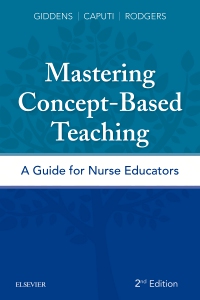

Mastering Concept-Based Teaching Elsevier eBook on VitalSource, 2nd Edition
Elsevier eBook on VitalSource
Now $54.89
Get all the strategies and guidance you need successfully implement conceptual learning with Mastering Concept-Based Teaching, 2nd Edition. Written specifically for nursing faculty, renowned educators Dr. Jean Foret Giddens, Dr. Linda Caputi, and Dr. Beth Rodgers walk you through the background and benefits of using a concept-based learning approach; how to plan, develop, and deliver an effective concept-based course; and how to improve and evaluate student learning with concepts. This new second edition also features two new chapters — one on how to conduct concept-based clinical experiences and another chapter on the future of concept-based interprofessional learning. You’ll also find updated content, more of the highly helpful Misconceptions and Clarifications boxes, and a more streamlined design with added color and larger type. So whether you’re teaching in an LPN, ADN, BSN, or MSN program, this insightful book is here to ensure a smooth execution concept-based teaching.
New Edition Expected Availability: 03-02-2023

Mastering Concept-Based Teaching and Competency Assessment - Elsevier eBook on VitalSource
-
- NEW! Updated content reflects the latest research in the neuroscience of learning, insightful illustrations, and best practices in concept-based curriculum design and instruction
- NEW! Expanded use of Misconceptions and Clarifications boxes also reflects the latest research in conceptual learning to help clarify important concepts
- NEW! Added color improves teaching and learning value
- UNIQUE! New chapter on concept-based clinical experiences includes simulation and lab experiences, "live" clinical experiences, and clinical learning activities for inpatient, outpatient, community, and health systems-level experiences
- UNIQUE! New chapter on thinking conceptually and the future of concept-based interprofessional learning covers both the ways CBC is spreading beyond just nursing and how to encourage faculty to shift their thinking to develop reasoning and critical thinking skills in students versus rote learning of content
-
- Framework for developing a concept-based curriculum provides guidance throughout the general steps associated with developing a CBC
- Strong foundation in how to teach within a concept-based curriculum dives into the nature of concepts, their function in the process of learning, and the importance of being consistent in the selection and implementation of concepts
- Balanced teaching strategies illustrate ways to enhance the conceptual approach through engaging learning activities and an open environment
- Success evaluation criteria explains the importance of analyzing evaluation data to determine the effectiveness of a new curriculum on meeting program learning outcomes
-
1. The Conceptual Approach: Background and Benefits
2. Concepts in the Discipline of Nursing
3. Developing Concepts for Concept-Based Teaching
4. Developing a Concept-Based Curriculum
5. Conceptual Learning
6. Conceptual Teaching Strategies for the Classroom Setting
7. Conceptual Teaching Strategies for Clinical Settings
8. Evaluation of Student Learning and Program Evaluation
9. Advancing the Conceptual Approach in Nursing Through Evidence, Professional Development, and Interprofessional Education -
-
Ways of Reading
- The appearance of the text and page layout can be modified according to the capabilities of the reading system (font family and font size, spaces between paragraphs, sentences, words, and letters, as well as color of background and text)
- This e-publication is accessible to the full extent that the file format and types of content allow, on a specific reading device, by default, without necessarily including any additions such as textual descriptions of images or enhanced navigation
- No information about nonvisual reading is available
-
Conformance
- The publication was certified on 27-05-2026
-
Navigation
- Table of contents to all chapters of the text via links
- Page list to go to pages from the print source version
-
Rich Content
- No information is available
-
Hazards
- No information is available
-
Product Content
- No information is available
-
Legal Considerations
- No information is available
-
Additional Accessibility Information
- Page breaks included from the original print source
- For readers with color vision deficiency, use of color (e.g., in diagrams, graphics and charts, in prompts, or on buttons inviting a response) is not the sole means of graphical distinction or of conveying information
- E-publication includes basic navigation (usually less detailed than TOC-based navigation)
- Where links, controls or buttons are included in the content, the purpose or functionality of each link, control or button is apparent from the associated text alone - or where it is unclear, separate link, control or button descriptions are provided
- All (or substantially all) textual matter is arranged in a single logical reading order (including text that is visually presented as separate from the main text flow, e.g., in boxouts, captions, tables, footnotes, endnotes, citations, etc.). Non-textual content is also linked from within this logical reading order. (Purely decorative non-text content can be ignored).
- The language of the text has been specified (e.g., via the HTML or XML lang attribute) to optimise text-to-speech (and other alternative renderings), both at the whole document level and, where appropriate, for individual words, phrases or passages in a different language.
-
Ways of Reading

 as described in our