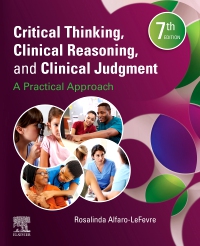

Critical Thinking, Clinical Reasoning and Clinical Judgment Elsevier eBook on VitalSource, 7th Edition
Elsevier eBook on VitalSource
Now $57.59
Develop the critical thinking and reasoning skills you need to make sound clinical judgments! Alfaro-LeFevre's Critical Thinking, Clinical Reasoning, and Clinical Judgment: A Practical Approach, 7th Edition brings these concepts to life through engaging text, diverse learning activities, and real-life examples. Easy-to-understand language and a "how-to" approach equip you to become a sensible, resilient critical thinker with the clinical reasoning skills you need to think think through complex issues and make sound clinical decisions. This edition emphasizes readiness for clinical practice and the Next Generation NCLEX exam, with a focus on systems thinking, interprofessional practice, nursing skills for the 21st century, and Quality and Safety for Nursing Education (QSEN) competencies.
New Edition Expected Availability: 11-08-2024

Alfaro’s Clinical Judgment in Nursing: A How-To Practice Approach - Elsevier eBook on VitalSource
-
- NEW! Spotlight on systems thinking teaches you to consider how things are related, while coverage of conceptual thinking helps you focus on big ideas first.
- NEW! Information on effective clinical simulations encourages learning through practice and debriefing.
- NEW! Clinical reasoning principles are highlighted throughout to ensure you are practice ready.
- NEW! Current critical judgment models are illustrated and explained in a clear, engaging style.
- NEW! Expanded content on growing nursing trends addresses competency assessment, electronic charting (informatics) and "thinking beyond the EHR," clinical evaluation, and preceptor and learner strategies.
- NEW! Strong emphasis on interprofessional collaboration includes new content on its growing importance in health care.
-
- Clear, straightforward approach and motivational writing style provides vivid examples, memorable anecdotes, and real-life case scenarios to make content come alive.
- Focus on application ("how to") with supporting rationales (theory) makes difficult concepts easy to learn.
- Critical Thinking Indicators feature evidence-based descriptions of behaviors that foster critical thinking in nursing practice.
- Highlighted features and sections that promote deep learning include: This Chapter at a Glance, Learning Outcomes, Key Concepts, Guiding Principle boxes, Critical Moments boxes, Other Perspectives features, Think-Pair-Share activities, H.M.O. (Help Me Out) cartoons, real-life clinical scenarios, Key Points, Critical Thinking Exercises, and more!
- Cultural, spiritual, and lifespan content explores the nurse’s role in hospitals, long-term care settings, and entire communities, presenting a broad approach to critical thinking.
- Inclusion of ethics- and standards-based professional practice reflects the increased demand for accountability in today’s professional climate.
- Timely coverage of the latest in nursing education and critical thinking includes concept-based learning; QSEN and IOM standards; problem-focused versus outcome-focused thinking; prioritization and delegation; developing a culture of safe, healthy work environments; expanding roles related to diagnosis and management; improving grades and passing tests the first time; NCLEX exam preparation; ensuring that documentation reflects critical thinking; communication and interpersonal skills; strategies for common workplace challenges; and more.
-
1. What are Critical Thinking, Clinical Reasoning, and Clinical Judgment?
2. Becoming a Critical Thinker
3. Critical Thinking and Learning Cultures: Teaching, Learning, and Taking Tests
4. Interprofessional Clinical Reasoning, Decision Making, and Judgment
5. Ethical Reasoning, Professionalism, Evidence-Based Practice, and Quality Improvement
6. Practicing Clinical Reasoning, Clinical Judgment, and Decision-making Skills
7. Interprofessional Practice Skills: Communication, Teamwork, and Self-Management NEW interprofessional collaboration focus!Appendices
Appendix A. Concept Mapping
Appendix B. Nursing Process Summary
Appendix C. Examples of CTIs within 4-Circle Model (New)
Appendix D. Patient’s Rights and Nurses’ Rights
Appendix E. DEAD ON Game
Appendix F. Key Brain Parts Involved in Thinking
Appendix G. Example SBAR Tool
Appendix H. Results of Two Studies Describing Critical Thinking Skills
Appendix I. Example Responses for Critical Thinking and Clinical Reasoning ExercisesGlossary
Index
-
-
Ways of Reading
- The appearance of the text and page layout can be modified according to the capabilities of the reading system (font family and font size, spaces between paragraphs, sentences, words, and letters, as well as color of background and text)
- This e-publication is accessible to the full extent that the file format and types of content allow, on a specific reading device, by default, without necessarily including any additions such as textual descriptions of images or enhanced navigation
- No information about nonvisual reading is available
-
Conformance
- No information is available
-
Navigation
- Table of contents to all chapters of the text via links
- Page list to go to pages from the print source version
-
Rich Content
- No information is available
-
Hazards
- No information is available
-
Product Content
- No information is available
-
Legal Considerations
- No information is available
-
Additional Accessibility Information
- Page breaks included from the original print source
- For readers with color vision deficiency, use of color (e.g., in diagrams, graphics and charts, in prompts, or on buttons inviting a response) is not the sole means of graphical distinction or of conveying information
- E-publication includes basic navigation (usually less detailed than TOC-based navigation)
- Where links, controls or buttons are included in the content, the purpose or functionality of each link, control or button is apparent from the associated text alone - or where it is unclear, separate link, control or button descriptions are provided
- All (or substantially all) textual matter is arranged in a single logical reading order (including text that is visually presented as separate from the main text flow, e.g., in boxouts, captions, tables, footnotes, endnotes, citations, etc.). Non-textual content is also linked from within this logical reading order. (Purely decorative non-text content can be ignored).
- The language of the text has been specified (e.g., via the HTML or XML lang attribute) to optimise text-to-speech (and other alternative renderings), both at the whole document level and, where appropriate, for individual words, phrases or passages in a different language.
-
Ways of Reading

 as described in our