
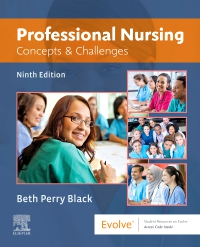

Professional Nursing Elsevier eBook on VitalSource, 9th Edition
Elsevier eBook on VitalSource
Now $69.29
Discover what it means to be a professional nurse — the history, values and standards, and commitment to life-long learning. Professional Nursing: Concepts & Challenges, 9th Edition equips you with current professional nursing practices to positively impact your career. This easy-to-read text helps you gain insight into the current state of the profession and benefit from a thorough examination of standards and scope of practice, with new information on the Affordable Care Act, real-life interview narratives, coverage of social justice in nursing, transition into professional practice, health care delivery systems, future challenges for the nursing profession. and more. Valuable learning aids throughout this text include: case studies, cultural challenges, evidence-based practice, critical thinking, interviews, professional profiles, historical notes, nursing research, and ideas for further exploration.
New Edition Expected Availability: 01-25-2023

Professional Nursing - Elsevier eBook on VitalSource
-
- NEW! Updated information on the Affordable Care Act keeps you in the know
- NEW! Information on care coordination prepares you to make more informed decisions about patient care
- NEW! Information on care transitions so you know what to expect upon entering the workforce
- NEW! Increased content on diversity in nursing, ethnocentrism, moral distress and moral courage, communication models (SBAR, CUS and others), and RN to BSN education
- NEW! Cognitive rehearsal prepares you for the unlikely threat of lateral violence
- NEW! Tips on documentation include both electronic and paper types
- NEW! Social justice in nursing helps you to learn to advocate for patients who need your help
-
- Professional Profiles boxes provide prospective from nurses in the field
- Case Study boxes feature scenarios involving relevant issues in patient care
- Considering Culture boxes highlight the impact of culture in regards to a nurse’s role and responsibilities and the patient’s healthcare experience
- Evidence-based Practice boxes identify leading findings in nursing topics and trends
- Nurses Doing Research boxes highlight problems identified in patient care and the ongoing efforts to find patient interventions
- Interview narratives explore the issues like culture and faith from the perspectives of leaders in those fields
- Discussions on the implications of social media on nursing, including ethics and boundaries
- Historical Notes highlight little-known stories of heroisms in the nursing profession.
- Key terms are bolded where defined in the text
- A Glossary is included at the end of the text
- Learning outcomes are presented at the chapter openings
- Concepts and Challenges and Ideas for Further Exploration at the end of the chapters help you to review and test prep
-
1. Nursing in Today’s Evolving Health Care Environment
2. The History and Social Context of Nursing
3. Nursing’s Pathway to Professionalism
4. Nursing Education in an Evolving Health Care Environment
5. Becoming a Professional Nurse: Defining Nursing and Socialization into Practice
6. Nursing as a Regulated Practice: Legal Issues
7. Ethics: Basic Concepts for Professional Nursing Practice
8. Conceptual and Philosophical Foundations of Professional Nursing Practice
9. Nursing Theory: The Basis for Professional Nursing
10. The Science of Nursing and Evidence-Based Practice
11. Developing Nursing Judgment Through Critical Thinking
12. Communication and Collaboration in Professional Nursing
13. Nurses, Patients, and Families: Caring at the Intersection of Health, Illness, and Culture
14. Health Care in the United States
15. Political Activism in Nursing: Communities, Organizations, Government
16. Nursing Challenge: To Continue to Evolve -
-
Ways of Reading
- The appearance of the text and page layout can be modified according to the capabilities of the reading system (font family and font size, spaces between paragraphs, sentences, words, and letters, as well as color of background and text)
- This e-publication is accessible to the full extent that the file format and types of content allow, on a specific reading device, by default, without necessarily including any additions such as textual descriptions of images or enhanced navigation
- All content can be read as read aloud speech or dynamic braille
-
Conformance
- The publication contains a conformance statement that it meets the EPUB Accessibility 1.1, WCAG 2.1, Level AA standard. Please see https://bornaccessible.benetech.org/certified-publishers/ for further details of our compatibility testing.
- The certifier's credential is https://bornaccessible.benetech.org/certified-publishers/
- For detailed accessibility information, see Elsevier's website at https://www.elsevier.com/about/accessibility
- For queries regarding accessibility information, contact [email protected]
- The publication was certified on 28-05-2026
-
Navigation
- Table of contents to all chapters of the text via links
- Page list to go to pages from the print source version
-
Rich Content
- No information is available
-
Hazards
- No information is available
-
Product Content
- No information is available
-
Legal Considerations
- No information is available
-
Additional Accessibility Information
- Content is enhanced with ARIA roles to optimize organization and facilitate navigation
- Page breaks included from the original print source
- For readers with color vision deficiency, use of color (e.g., in diagrams, graphics and charts, in prompts, or on buttons inviting a response) is not the sole means of graphical distinction or of conveying information
- The body text is presented with a contrast ratio of at least 4.5:1 (or 3:1 for large/heading text)
- Ultra-high contrast between text and background
- E-publication includes basic navigation (usually less detailed than TOC-based navigation)
- Where links, controls or buttons are included in the content, the purpose or functionality of each link, control or button is apparent from the associated text alone - or where it is unclear, separate link, control or button descriptions are provided
- All (or substantially all) textual matter is arranged in a single logical reading order (including text that is visually presented as separate from the main text flow, e.g., in boxouts, captions, tables, footnotes, endnotes, citations, etc.). Non-textual content is also linked from within this logical reading order. (Purely decorative non-text content can be ignored).
- Where interactive content is included in the product, controls are provided (e.g., for speed, pause and resume, reset) and labelled to make their use clear.
- The language of the text has been specified (e.g., via the HTML or XML lang attribute) to optimise text-to-speech (and other alternative renderings), both at the whole document level and, where appropriate, for individual words, phrases or passages in a different language.
-
Ways of Reading

 as described in our