ISBN:
9780323597357
Copyright:
2022
Publication Date:
11-24-2021
Page Count:
662
Imprint:
Elsevier
List Price:
$75.99

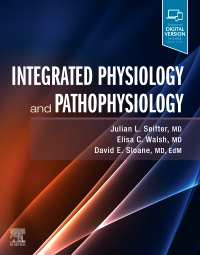
Integrated Physiology and Pathophysiology Elsevier eBook on VitalSource, 1st Edition
by Julian L Seifter, MD, Elisa Walsh and David E Sloane, MD, EdM
Elsevier eBook on VitalSource
ISBN:
9780323597357
Copyright:
2022
Publication Date:
11-24-2021
Page Count:
662
Imprint:
Elsevier
List Price:
$75.99
Was
$75.99
Now $68.39
Or $0.00 with a valid access code
Edited by physiology instructors who are also active clinicians, Integrated Physiology and Pathophysiology is a one-stop guide to key information you need for early clinical and medical training and practice. This unique, integrated textbook unites these two essential disciplines and focuses on the most relevant aspects for clinical application. A concise, review-like format, tables and diagrams, spaced repetition for effective learning, and self-assessment features help you gain and retain a firm understanding of basic physiology and pathophysiology. Integrated Physiology and Pathophysiology works equally well as a great starting point in your studies and as a review for boards.
-
- Shares the knowledge and expertise of an outstanding editorial team consisting of two practicing clinicians who also teach physiology and pathophysiology at Harvard Medical School, plus a top Harvard medical student
- Provides an integrated approach to physiology and pathophysiology in a concise, bulleted format. Chapters are short and focus on clinically relevant, foundational concepts in clear, simple language
- Employs focused repetition of key points, helping you quickly recall core concepts such as pressure-flow-resistance relationships, ion gradients and action potentials, and mass balance. You’ll revisit these concepts in a variety of meaningful clinical contexts in different chapters; this "spaced learning" method of reinforcement promotes deeper and more flexible understanding and application
- Includes Fast Facts boxes that emphasize take-home messages or definitions
- Contains Integration boxes that link physiology and pathophysiology to pharmacology, genetics, and other related sciences
- Presents clinical cases and with signs and symptoms, history, and laboratory data that bring pathophysiology to life
- Features end-of-chapter board-type questions, complete with clear explanations of the answers, to help prepare you for standardized exams
- Enhanced eBook version included with purchase. Your enhanced eBook allows you to access all of the text, figures, and references from the book on a variety of devices
-
Section 1: Foundations
1. General Principles of Physiology
1.1 Case Study #1
Section 2: Neurophysiology
2. An Overview of Nerve Cell Physiology and Electrophysiology
3. Central Nervous System
4. Peripheral Nervous System and the Autonomic Nervous System
5. The Neuromuscular Junction and Skeletal Muscle
6. Smooth Muscle
6.1 Case Study #2
Section 3: Circulatory Physiology
7. Blood and the Endothelium
8. The Lymphatic System and the Immune System
8.1 Case Study #3
Section 4: Cardiovascular Physiology
9. The Vasculature
10. The Heart As a Pump
11. Cardiac Electrophysiology
12. Exercise Physiology
12.1 Case Study #4
Section 5: Pulmonary Physiology
13. The Mechanics of Breathing
14. Gas Exchange in the Lung
15. Gas Transport
16. The Regulation of Breathing
16.1 Case Study #5
Section 6: Renal Physiology
17. Renal Structure and Function
18. Tubular Transport
19. The Regulation of Blood Pressure and Extracellular Fluid Volume
20. Osmoregulation
21. The Regulation of Potassium Balance
22. Acid-Base Balance
23. Micturition
23.1 Case Study #6
Section 7: Gastrointestinal Physiology
24. Nutrition, Digestion, and Absorption
25. Control of Gastrointestinal Motility and Secretion
26. Hepatic Physiology
27. The Gastrointestinal Immune System
27.1 Case Study #7
Section 8: Endocrine Physiology
28. The Endocrine Pancreas: Fed and Fasted Metabolic States
29. The Pituitary Gland
30. The Thyroid Gland
31. The Adrenal Gland
32. Calcium Regulation: Parathyroid Physiology
33. Calcium Regulation: Bone Physiology
34. The Female Reproductive System
35. Pregnancy and Partiution
36. The Male Reproductive System -
-
Ways of Reading
- The appearance of the text and page layout can be modified according to the capabilities of the reading system (font family and font size, spaces between paragraphs, sentences, words, and letters, as well as color of background and text)
- This e-publication is accessible to the full extent that the file format and types of content allow, on a specific reading device, by default, without necessarily including any additions such as textual descriptions of images or enhanced navigation
- No information about nonvisual reading is available
-
Conformance
- No information is available
-
Navigation
- Table of contents to all chapters of the text via links
- Page list to go to pages from the print source version
-
Rich Content
- No information is available
-
Hazards
- No information is available
-
Product Content
- No information is available
-
Legal Considerations
- No information is available
-
Additional Accessibility Information
- Page breaks included from the original print source
- For readers with color vision deficiency, use of color (e.g., in diagrams, graphics and charts, in prompts, or on buttons inviting a response) is not the sole means of graphical distinction or of conveying information
- E-publication includes basic navigation (usually less detailed than TOC-based navigation)
- Where links, controls or buttons are included in the content, the purpose or functionality of each link, control or button is apparent from the associated text alone - or where it is unclear, separate link, control or button descriptions are provided
- All (or substantially all) textual matter is arranged in a single logical reading order (including text that is visually presented as separate from the main text flow, e.g., in boxouts, captions, tables, footnotes, endnotes, citations, etc.). Non-textual content is also linked from within this logical reading order. (Purely decorative non-text content can be ignored).
- The language of the text has been specified (e.g., via the HTML or XML lang attribute) to optimise text-to-speech (and other alternative renderings), both at the whole document level and, where appropriate, for individual words, phrases or passages in a different language.
-
Ways of Reading

Was
$75.99
Now $68.39
Or $0.00 with a valid access code

 as described in our