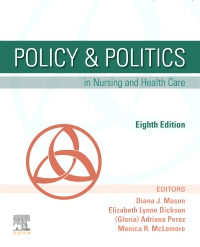

Policy and Politics in Nursing and Health Care Elsevier eBook on VitalSource, 8th Edition
Elsevier eBook on VitalSource
Now $97.19
**Selected for Doody’s Core Titles® 2024 with "Essential Purchase" designation in Health Policy/Reform**
Learn how to influence policy and become a leader in today's changing health care environment. Featuring analysis of cutting-edge healthcare issues and first-person insights, Policy & Politics in Nursing and Health Care, 8th Edition continues to be the leading text on nursing action and activism. Approximately 150 expert contributors present a wide range of topics in policies and politics, providing a more complete background than can be found in any other policy textbook on the market. This expanded 8th edition helps you develop a global understanding of nursing leadership and political activism, as well as the complex business and financial issues that drive many actions in the health system. Discussions include the latest updates on conflict management, health economics, lobbying, the use of media, and working with communities for change. With these innovative insights and strategies, you will be prepared to play a leadership role in the four spheres in which nurses are politically active: the workplace, government, professional organizations, and the community.
New Edition Expected Availability: 08-28-2026

Policy and Politics in Nursing and Health Care - Elsevier E-Book on VitalSource
-
- NEW! The latest information and perspectives are provided by nursing leaders who influenced health care reform, including the Affordable Care Act.
- NEW! Added information on medical marijuana presents both sides of this ongoing debate.
- NEW! More information on health care policy and the aging population covers the most up-do-date information on this growing population.
- NEW! Expanded information on the Globalization of Nursing explores international policies and procedures related to nursing around the world.
- NEW! Expanded focus on media strategies details proper etiquette when speaking with the press.
- NEW! Expanded coverage of primary care models and issues throughout text.
- NEW! APRN and additional Taking Action chapters reflect the most recent industry changes.
- NEW! Perspectives on issues and challenges in the government sphere showcase recent strategies and complications.
-
- NEW! Nora AI - an AI-powered learning assistant exclusive to Elsevier ebooks on VitalSource's Bookshelf® platform - offers built-in AI learning support that provides personalized answers based on content from the Elsevier ebook
- Comprehensive coverage of healthcare policies and politics provides a broader understanding of nursing leadership and political activism, as well as complex business and financial issues.
- Key Points at the end of chapters helps you review important, need-to-know lesson content.
- Taking Action essays include personal accounts of how nurses have participated in politics and what they have accomplished.
- Expert authors make up a virtual Nursing Who's Who in healthcare policy, sharing information and personal perspectives gained in the crafting of healthcare policy.
-
UNIT 1: INTRODUCTION TO POLICY AND POLITICS IN NURSING AND HEALTH CARE
1.Frameworks for Action in Policy and Politics
2.A Historical Perspective on Policy, Politics and Nursing
3.Advocacy in Nursing and Health Care
4.Learning the Ropes of Policy and Politics
5.TAKING ACTION: Just Say Yes: Learning to Move Beyond the Fear
6.A Primer on Political Philosophy
7.The Policy Process
8.Political Analysis and Strategies
9.Communication and Conflict Management in Health Policy
10.Research as a Political and Policy Tool
11.Using Research to Advance Health and Social Policies for Children
12.Using the Power of the Media to Influence Health Policy and Politics
13.TAKING ACTION: How A Social Media Campaign and Billboards Can Influence Policy
14.Health Policy, Politics, and Professional EthicsUNIT 2: HEALTH CARE DELIVERY AND FINANCING
15.The Changing United States Health Care System
16.A Primer on Health Economics of Nursing and Health Policy
17.Financing Health Care in the United States
18.The Affordable Care Act: An Uncertain Future
19.The National Association of Hispanic Nurses Educating Multicultural Communities on the Patient Protection & Affordable Care Act
20.Patient Engagement and Public Policy: Emerging New Paradigms and Roles
21.The Marinated Mind: Why Overuse Is an Epidemic and How to Reduce It
22.Policy Approaches to Address Health Disparities
23.TAKING ACTION: Policy Advocacy for American Indian/Alaska Native Children: School Nutrition and the Need for Indigenous Food Sovereignty
24.TAKING ACTION: Addressing the Health Needs of Immigrant/Migrant Farmworkers
25.The Unfulfilled Promise of Mental Health and Addiction Parity
26.Improving LGBTQ+ Health: Nursing Policy Can Make a Difference
27.Reproductive Health Policy
28.Public and Population Health: Promoting the Health of the Public
29.TAKING ACTION: Influencing Public Health in a Politically Charged Environment
30.The Politics and Policy of Disaster Response and Public Health Emergency Preparedness
31.Advancing New Models of Primary Care
32.Family Caregiving and Social Policy
33.Dual Eligibles: Challenges and Innovations in Care
34.HOMECARE, HOSPICE AND COMMUNITY BASED CARE: EVOLVING POLICY
35.Long-Term Services and Supports Policy Issues
36.The United States Military and Veterans Administration Health Systems: Contemporary Overview and Policy ChallengesUNIT 3: POLICY AND POLITICS IN THE GOVERNMENT
37.Contemporary Issues in Government
38.How Government Works: What You Need to Know to Influence the Process
39.An Overview of Legislative and Regulatory Processes
40.Lobbying Policymakers: Individual and Collective Strategies
41.Political Activity: Different Rules for Government-Employees
42.TAKING ACTION: Reflective Musings from a Nurse Politician!
43.TAKING ACTION: Running Against the Odds: There’s a Nurse in the Assembly
44.Political Appointments
45.Nursing and the Courts
46.Nursing Licensure and Regulations
47.TAKING ACTION: Nurse, Educator, and Legislator: My Journey to the Delaware General Assembly and as Lieutenant GovernorUNIT 4: POLICY AND POLITICS IN THE WORKPLACE AND WORKFORCE
48.Policy and Politics in Health Care Organizations
49.Taking Your Place at the Table: Board Appointments and Service
50.TAKING ACTION: Nurse Leaders in the Boardroom
51.Quality and Safety in Healthcare: Policy Issues
52.Politics and Evidence-Based Practice and Policy
53.The Nursing Workforce
54.Rural Health Care: Workforce Challenges and Opportunities
55.TAKING ACTION: Increasing Specialty Medical Care ACCESS in Rural Communities
56.Nurse Staffing Ratios: Policy Options
57.The Contemporary Work Environment of Nursing
58.Taking Action: Racism in the Workplace
59.Collective Strategies for Transformation in the Workplace
60.Political Context of Advanced Practice Nursing
61.TAKING ACTION: Never Underestimate the Power of a Personal Story!
62.TAKING ACTION: Removing APRN Regulatory Barriers in West Virginia
63.TAKING ACTION: Full Practice Authority: A Tale of Two States
64.Policy and Politics in Nursing Academia
65.The Intersection of Technology and Health Care: Policy and Practice ImplicationsUNIT 5: POLICY AND POLITICS IN ASSOCIATIONS AND INTEREST GROUPS
66.Interest Group in Health Care Policy and Politics
67.Policy Issues in Nursing Associations
68.TAKING ACTION: School Nursing at the Intersection of Health and Education
69.TAKING ACTION: The Alliance of Nursing for Healthy Environments Promoting Environmental Health
70.Coalitions: A Powerful Political Strategy
71.TAKING ACTION: Campaign For Action
72.TAKING ACTION: Why Not Minot? The battle over North Dakota's first smoke-free ordinance
UNIT 6: POLICY AND POLITICS IN THE COMMUNITY
73.Where Policy Hits the Pavement: Contemporary Issues In Communities
74.An Introduction to Community Activism
75.TAKING ACTION: From Sewage Problems to the State House: Serving Communities
76.TAKING ACTION: Contaminated Water and Elevated Blood Lead Levels in Flint
77.Creating Culture of Health and working with communities
78.TAKING ACTION: Activism: A Community Rises
79.Family and Sexual Violence: Nursing and U.S. Policy
80.Human Trafficking: The Need for Nursing Advocacy
81.TAKING ACTION: Policy, Politics, and Advocating for Medicinal Cannabis Use
82.Think Globally, Act Locally: Nursing and Global Health
83.Infectious Disease in a Highly Connected World: Nurses' Role to Prevent, Detect, Respond -
-
Ways of Reading
- The appearance of the text and page layout can be modified according to the capabilities of the reading system (font family and font size, spaces between paragraphs, sentences, words, and letters, as well as color of background and text)
- This e-publication is accessible to the full extent that the file format and types of content allow, on a specific reading device, by default, without necessarily including any additions such as textual descriptions of images or enhanced navigation
- All content can be read as read aloud speech or dynamic braille
- Has alternative text descriptions for images
-
Conformance
- The certifier's credential is https://bornaccessible.benetech.org/certified-publishers/
- The publication was certified on 24-03-2026
-
Navigation
- Table of contents to all chapters of the text via links
- Index with links to referenced entries
- Elements such as headings, tables, etc. for structured navigation
- Page list to go to pages from the print source version
-
Rich Content
- Information-rich images are described by extended descriptions
-
Hazards
- The publication contains no hazards
-
Product Content
- Content includes any type of illustrations.
- The primary content is text.
- Content includes maps and/or other cartographic content.
- Content includes a significant number of actionable (clickable) web links to external content, downloadable resources, supplementary material, etc.
- Content includes a significant number of actionable (clickable) cross-references, hyperlinked notes and annotations, or with other actionable links between largely textual elements (e.g., quiz/test questions, 'choose your own ending', etc.).
- Content includes photographs, whether in a plate section / insert or not.
- Content includes figures, diagrams, charts and/or graphs, including other 'mechanical' (i.e. non-photographic) illustrations.
- Content includes images displayed in a specific order for the purpose of graphic storytelling or giving information (e.g. graphic novels, comics and manga). May include text integrated into the image (as speech and thought bubbles, textual 'sound' effects, captions etc.).
- Content includes text within images, including text-as-text embedded in diagrams, charts, or within images containing speech balloons, thought bubbles, captions, etc.
- Content includes visual content that is purely decorative and is not necessary to understanding of the content.
- At least some text - including text within other images - is 'text as an image' (i.e., a picture of text).
-
Legal Considerations
- No information is available
-
Additional Accessibility Information
- Content is enhanced with ARIA roles to optimize organization and facilitate navigation
- Page breaks included from the original print source
- For readers with color vision deficiency, use of color (e.g., in diagrams, graphics and charts, in prompts, or on buttons inviting a response) is not the sole means of graphical distinction or of conveying information
- The body text is presented with a contrast ratio of at least 4.5:1 (or 3:1 for large/heading text)
- Ultra-high contrast between text and background
- E-publication includes basic navigation (usually less detailed than TOC-based navigation)
- Where links, controls or buttons are included in the content, the purpose or functionality of each link, control or button is apparent from the associated text alone - or where it is unclear, separate link, control or button descriptions are provided
- All (or substantially all) textual matter is arranged in a single logical reading order (including text that is visually presented as separate from the main text flow, e.g., in boxouts, captions, tables, footnotes, endnotes, citations, etc.). Non-textual content is also linked from within this logical reading order. (Purely decorative non-text content can be ignored).
- Content provides explanations for unusual words, abbreviations, acronyms, idioms, jargon in an accessible form, such as glossaries, scripted pop-ups.
- Where interactive content is included in the product, controls are provided (e.g., for speed, pause and resume, reset) and labelled to make their use clear.
- The language of the text has been specified (e.g., via the HTML or XML lang attribute) to optimise text-to-speech (and other alternative renderings), both at the whole document level and, where appropriate, for individual words, phrases or passages in a different language.
-
Ways of Reading


 as described in our