ISBN:
9780323609999
Copyright:
2021
Publication Date:
04-06-2020
Page Count:
656
Imprint:
Mosby
List Price:
$116.99

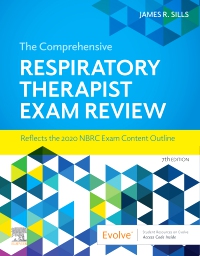
The Comprehensive Respiratory Exam Review Elsevier eBook on VitalSource, 7th Edition
by James R. Sills, MEd, CPFT, RRT
Elsevier eBook on VitalSource
ISBN:
9780323609999
Copyright:
2021
Publication Date:
04-06-2020
Page Count:
656
Imprint:
Mosby
List Price:
$116.99
Most review copies are eBooks – how fast!
A review copy request is most likely to be fulfilled as an eBook on VitalSource rather than a print product, unless no eBook is available. eBooks become available in as little as a few hours. Print products will take between 7 and 10 days to arrive. To request a print copy, please contact us through the Evolve Support Center for further assistance or contact your Elsevier Sales Rep.
Give students realistic National Board of Respiratory Care (NBRC) Exam experience to help eliminate exam day surprises! The Comprehensive Respiratory Therapist's Exam Review, 7th Edition covers every topic listed on the 2020 NBRC Detailed Content Outline — and presents every item listed as testable on the Therapist Multiple Choice (TMC) Exam and Clinical Simulation Exam (CSE). It provides study hints, in-depth content review, and self-assessment questions with rationales so students retain more information. Two practice exams on an accompanying Evolve website prepare students and practicing respiratory therapists for the TMC Exam. In addition, twenty-two updated practice clinical simulation scenarios on Evolve offer invaluable CSE prep.
-
- NEW! Every item listed as testable on the 2020 National Board for Respiratory Care (NBRC) Therapist Multiple Choice (TMC) Exam and Clinical Simulation Exam (CSE) presented to get you exam-ready
- UPDATED! Two TMC practice exams on Evolve
- UPDATED! Twenty-two updated practice clinical simulation scenarios on the practice CSE (on Evolve)
- NEW! Updated artwork enhances comprehension
-
- NEW! Every item listed as testable on the 2020 National Board for Respiratory Care (NBRC) Therapist Multiple Choice (TMC) Exam and Clinical Simulation Exam (CSE) presented to get students exam-ready
- UPDATED! Two TMC practice exams on Evolve
- UPDATED! Twenty-two updated practice clinical simulation scenarios on the practice CSE (on Evolve)
- NEW! Updated artwork enhances comprehension
- Updated content reflects 2020 NBRC Detailed Content Outline and examination matrix so that students know exactly what to expect on the exams and can review each of the areas covered on the matrix
- Exam Hints point out commonly tested items to help students determine what to study, how to plan their time, and improve test-taking skills
- Special NBRC coding of topics corresponds to every topic covered on the NBRC Detailed Content Outline (DCO) so that students know exactly what to expect on the exams and can easily review each of the areas covered on the DCO
- Self-study questions at the end of each chapter include an answer key with rationales to help students analyze areas of strengths and weaknesses in content learned. Additional analysis-type questions account for changes in the testing matrix
- Rationales for each question provide feedback for correct and incorrect answers to help students understand why an answer is correct or incorrect and retain information better
- Difficulty level codes (recall, application, analysis) for each question included with each NBRC topic to help students prepare for questions in a way that is most appropriate for that type of question (e.g., memorization for recall or synthesis for analysis)
- Twenty-two clinical simulations align in content and structure with the new 2020 NBRC Clinical Simulation Exam in both study mode and exam mode. In the untimed study mode students can select each scenario individually and choose to receive detailed feedback on the items that were selected, or on all possible items, upon completion. In the exam mode students take all 22 scenarios with a 4-hour time limit and receive feedback after completion. The clinical simulations can be found on the secured Evolve website and accessed by a pin code (access code in book). The software mimics that used on the actual NBRC CSE
- Two 160-question versions of the Therapist Multiple Choice (TMC) Exam align in content and structure with the new 2020 NBRC TMC Exam. The untimed study (pretest) version provides immediate feedback on each question with a rationale about the correct and incorrect answers. The timed exam (posttest) version has a 3-hour limit. Feedback, including the correct answer and a rationale for the correct and the incorrect answers, is provided on each question upon completion. Final scores are given in the pretest and posttest versions, and the software for both versions mimics that used on the actual NBRC TMC Exam. The question sequence mixes with each repeated attempt, giving students a unique exam experience each time. This content can be found on the secured Evolve website and accessed by a pin code (access code in book)
-
1. Patient Assessment and Care Management
2. Infection Control
3. Blood Gas Sampling, Analysis, Monitoring and Interpretation
4. Pulmonary Function Testing
5. Advanced Cardiopulmonary Monitoring
6. Oxygen and Medical Gas Therapy
7. Hyperinflation Therapy
8. Humidity and Aerosol Therapy
9. Pharmacology
10. Bronchopulmonary Hygiene Therapy
11. Cardiac Monitoring and Cardiopulmonary Resuscitation
12. Airway Management
13. Suctioning the Airway
14. Intermittent Positive-Pressure Breathing (IPPB)
15. Mechanical Ventilation of the Adult
16. Mechanical Ventilation of the Neonate
17. Home Care and Pulmonary Rehabilitation
18. Special Procedures
Appendix: Answer Key for Self-study Questions -
-
Ways of Reading
- The appearance of the text and page layout can be modified according to the capabilities of the reading system (font family and font size, spaces between paragraphs, sentences, words, and letters, as well as color of background and text)
- This e-publication is accessible to the full extent that the file format and types of content allow, on a specific reading device, by default, without necessarily including any additions such as textual descriptions of images or enhanced navigation
- No information about nonvisual reading is available
-
Conformance
- No information is available
-
Navigation
- Table of contents to all chapters of the text via links
- Page list to go to pages from the print source version
-
Rich Content
- No information is available
-
Hazards
- No information is available
-
Product Content
- No information is available
-
Legal Considerations
- No information is available
-
Additional Accessibility Information
- Page breaks included from the original print source
- For readers with color vision deficiency, use of color (e.g., in diagrams, graphics and charts, in prompts, or on buttons inviting a response) is not the sole means of graphical distinction or of conveying information
- E-publication includes basic navigation (usually less detailed than TOC-based navigation)
- Where links, controls or buttons are included in the content, the purpose or functionality of each link, control or button is apparent from the associated text alone - or where it is unclear, separate link, control or button descriptions are provided
- All (or substantially all) textual matter is arranged in a single logical reading order (including text that is visually presented as separate from the main text flow, e.g., in boxouts, captions, tables, footnotes, endnotes, citations, etc.). Non-textual content is also linked from within this logical reading order. (Purely decorative non-text content can be ignored).
- The language of the text has been specified (e.g., via the HTML or XML lang attribute) to optimise text-to-speech (and other alternative renderings), both at the whole document level and, where appropriate, for individual words, phrases or passages in a different language.
-
Ways of Reading


Most review copies are eBooks – how fast!
A review copy request is most likely to be fulfilled as an eBook on VitalSource rather than a print product, unless no eBook is available. eBooks become available in as little as a few hours. Print products will take between 7 and 10 days to arrive. To request a print copy, please contact us through the Evolve Support Center for further assistance or contact your Elsevier Sales Rep.

 as described in our