ISBN:
9780323610278
Copyright:
2021
Publication Date:
10-09-2020
Page Count:
680
Imprint:
Mosby
List Price:
$92.99

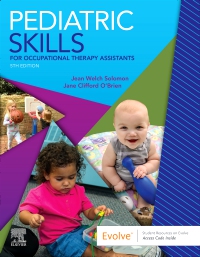
Pediatric Skills for Occupational Therapy Assistants Elsevier eBook on VitalSource, 5th Edition
by Jean W. Solomon, MHS, OTR/L, FAOTA
Elsevier eBook on VitalSource
ISBN:
9780323610278
Copyright:
2021
Publication Date:
10-09-2020
Page Count:
680
Imprint:
Mosby
List Price:
$92.99
Was
$92.99
Now $83.69
Or $0.00 with a valid access code
Learn to provide effective therapy for children and adolescents! Pediatric Skills for Occupational Therapy Assistants, 5th Edition covers the entire scope of pediatric OT practice, from normal childhood development to pediatric disorders and treatment planning. Case studies and helpful tips reinforce your understanding and make it easier to apply OT principles to the clinical setting. This edition is thoroughly updated with online videos and new coverage of community systems, physical agent modalities, childhood obesity, Model of Human Occupation assessments, and Kinesio Taping®. Written by noted OTA educators Jean Solomon and Jane O'Brien, this resource is both a comprehensive textbook and a practical clinical reference!
-
- NEW! Every Moment Counts content is added to The Occupational Therapy Process chapter, promoting pediatric mental health
- NEW! Coverage of educational expectations is added to the Educational System chapter
- NEW! Coverage of "signature" constraint-induced movement therapy (CIMT) is added to Cerebral Palsy chapter
- NEW photographs and illustrations are added throughout the book
- NEW video clips on the Evolve companion website show the typical development of children/adolescents
- NEW! Extensive assessment and abbreviations appendices are added to Evolve
- NEW! Expanded glossary is added to Evolve
-
- Hundreds of case examples provide snapshots of real-life situations and solutions, helping you apply key concepts in a real-life setting
- UNIQUE! Clinical Pearls boxes highlight practical advice from the authors and contributors, sharing what they have learned from years of experience
- Coverage of evidence-based practice includes clinical trials and outcome studies, especially those relating to evaluation and intervention
- Coverage of cultural diversity and sensitivity issues addresses the many different groups of people that OTAs treat in practice
- Information on preventive care takes the role of the OTA beyond intervention and treatment
- Family-centered perspective uses the terminology of the AOTA Practice Framework in showing how to tailor your treatment to meet the needs of children from different environments
- Key terms, outlines, and objectives at the beginning of each chapter prepare readers for the information they're expected to learn from the chapter
- Content reviews and questions at the end of each chapter summarize key concepts and help you assess your understanding
- Suggested activities in each chapter help readers to bridge the gap between the classroom and the clinic by exploring realistic situations
- UNIQUE! Learning resources on the Evolve companion website include video clips and review questions, reinforcing your understanding and demonstrating how concepts apply to actual practice
-
1. Scope of Practice
2. Family Systems
3. Medical System
4. Educational System
5. Community Practice
6. Principles of Normal Development
7. Development of Performance Skills
8. Development of Occupations
9. Adolescent Development: Becoming an Adolescent, Becoming an Adult
10. The Occupational Therapy Process
11. Anatomy and Physiology for the Pediatric Practitioner
12. Neuroanatomy for the Pediatric Practitioner
13. Pediatric Health Conditions
14. Childhood and Adolescent Psychosocial and Mental Health Disorders
15. Childhood and Adolescent Obesity
16. Intellectual Disabilities
17. Cerebral Palsy
18. Positioning and Handling: An Neurodevelopmental Approach
19. Activities of Daily Living (ADLs) and Sleep/Rest
20. Instrumental Activities of Daily Living
21. Play and Playfulness
22. Functional Task at School: Handwriting
23. Therapeutic Media: Activity with Purpose
24. Motor Control and Motor Learning
25. Sensory Processing/Integration and Occupation
26. Applying the Model of Human Occupation to Pediatric Practice
27. Assistive Technology
28. Orthoses, Orthosis Fabrication, and Elastic Therapeutic Taping for the Pediatric Population
29. Animal-Assisted Therapy
30. Glossary
31. Index -
-
Ways of Reading
- The appearance of the text and page layout can be modified according to the capabilities of the reading system (font family and font size, spaces between paragraphs, sentences, words, and letters, as well as color of background and text)
- This e-publication is accessible to the full extent that the file format and types of content allow, on a specific reading device, by default, without necessarily including any additions such as textual descriptions of images or enhanced navigation
- No information about nonvisual reading is available
-
Conformance
- No information is available
-
Navigation
- Table of contents to all chapters of the text via links
- Page list to go to pages from the print source version
-
Rich Content
- No information is available
-
Hazards
- No information is available
-
Product Content
- No information is available
-
Legal Considerations
- No information is available
-
Additional Accessibility Information
- Page breaks included from the original print source
- For readers with color vision deficiency, use of color (e.g., in diagrams, graphics and charts, in prompts, or on buttons inviting a response) is not the sole means of graphical distinction or of conveying information
- E-publication includes basic navigation (usually less detailed than TOC-based navigation)
- Where links, controls or buttons are included in the content, the purpose or functionality of each link, control or button is apparent from the associated text alone - or where it is unclear, separate link, control or button descriptions are provided
- All (or substantially all) textual matter is arranged in a single logical reading order (including text that is visually presented as separate from the main text flow, e.g., in boxouts, captions, tables, footnotes, endnotes, citations, etc.). Non-textual content is also linked from within this logical reading order. (Purely decorative non-text content can be ignored).
- The language of the text has been specified (e.g., via the HTML or XML lang attribute) to optimise text-to-speech (and other alternative renderings), both at the whole document level and, where appropriate, for individual words, phrases or passages in a different language.
-
Ways of Reading

Was
$92.99
Now $83.69
Or $0.00 with a valid access code

 as described in our