ISBN:
9780323611589
Copyright:
2020
Publication Date:
03-01-2019
Page Count:
544
Imprint:
Saunders
List Price:
$71.99

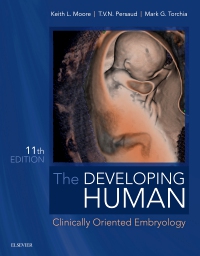
The Developing Human - Elsevier eBook on VitalSource, 11th Edition
by Keith L. Moore, BA, MSc, PhD, DSc, FIAC, FRSM, FAAA, T. V. N. Persaud, MD, PhD, DSc, FRCPath (Lond.), FAAA and Mark G. Torchia, MSc, PhD
Elsevier eBook on VitalSource
ISBN:
9780323611589
Copyright:
2020
Publication Date:
03-01-2019
Page Count:
544
Imprint:
Saunders
List Price:
$71.99
Was
$71.99
Now $64.79
Or $0.00 with a valid access code
Extensively revised to incorporate recent research and current clinical practice, The Developing Human: Clinically Oriented Embryology, 11th Edition, covers all aspects of normal and abnormal embryonic and fetal development. In a clear, concise manner and lavishly illustrated throughout, this textbook is designed to successfully meet the needs of medical and health sciences profession students, as well as those in graduate programs. It provides an easy-to-digest, comprehensive review of what can be a complex and challenging subject. BONUS online features such as multiple-choice questions and narrated animations further support student success.
New Edition Expected Availability: 11-04-2024

The Developing Human - Elsevier E-Book on VitalSource
Elsevier eBook on VitalSource
ISBN: 9780443546303
-
- Guides readers month by month and stage by stage through embryo and fetal organ and systems development, using full-color photographs of clinical cases, relevant modern medical imaging, and numerous high-quality supportive figures
- Includes many new 3D HD color rendered images of embryos and fetuses, as well as 3D reconstructions of whole embryos
- Provides clinically-oriented problems for each chapter, with corresponding answers and explanations designed to facilitate discussion and learning. In addition, multiple-choice questions and answers are available online for supportive self-assessment
- Features 18 exceptional color animations, now with narration, to help students as they explore and learn the complexity of embryological development
- Provides the knowledge base needed for today’s examinations, including USMLE Step 1, as well as for future clinical practice
- Thoroughly updated information includes new annotations on fundamental molecular events during embryogenesis, now required for many professional examinations
- Includes enhanced clinical material in all chapters, with updated tables, Clinical Case highlights and a critical chapter on common signalling pathways during development that covers gene editing (CRISPR/Cas9), induced pluripotent stem cells (iPS), a revision of the sonic hedgehog signalling pathway; and more
- Details how molecular biology has affected clinical practice, including techniques such as recumbent DNA technology and stem cell manipulation
- Includes an Enhanced eBook version with purchase. Your enhanced eBook allows you to access all of the text, figures, and references from the book on a variety of devices
-
1. Introduction to Human Development
2. First Week of Human Development
3. Second Week of Human Development
4. Third Week of Human Development
5. Fourth to Eighth Weeks of Human Development
6. Fetal Period: Ninth Week to Birth
7. Placenta and Fetal Membranes
8. Body Cavities, Mesenteries, and Diaphragm
9. Pharyngeal Apparatus, Face, and Neck
10. Respiratory System
11. Alimentary System
12. Urogenital System
13. Cardiovascular System
14. Skeletal System
15. Muscular System
16. Development of Limbs
17. Nervous System
18. Development of Eyes and Ears
19. Integumentary System
20. Human Birth Defects
21. Common Signaling Pathways Used During Development -
-
Ways of Reading
- The appearance of the text and page layout can be modified according to the capabilities of the reading system (font family and font size, spaces between paragraphs, sentences, words, and letters, as well as color of background and text)
- This e-publication is accessible to the full extent that the file format and types of content allow, on a specific reading device, by default, without necessarily including any additions such as textual descriptions of images or enhanced navigation
- No information about nonvisual reading is available
-
Conformance
- No information is available
-
Navigation
- Table of contents to all chapters of the text via links
- Page list to go to pages from the print source version
-
Rich Content
- No information is available
-
Hazards
- No information is available
-
Product Content
- No information is available
-
Legal Considerations
- No information is available
-
Additional Accessibility Information
- Page breaks included from the original print source
- For readers with color vision deficiency, use of color (e.g., in diagrams, graphics and charts, in prompts, or on buttons inviting a response) is not the sole means of graphical distinction or of conveying information
- E-publication includes basic navigation (usually less detailed than TOC-based navigation)
- Where links, controls or buttons are included in the content, the purpose or functionality of each link, control or button is apparent from the associated text alone - or where it is unclear, separate link, control or button descriptions are provided
- All (or substantially all) textual matter is arranged in a single logical reading order (including text that is visually presented as separate from the main text flow, e.g., in boxouts, captions, tables, footnotes, endnotes, citations, etc.). Non-textual content is also linked from within this logical reading order. (Purely decorative non-text content can be ignored).
- The language of the text has been specified (e.g., via the HTML or XML lang attribute) to optimise text-to-speech (and other alternative renderings), both at the whole document level and, where appropriate, for individual words, phrases or passages in a different language.
-
Ways of Reading
Was
$71.99
Now $64.79
Or $0.00 with a valid access code

 as described in our