ISBN:
9780323612821
Copyright:
2020
Publication Date:
03-07-2019
Page Count:
462
Imprint:
Elsevier
List Price:
$62.99

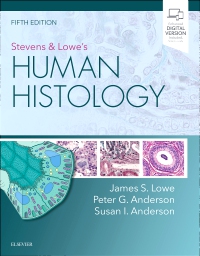
Stevens & Lowe's Human Histology - Elsevier eBook on VitalSource, 5th Edition
by James S. Lowe, BMedSci, BMBS, DM, FRCPath, Peter G. Anderson, DVM, PhD and Susan I. Anderson, BSc, M Med Sc, PhD
Elsevier eBook on VitalSource
ISBN:
9780323612821
Copyright:
2020
Publication Date:
03-07-2019
Page Count:
462
Imprint:
Elsevier
List Price:
$62.99
Most review copies are eBooks – how fast!
A review copy request is most likely to be fulfilled as an eBook on VitalSource rather than a print product, unless no eBook is available. eBooks become available in as little as a few hours. Print products will take between 7 and 10 days to arrive. To request a print copy, please contact us through the Evolve Support Center for further assistance or contact your Elsevier Sales Rep.
Easy to read, well organized, and focused on high-yield content, Stevens & Lowe's Human Histology, Fifth Edition, features concise, up-to-date coverage of the core knowledge in this complex field. Ideal for students in all areas of health care, this revised edition is aligned with recent developments in integrated and problem-based learning, providing rapid access to relevant, practical knowledge in histology. It provides students with opportunities to make important connections between histological knowledge, cell biology, anatomy, clinical understanding, and assessment.
-
- Features an easy-to-navigate, full-colour layout that includes summary headings, readable text, quick-reference tables, and key facts – all highlighted by nearly 900 clear illustrations, photos, and graphics throughout
- Covers the latest concepts and advances in histology including developments in the primary cilium, the nuclear pore, extracellular matrix components, dendritic spines, subsets of astrocytes, haematopoiesis, classification of cells in the immune system, macrophage subsets, and much more
- Includes NEW self-assessment questions
- Provides just the right amount of detail for maximum readability and retention
- Highlights key laboratory, clinical, and high-level scientific material in boxes
- Presents advanced concepts such as the molecular and functional relevance of histological features
- Provides review material in the book and online, self-assessment questions plus 180 additional review questions online
- Enhanced eBook version included with purchase. Your enhanced eBook allows you to access all of the text, figures, and references - including bonus videos showing important histological features for each chapter -from the book on a variety of devices
-
Preface
Acknowledgements
Dedication
1. Histology
2. The Cell
3. Epithelial Cells
4. Support Cells and the Extracellular Matrix
5. Contractile Cells
6. Nervous Tissue
7. Blood Cells
8. Immune System
9. Blood and Lymphatic Circulatory Systems and Heart
10. Respiratory System
11. Alimentary Tract
12. Liver
13. Musculoskeletal System
14. Endocrine System
15. Urinary System
16. Male Reproductive System
17. Female Reproductive System
18. Skin and Breast
19. Special Senses
Self-Assessment Questions -
-
Ways of Reading
- The appearance of the text and page layout can be modified according to the capabilities of the reading system (font family and font size, spaces between paragraphs, sentences, words, and letters, as well as color of background and text)
- This e-publication is accessible to the full extent that the file format and types of content allow, on a specific reading device, by default, without necessarily including any additions such as textual descriptions of images or enhanced navigation
- No information about nonvisual reading is available
-
Conformance
- No information is available
-
Navigation
- Table of contents to all chapters of the text via links
- Page list to go to pages from the print source version
-
Rich Content
- No information is available
-
Hazards
- No information is available
-
Product Content
- No information is available
-
Legal Considerations
- No information is available
-
Additional Accessibility Information
- Page breaks included from the original print source
- For readers with color vision deficiency, use of color (e.g., in diagrams, graphics and charts, in prompts, or on buttons inviting a response) is not the sole means of graphical distinction or of conveying information
- E-publication includes basic navigation (usually less detailed than TOC-based navigation)
- Where links, controls or buttons are included in the content, the purpose or functionality of each link, control or button is apparent from the associated text alone - or where it is unclear, separate link, control or button descriptions are provided
- All (or substantially all) textual matter is arranged in a single logical reading order (including text that is visually presented as separate from the main text flow, e.g., in boxouts, captions, tables, footnotes, endnotes, citations, etc.). Non-textual content is also linked from within this logical reading order. (Purely decorative non-text content can be ignored).
- The language of the text has been specified (e.g., via the HTML or XML lang attribute) to optimise text-to-speech (and other alternative renderings), both at the whole document level and, where appropriate, for individual words, phrases or passages in a different language.
-
Ways of Reading

Most review copies are eBooks – how fast!
A review copy request is most likely to be fulfilled as an eBook on VitalSource rather than a print product, unless no eBook is available. eBooks become available in as little as a few hours. Print products will take between 7 and 10 days to arrive. To request a print copy, please contact us through the Evolve Support Center for further assistance or contact your Elsevier Sales Rep.

 as described in our