ISBN:
9780323613422
Copyright:
2021
Publication Date:
04-06-2020
Page Count:
1320
Imprint:
Saunders
List Price:
$160.99

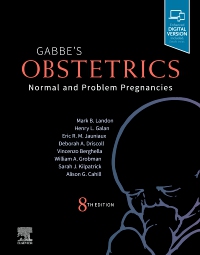
Obstetrics: Normal and Problem Pregnancies Elsevier eBook on VitalSource, 8th Edition
by Mark B. Landon, MD, Henry L. Galan, MD, Eric R.M. Jauniaux, MD, PhD, FRCOG, Deborah A. Driscoll, MD, Vincenzo Berghella, MD, William A. Grobman, MD, MBA, Sarah J. Kilpatrick, MD, PhD and Alison G. Cahill, MD, MSCI
Elsevier eBook on VitalSource
ISBN:
9780323613422
Copyright:
2021
Publication Date:
04-06-2020
Page Count:
1320
Imprint:
Saunders
List Price:
$160.99
Was
$160.99
Now $144.89
Or $0.00 with a valid access code
**Selected for Doody’s Core Titles® 2024 with "Essential Purchase" designation in Obstetrics & Gynecology**
Highly readable, well-illustrated, and easy to understand, Gabbe’s Obstetrics: Normal and Problem Pregnancies is an ideal day-to-day reference or study tool for residents and clinicians. This 8th Edition of this bestselling text offers fast access to evidence-based, comprehensive information, now fully revised with substantial content updates, new and improved illustrations, and a new, international editorial team that continues the tradition of excellence established by Dr. Steven Gabbe.
Highly readable, well-illustrated, and easy to understand, Gabbe’s Obstetrics: Normal and Problem Pregnancies is an ideal day-to-day reference or study tool for residents and clinicians. This 8th Edition of this bestselling text offers fast access to evidence-based, comprehensive information, now fully revised with substantial content updates, new and improved illustrations, and a new, international editorial team that continues the tradition of excellence established by Dr. Steven Gabbe.
-
- Puts the latest knowledge in this complex specialty at your fingertips, allowing you to quickly access the information you need to treat patients, participate knowledgably on rounds, and perform well on exams
- Contains at-a-glance features such as key points boxes, bolded text, chapter summaries and conclusions, key abbreviations boxes, and quick-reference tables, management and treatment algorithms, and bulleted lists throughout
- Features detailed illustrations from cover to cover—many new and improved—including more than 100 ultrasound images that provide an important resource for normal and abnormal fetal anatomy
- Covers key topics such as prevention of maternal mortality, diabetes in pregnancy, obesity in pregnancy, vaginal birth after cesarean section, and antepartum fetal evaluation
- Provides access to 11 videos that enhance learning in areas such as cesarean delivery and operative vaginal delivery
- Enhanced eBook version included with purchase. Your enhanced eBook allows you to access all of the text, figures, and references from the book on a variety of devices
-
Section I, Physiology
1. Placental Anatomy and Physiology
2. Fetal Development, Physiology and Effects on Long-term Health
3. Maternal Physiology
4. Maternal-Fetal Immunology
Section II, Prenatal Care
5. Preconception and Prenatal Care
6. Nutrition During Pregnancy
7. Drugs and Environmental Agents in Pregnancy and Lactation : Teratology, Epidemiology and Patient Management
8. Opioids and Substance Abuse
9. Obstetrical Ultrasound: Imaging, Dating, Growth and Anomaly
10. Genetic Screening and Prenatal Genetic Diagnosis
Section III, Intrapartum Care
11. Normal and Abnormal Labor and Delivery
12. Induction of Labor
13. Operative Vaginal Delivery
14. Shoulder Dystocia
15. Intrapartum Fetal Evaluation
16. Obstetric Anesthesia
17. Malpresentations
18. Antepartum and Postpartum Hemorrhage
19. Cesarean Delivery
20. Vaginal Birth After Cesarean Delivery (VBAC)
21. Placenta Accreta
22. Patient Safety and Quality Measurement in Obstetrical Care
Section IV, Postpartum Care
23. The Neonate
24. Postpartum Care and Long-Term Health Considerations
25. Lactation and Breastfeeding
26. Pregnancy as a Window to Maternal and Child Health
Section V, Complicated Pregnancy
27. Antepartum Fetal Evaluation
28. Amniotic Fluid Disorders
29. Late and Postterm Pregnancy
30. Fetal Growth Restriction
31. Surgery During Pregnancy
32. Trauma and Related Surgery in Pregnancy
33. Pregnancy Loss
34. Stillbirth
35. Cervical Insufficiency
36. Preterm Labor and Birth
37. Premature Rupture of the Membranes
38. Preeclampsia and Hypertensive Disorders
39. Multiple Gestations
40. Red Cell Alloimmunization
41. Maternal mortality: a global perspective
Section VI, Pregnancy and Coexisting Disease
42. Heart Disease in Pregnancy
43. Respiratory Disease in Pregnancy
44. Renal Disease in Pregnancy
45. Diabetes Mellitus Complicating Pregnancy
46. Obesity in Pregnancy
47. Thyroid and Parathyroid Diseases in Pregnancy
48. Pituitary and Adrenal Disorders in Pregnancy
49. Hematologic Complications of Pregnancy
50. Thromboembolic Disorders in Pregnancy
51. Collagen Vascular Diseases in Pregnancy
52. Hepatic Disorders during Pregnancy
53. Gastrointestinal Disorders during Pregnancy
54. Neurologic Disorders in Pregnancy
55. Malignant Diseases and Pregnancy
56. Skin Disease and Pregnancy
57. Maternal and Perinatal Infection in Pregnancy - Viral
58. Maternal and Perinatal Infection: Bacterial, Chlamydia, Syphillis in Pregnancy
59. Mental Health and Behavioral Disorders in Pregnancy Appendices
60. Appendix 1: Normal Values in Pregnancy: Ultrasound Measurements
61. Appendix 2: Anatomy of the Pelvis
62. Appendix 3: Glossary of Key Abbreviations -
-
Ways of Reading
- The appearance of the text and page layout can be modified according to the capabilities of the reading system (font family and font size, spaces between paragraphs, sentences, words, and letters, as well as color of background and text)
- This e-publication is accessible to the full extent that the file format and types of content allow, on a specific reading device, by default, without necessarily including any additions such as textual descriptions of images or enhanced navigation
- No information about nonvisual reading is available
-
Conformance
- No information is available
-
Navigation
- Table of contents to all chapters of the text via links
- Page list to go to pages from the print source version
-
Rich Content
- No information is available
-
Hazards
- No information is available
-
Product Content
- No information is available
-
Legal Considerations
- No information is available
-
Additional Accessibility Information
- Page breaks included from the original print source
- For readers with color vision deficiency, use of color (e.g., in diagrams, graphics and charts, in prompts, or on buttons inviting a response) is not the sole means of graphical distinction or of conveying information
- E-publication includes basic navigation (usually less detailed than TOC-based navigation)
- Where links, controls or buttons are included in the content, the purpose or functionality of each link, control or button is apparent from the associated text alone - or where it is unclear, separate link, control or button descriptions are provided
- All (or substantially all) textual matter is arranged in a single logical reading order (including text that is visually presented as separate from the main text flow, e.g., in boxouts, captions, tables, footnotes, endnotes, citations, etc.). Non-textual content is also linked from within this logical reading order. (Purely decorative non-text content can be ignored).
- The language of the text has been specified (e.g., via the HTML or XML lang attribute) to optimise text-to-speech (and other alternative renderings), both at the whole document level and, where appropriate, for individual words, phrases or passages in a different language.
-
Ways of Reading
Was
$160.99
Now $144.89
Or $0.00 with a valid access code

 as described in our