ISBN:
9780323639118
Copyright:
2020
Publication Date:
04-12-2019
Page Count:
336
Imprint:
Elsevier
List Price:
$70.99

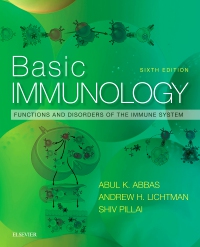
Basic Immunology - Elsevier eBook on VitalSource, 6th Edition
by Abul K. Abbas, MBBS, Andrew H. Lichtman, MD, PhD and Shiv Pillai, MD, PhD
Elsevier eBook on VitalSource
ISBN:
9780323639118
Copyright:
2020
Publication Date:
04-12-2019
Page Count:
336
Imprint:
Elsevier
List Price:
$70.99
Was
$70.99
Now $49.69
Or $0.00 with a valid access code
Meticulously reviewed and updated for today’s medical students, Basic Immunology, 6th Edition, is a concise text expertly written by the same distinguished author team as the best-selling, comprehensive text, Cellular and Molecular Immunology. This focused, easy-to-understand volume uses full-color illustrations and clinical images, useful tables, and practical features such as Summary Point boxes, end-of-chapter review questions, glossary terms, and clinical cases—all designed to help students master this complex topic in the most efficient, effective manner possible.
-
- Emphasizes clinical aspects of immunology, including disease pathogenesis, the development of novel therapies based on basic science, and an appendix of clinical cases for real-world application
- Provides top-notch instruction from experienced teachers, course directors, and lecturers led by well-known editor and author Dr. Abul Abbas
- Features a highly readable writing style and practical organization, now with fully revised content and updated images to reflect recent important advances in today’s understanding of the immune system
- Provides additional online features such as answers to in-book chapter review questions, helpful animations, and up to 10 self-assessment questions per chapter
- Presents information in a format and style that maximizes usefulness to students and teachers studying medicine, allied health fields, and biology
- Contains numerous features designed to help students understand key immunologic concepts: high-quality illustrations, practical tables, chapter outlines, bolded key points, and focus questions in every chapter for self-assessment and review
- Includes an Enhanced eBook version with purchase. Your enhanced eBook allows you to access all of the text, figures, and references from the book on a variety of devices
-
1. Introduction to the Immune System
Nomenclature, General Properties, and Components
2. Innate Immunity
The Early Defense Against Infections
3. Antigen Capture and Presentation to Lymphocytes
What Lymphocytes See
4. Antigen Recognition in the Adaptive Immune System
Structure of Lymphocyte Antigen Receptors and Development of Immune Repertoires
5. T Cell–Mediated Immunity
Activation of T Lymphocytes
6. Effector Mechanisms of T Cell–Mediated Immunity
Functions of T Cells in Host Defense
7. Humoral Immune Responses
Activation of B Lymphocytes and Production of Antibodies
8. Effector Mechanisms of Humoral Immunity
Elimination of Extracellular Microbes and Toxins
9. Immunological Tolerance and Autoimmunity
Self-Nonself Discrimination in the Immune System and Its Failure
10. Immune Responses Against Tumors and Transplants
Immunity to Noninfectious Transformed and Foreign Cells
11. Hypersensitivity
Disorders Caused by Immune Responses
12. Congenital and Acquired Immunodeficiencies
Diseases Caused by Defective Immunity
Selected Readings
Appendix
I. Glossary
II. Cytokines
III. Principal Features of Selected CD Molecules
IV. Clinical Cases -
-
Ways of Reading
- The appearance of the text and page layout can be modified according to the capabilities of the reading system (font family and font size, spaces between paragraphs, sentences, words, and letters, as well as color of background and text)
- This e-publication is accessible to the full extent that the file format and types of content allow, on a specific reading device, by default, without necessarily including any additions such as textual descriptions of images or enhanced navigation
- No information about nonvisual reading is available
-
Conformance
- No information is available
-
Navigation
- Table of contents to all chapters of the text via links
- Page list to go to pages from the print source version
-
Rich Content
- No information is available
-
Hazards
- No information is available
-
Product Content
- No information is available
-
Legal Considerations
- No information is available
-
Additional Accessibility Information
- Page breaks included from the original print source
- For readers with color vision deficiency, use of color (e.g., in diagrams, graphics and charts, in prompts, or on buttons inviting a response) is not the sole means of graphical distinction or of conveying information
- E-publication includes basic navigation (usually less detailed than TOC-based navigation)
- Where links, controls or buttons are included in the content, the purpose or functionality of each link, control or button is apparent from the associated text alone - or where it is unclear, separate link, control or button descriptions are provided
- All (or substantially all) textual matter is arranged in a single logical reading order (including text that is visually presented as separate from the main text flow, e.g., in boxouts, captions, tables, footnotes, endnotes, citations, etc.). Non-textual content is also linked from within this logical reading order. (Purely decorative non-text content can be ignored).
- The language of the text has been specified (e.g., via the HTML or XML lang attribute) to optimise text-to-speech (and other alternative renderings), both at the whole document level and, where appropriate, for individual words, phrases or passages in a different language.
-
Ways of Reading
Was
$70.99
Now $49.69
Or $0.00 with a valid access code

 as described in our