ISBN:
9780323640275
Copyright:
2021
Publication Date:
06-24-2020
Page Count:
352
Imprint:
Elsevier
List Price:
$62.99

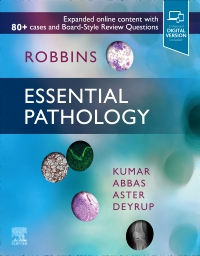
Robbins Essential Pathology Elsevier eBook on VitalSource, 1st Edition
by Vinay Kumar, MBBS, MD, FRCPath, Abul K. Abbas, MBBS, Jon C. Aster, MD, PhD and Andrea T Deyrup, M.D., Ph.D.
Elsevier eBook on VitalSource
ISBN:
9780323640275
Copyright:
2021
Publication Date:
06-24-2020
Page Count:
352
Imprint:
Elsevier
List Price:
$62.99
Was
$62.99
Now $56.69
Or $0.00 with a valid access code
The newest addition to the highly regarded Robbins family of pathology references, Robbins Essential Pathology is a concise resource that covers the core knowledge needed for coursework and exams in an integrated, multimedia format designed for today’s students. Ideal for use with an integrated medical curriculum, this easy-to-study multimedia package provides reliable Robbins content in a concentrated, highly efficient format, now fully integrated with interactive digital resources (cases, MCQs, images). Efficient, effective, and up to date, this new Robbins learning resource delivers the essential information you need to obtain a strong scientific foundation in pathology.
New Edition Expected Availability: 01-15-2027

Robbins and Kumar Essential Pathology - Elsevier E-Book on VitalSource
Elsevier eBook on VitalSource
ISBN: 9780443285820
-
- The most concise Robbins text available, providing high-quality content and a case-based approach in a focused, multimedia learning package for coursework and exam preparation
- Focuses on the core knowledge of disease mechanisms and essential clinical aspects that medical students need to know
- Features more than 500 images and tables that illustrate key disorders and concepts.
- Includes Student Consult access which features the full contents of the book, plus exclusive integrated digital learning tools:
- Interactive cases and images that reinforce clinical application of core concepts
- Therapy boxes that describe new advances in medical therapeutics and support your transition to practice
- Self-assessment questions to help you evaluate your progress, with links to the Essentials text
- Searchable glossary of terms
-
-

-
 Robbins Essential PathologyPaperback
-
-
1. Cell Injury and Cell Death
2. Inflammation and Repair
3. Hemodynamic Disorders, Thromboembolism, and Shock
4. Diseases of the Immune System
5. Neoplasia
6. Genetic Disorders
7. Disease of Blood Vessels
8. Heart
9. Hematopoietic and Lymphoid Systems
10. Lung and Upper Respiratory Tract
11. Kidney
12. Gastrointestinal System
13. Liver, Biliary System, and Pancreas
14. Male Genital Tract, Prostate, and Bladder
15. Female Genital Tract and Breast
16. Endocrine System
17. Disorders of the Nervous system
18. Musculoskeletal System and Skin
19. Environmental Disease -
-
Ways of Reading
- The appearance of the text and page layout can be modified according to the capabilities of the reading system (font family and font size, spaces between paragraphs, sentences, words, and letters, as well as color of background and text)
- This e-publication is accessible to the full extent that the file format and types of content allow, on a specific reading device, by default, without necessarily including any additions such as textual descriptions of images or enhanced navigation
- No information about nonvisual reading is available
-
Conformance
- No information is available
-
Navigation
- Table of contents to all chapters of the text via links
- Page list to go to pages from the print source version
-
Rich Content
- No information is available
-
Hazards
- No information is available
-
Product Content
- No information is available
-
Legal Considerations
- No information is available
-
Additional Accessibility Information
- Page breaks included from the original print source
- For readers with color vision deficiency, use of color (e.g., in diagrams, graphics and charts, in prompts, or on buttons inviting a response) is not the sole means of graphical distinction or of conveying information
- E-publication includes basic navigation (usually less detailed than TOC-based navigation)
- Where links, controls or buttons are included in the content, the purpose or functionality of each link, control or button is apparent from the associated text alone - or where it is unclear, separate link, control or button descriptions are provided
- All (or substantially all) textual matter is arranged in a single logical reading order (including text that is visually presented as separate from the main text flow, e.g., in boxouts, captions, tables, footnotes, endnotes, citations, etc.). Non-textual content is also linked from within this logical reading order. (Purely decorative non-text content can be ignored).
- The language of the text has been specified (e.g., via the HTML or XML lang attribute) to optimise text-to-speech (and other alternative renderings), both at the whole document level and, where appropriate, for individual words, phrases or passages in a different language.
-
Ways of Reading
Was
$62.99
Now $56.69
Or $0.00 with a valid access code

 as described in our