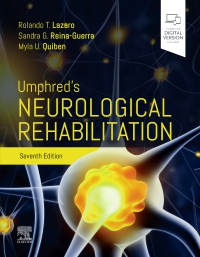

Umphred's Neurological Rehabilitation - Elsevier eBook on VitalSource, 7th Edition
Elsevier eBook on VitalSource
Now $131.09
**Selected for Doody’s Core Titles® 2024 in Physical Medicine and Rehabilitation**
Develop problem-solving strategies for individualized, effective neurologic care! Under the new leadership of Rolando Lazaro, Umphred’s Neurological Rehabilitation, 7th Edition, covers the therapeutic management of people with activity limitations, participation restrictions, and quality of life issues following a neurological event. This comprehensive reference reviews basic theory and addresses the best evidence for evaluation tools and interventions commonly used in today's clinical practice. It applies a time-tested, evidence-based approach to neurological rehabilitation that is perfect for both the classroom and the clinic. Now fully searchable with additional case studies through Student Consult, this edition includes updated chapters and the latest advances in neuroscience.
-
- NEW! enhanced eBook on Student Consult
- UPDATED! Color photos and line drawings clearly demonstrate important concepts and clinical conditions students will encounter in practice
- NEW and EXPANDED! Additional case studies and videos illustrate how concepts apply to practice
- Updated chapters incorporate the latest advances and the newest information in neurological rehabilitation strategies
- NEW and UNIQUE! New chapter on concussion has been added
- Separate and expanded chapters on two important topics: Balance and Vestibular
-
- Comprehensive reference offers a thorough understanding of all aspects of neurological rehabilitation
- Expert authorship and editors lend their experience and guidance for on-the-job success
- UNIQUE! A section on neurological problems accompanying specific system problems includes hot topics such as poor vision, vestibular dysfunction, dementia and problems with cognition, and aging with a disability
- A problem-solving approach helps you apply your knowledge to examinations, evaluations, prognoses, and intervention strategies
- Evidence-based research sets up best practices, covering topics such as the theory of neurologic rehabilitation, screening and diagnostic tests, treatments and interventions, and the patient's psychosocial concerns
- Case studies use real-world examples to promote problem-solving skills
- Comprehensive coverage of neurological rehabilitation across the lifespan — from pediatrics to geriatrics
- Terminology adheres to the best practices, follows The Guide to Physical Therapy Practice and the WHO-ICF World Health model
-
Section 1: Foundations for Clinical Practice in Neurological Rehabilitation
1. Foundations for Clinical Practice in Neurologic Rehabilitation
2. Movement Analysis Across the Life Span
3. Motor Control, Motor Learning, and Neuroplasticity
4. The Limbic System: Influence over Motor Control and Learning
5. Psychosocial Aspects of Adaptation and Adjustment during Various Phases of Neurological Disability
6. Medical Screening by the Therapist
7. Examination and Evaluation of Functional Movement Activities, Body Functions and Structures, and Participation
8. Interventions for Clients with Movement Limitations
Section 2: Physical Rehabilitation Management of Clients with Neurologic System Pathology
9. Neonates and Parents: Neurodevelopmental Perspectives in the Neonatal Intensive Care Unit and Follow-Up
10. Management of Clinical Problems of Children with Cerebral Palsy
11. Genetic Disorders: A Pediatric Perspective
12. Learning Disabilities and Developmental Coordination Disorder
13. Spina Bifida: A Congenital Spinal Cord Injury
14. Traumatic Spinal Cord Injury
15. Neuromuscular Diseases
16. Beyond the Central Nervous System: Neurovascular Entrapment Syndromes
17. Multiple Sclerosis
18. Disorders of the Basal Nuclei
19. Movement Dysfunction Associated with Cerebellar Damage
20. Balance Dysfunction
21. Vestibular Dysfunction
22. Traumatic Brain Injury
23. NEW! Special Focus: Concussions
24. Movement Dysfunction Associated with Hemiplegia
25. Brain Tumors
26. Inflammatory and Infectious Disorders of the Brain
27. Aging, Dementia and Disorders of Cognition
Section 3: Neurological Disorders and Application Issues
28. Disorders of Vision and Visual-Perceptual Dysfunction
29. Cardiovascular and Pulmonary System Health in Populations with Nervous System Disorders
30. Pain Management
31. Electrophysiological Testing and Electrical Stimulation in Neurological Rehabilitation
32. Orthotics: Evaluation, Intervention, and Prescription
33. Health and Wellness in Neurologic Populations NEW
34. Human Immunodeficiency Virus Infection: Living with a Chronic Illness
35. Management of Chronic Impairments in Individuals with Nervous System Conditions
36. Pharmacology in Neurologic Rehabilitation
37. Medical Imaging in Neurologic Rehabilitation
38. Integrating Technology in Neurologic Rehabilitation
39. Role of Complementary and Alternative Therapies in Neurologic Diseases and Movement Disorders -
-
Ways of Reading
- The appearance of the text and page layout can be modified according to the capabilities of the reading system (font family and font size, spaces between paragraphs, sentences, words, and letters, as well as color of background and text)
- This e-publication is accessible to the full extent that the file format and types of content allow, on a specific reading device, by default, without necessarily including any additions such as textual descriptions of images or enhanced navigation
- No information about nonvisual reading is available
-
Conformance
- No information is available
-
Navigation
- Table of contents to all chapters of the text via links
- Page list to go to pages from the print source version
-
Rich Content
- No information is available
-
Hazards
- No information is available
-
Product Content
- No information is available
-
Legal Considerations
- No information is available
-
Additional Accessibility Information
- Page breaks included from the original print source
- For readers with color vision deficiency, use of color (e.g., in diagrams, graphics and charts, in prompts, or on buttons inviting a response) is not the sole means of graphical distinction or of conveying information
- E-publication includes basic navigation (usually less detailed than TOC-based navigation)
- Where links, controls or buttons are included in the content, the purpose or functionality of each link, control or button is apparent from the associated text alone - or where it is unclear, separate link, control or button descriptions are provided
- All (or substantially all) textual matter is arranged in a single logical reading order (including text that is visually presented as separate from the main text flow, e.g., in boxouts, captions, tables, footnotes, endnotes, citations, etc.). Non-textual content is also linked from within this logical reading order. (Purely decorative non-text content can be ignored).
- The language of the text has been specified (e.g., via the HTML or XML lang attribute) to optimise text-to-speech (and other alternative renderings), both at the whole document level and, where appropriate, for individual words, phrases or passages in a different language.
-
Ways of Reading


 as described in our