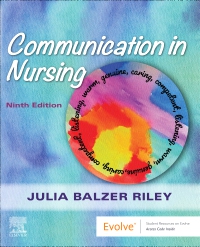

Communication in Nursing - Elsevier eBook on VitalSource, 9th Edition
Elsevier eBook on VitalSource
Now $55.29
Immerse yourself in the ideas, theories, and techniques of effective communication in the workplace! Communication in Nursing, 9th Edition adopts a uniquely practical and personal approach to the demands of today’s nursing practice, providing extensive examples, exercises, and techniques that help you to apply communication skills in a variety of clinical settings. Using a conversational tone, this relatable text takes you beyond theory to show you how to understand important concepts and use communication as a tool to limit stress in your nursing practice. The 9th edition includes a new chapter which focuses on the foundation of communication and personality assessment. It also includes a new Putting it into Practice feature to help you apply your new communication skills in the work environment. In addition, updates on the topics of mindfulness, resilience, and inter-collaborative communication highlight the importance of implementing these tools in practice.
New Edition Expected Availability: 07-27-2023

Communication in Nursing - Elsevier eBook on VitalSource
-
- NEW! Starting with You chapter focuses on personality assessment using the Gallup CliftonStrengths among additional assessment methods
- Two chapters have been combined to create a new one titled, Communicating Assertively and Responsibly with "Difficult" Clients and Colleagues, to help you better address aggressive and difficult clients and colleagues
- UPDATED! Navigating the Expanding World of Digital Communication and Understanding Each Other chapters have been extensively updated to reflect most recent information
- NEW! Chapter exercises incorporate teaching strategies such as cinemeducation and medical improvisation to help facilitate various learning types
- UPDATED! Topics of mindfulness, resilience, and inter-collaborative communication have been incorporated throughout
- NEW! Additional examples incorporated into Moments of Connection boxes highlight beneficial outcomes of successful communication and provide concrete examples of how communication techniques work
-
- Active Learning features in every chapter promotes active, goal-directed reading
- Wit & Wisdom boxes present selected verses and quotations relevant to chapter topics, adding interest and humor. These boxes provide moments of relief from serious topics and "a-ha" moments when theory becomes linked to practice
- End-of-chapter exercises help you to master chapter techniques and strengthen your communication skills
- QSEN preface and exercises stress how communication impacts safety and quality of care
- Discusses the importance of interprofessional education and communication in the healthcare environment
- Addresses the importance of "presence" in nursing — being present for clients, families, colleagues, and self
-
Part 1: Packing Your Bags for the Journey of Caring, Assertive, Responsible Communication
1. Responsible, Assertive, Caring Communication in Nursing
2. The Client–Nurse Relationship: A Helping Relationship
3. Starting with YOU: Understanding Yourself to Build a Foundation for Learning
4. Solving Problems Together
5. Understanding Each Other: Communication and Culture
Part 2: Honoring Your Fellow Travelers along the Journey
6. Demonstrating Warmth
7. Showing Respect
8. Being Genuine
9. Being Empathetic
10. Using Self-Disclosure
11. Being Specific
12. Asking Questions
13. Expressing Opinions
14. Using Humor
15. Embracing the Spiritual Journey of Healthcaring: Meaning Making
Part 3: Developing Road-Worthy Practices along the Journey
16. Requesting Support
17. Overcoming Evaluation Anxiety
18. Working with Feedback
19. Using Relaxation Techniques
20. Incorporating Imagery in Professional Practice and Self Care
21. Incorporating Positive Self-Talk
22. Learning to Work Together in Groups
23. Navigating the Expanding World of Digital Communication
Part 4: Embracing the Transformative Process of the Journey
24. Learning Confrontation Skills
25. Refusing Unreasonable Requests
26. Communicating Assertively and Responsibly with Distressed Clients and Colleagues
27. Communicating Assertively and Responsibly with “Difficult” Clients and Colleagues
28. Managing Team Conflict Assertively and Responsibly
29. Communicating at the End of Life
30. Continuing the Commitment to the Journey -
-
Ways of Reading
- The appearance of the text and page layout can be modified according to the capabilities of the reading system (font family and font size, spaces between paragraphs, sentences, words, and letters, as well as color of background and text)
- This e-publication is accessible to the full extent that the file format and types of content allow, on a specific reading device, by default, without necessarily including any additions such as textual descriptions of images or enhanced navigation
- No information about nonvisual reading is available
-
Conformance
- No information is available
-
Navigation
- Table of contents to all chapters of the text via links
- Page list to go to pages from the print source version
-
Rich Content
- No information is available
-
Hazards
- No information is available
-
Product Content
- No information is available
-
Legal Considerations
- No information is available
-
Additional Accessibility Information
- Page breaks included from the original print source
- For readers with color vision deficiency, use of color (e.g., in diagrams, graphics and charts, in prompts, or on buttons inviting a response) is not the sole means of graphical distinction or of conveying information
- E-publication includes basic navigation (usually less detailed than TOC-based navigation)
- Where links, controls or buttons are included in the content, the purpose or functionality of each link, control or button is apparent from the associated text alone - or where it is unclear, separate link, control or button descriptions are provided
- All (or substantially all) textual matter is arranged in a single logical reading order (including text that is visually presented as separate from the main text flow, e.g., in boxouts, captions, tables, footnotes, endnotes, citations, etc.). Non-textual content is also linked from within this logical reading order. (Purely decorative non-text content can be ignored).
- The language of the text has been specified (e.g., via the HTML or XML lang attribute) to optimise text-to-speech (and other alternative renderings), both at the whole document level and, where appropriate, for individual words, phrases or passages in a different language.
-
Ways of Reading


 as described in our