ISBN:
9780323674393
Copyright:
2020
Publication Date:
06-12-2019
Page Count:
192
Imprint:
Mosby
List Price:
$74.99

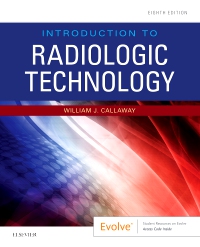
Introduction to Radiologic Technology - Elsevier eBook on VitalSource, 8th Edition
by William J. Callaway, MA, RT(R)
Elsevier eBook on VitalSource
ISBN:
9780323674393
Copyright:
2020
Publication Date:
06-12-2019
Page Count:
192
Imprint:
Mosby
List Price:
$74.99
Most review copies are eBooks – how fast!
A review copy request is most likely to be fulfilled as an eBook on VitalSource rather than a print product, unless no eBook is available. eBooks become available in as little as a few hours. Print products will take between 7 and 10 days to arrive. To request a print copy, please contact us through the Evolve Support Center for further assistance or contact your Elsevier Sales Rep.
Introduce your students to the radiologic technology profession with this solid text! Covering everything a beginning radiography student needs to know, Introduction to Radiologic Technology, 8th Edition lays the groundwork for a successful career. It includes coverage of the coursework required, basic learning skills, a historical perspective on radiology, and insight into key topics such as the language of medicine, digital imaging, patient interactions, and radiation safety. This book also includes a discussion of the radiographer’s role in the practice setting and opportunities for advancement.
New Edition Expected Availability: 06-26-2024

Introduction to Radiologic Technology - Elsevier E-Book on VitalSource
Elsevier eBook on VitalSource
ISBN: 9780443119217
-
- NEW! Updated career advancement opportunities and newest medical terminology include just the right amount detail for new radiographers
- NEW! Incorporation of SI units of measurement accurately depict current practice standards
-
- Thorough introduction to radiologic technology includes a concise overview of what students can expect in their coursework
- Guidelines for a solid radiography career foundation discuss customer service, ethics and professionalism, and professional organizations
- A clear, easy-to-read style does not assume prior knowledge of the subject matter.
- NEW! Incorporation of SI units of measurement accurately depict current practice standards
- NEW! Updated career advancement opportunities and newest medical terminology include just the right amount detail for new radiographers
- Critical thinking skills are highlighted, with four important steps to take in assessing situations and making informed decisions
- Cultural diversity coverage orients students to the challenge of dealing with patients from different cultures in the medical environment
-
Part I: Becoming a Radiologic Technologist
1. Radiography Education: From Classroom to Clinic
2. Becoming an Outstanding Student
3. Evolution of Health Care Delivery
4. Radiology: A Historic Perspective
Part II: Practicing the Profession
5. Orientation to Patient Care
6. Providing Quality Patient Service
7. The Language of Medicine
8. The Technology of Medical Imaging
9. Imaging Examinations: Diagnosing Disease and Injury
10. Radiation Protection
11. Ethics, Professionalism, and Law in Radiologic Technology
12. Organization and Operation of the Radiology Department
13. Health Professions
Part III: Growing with the Profession
14.The American Registry of Radiologic Technologists
15. Professional Associations
16. Clinical Specialization and Professional Advancement -
-
Ways of Reading
- The appearance of the text and page layout can be modified according to the capabilities of the reading system (font family and font size, spaces between paragraphs, sentences, words, and letters, as well as color of background and text)
- This e-publication is accessible to the full extent that the file format and types of content allow, on a specific reading device, by default, without necessarily including any additions such as textual descriptions of images or enhanced navigation
- No information about nonvisual reading is available
-
Conformance
- No information is available
-
Navigation
- Table of contents to all chapters of the text via links
- Page list to go to pages from the print source version
-
Rich Content
- No information is available
-
Hazards
- No information is available
-
Product Content
- No information is available
-
Legal Considerations
- No information is available
-
Additional Accessibility Information
- Page breaks included from the original print source
- For readers with color vision deficiency, use of color (e.g., in diagrams, graphics and charts, in prompts, or on buttons inviting a response) is not the sole means of graphical distinction or of conveying information
- E-publication includes basic navigation (usually less detailed than TOC-based navigation)
- Where links, controls or buttons are included in the content, the purpose or functionality of each link, control or button is apparent from the associated text alone - or where it is unclear, separate link, control or button descriptions are provided
- All (or substantially all) textual matter is arranged in a single logical reading order (including text that is visually presented as separate from the main text flow, e.g., in boxouts, captions, tables, footnotes, endnotes, citations, etc.). Non-textual content is also linked from within this logical reading order. (Purely decorative non-text content can be ignored).
- The language of the text has been specified (e.g., via the HTML or XML lang attribute) to optimise text-to-speech (and other alternative renderings), both at the whole document level and, where appropriate, for individual words, phrases or passages in a different language.
-
Ways of Reading

Most review copies are eBooks – how fast!
A review copy request is most likely to be fulfilled as an eBook on VitalSource rather than a print product, unless no eBook is available. eBooks become available in as little as a few hours. Print products will take between 7 and 10 days to arrive. To request a print copy, please contact us through the Evolve Support Center for further assistance or contact your Elsevier Sales Rep.

 as described in our