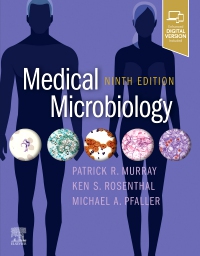

Medical Microbiology Elsevier eBook on VitalSource, 9th Edition
Elsevier eBook on VitalSource
Now $80.99
The foremost text in this complex and fast-changing field, Medical Microbiology, 9th Edition, provides concise, up-to-date, and understandable explanations of key concepts in medical microbiology, immunology, and the microbes that cause human disease. Clear, engaging coverage of basic principles, immunology, laboratory diagnosis, bacteriology, virology, mycology, and parasitology help you master the essentials of microbiology―effectively preparing you for your coursework, exams, and beyond.
New Edition Expected Availability: 07-18-2025

Medical Microbiology - Elsevier E-Book on VitalSource
-
- Features significant new information on the human microbiome and its influence on the immune and other body systems, and new developments in microbial diagnosis, treatment, diseases, and pathogens
- Updates every chapter with state-of-the-art information and current literature citations
- Summarizes detailed information in tabular format rather than in lengthy text
- Provides review questions at the end of each chapter that correlate basic science with clinical practice
- Features clinical cases that illustrate the epidemiology, diagnosis, and treatment of infectious diseases
- Introduces microbe chapters with summaries and trigger words for easy review.
- Highlights the text with clear, colorful figures, clinical photographs, and images that help you visualize the clinical presentation of infections
- Offers additional study features online, including 200 self-assessment questions, microscopic images of the microbes, videos, and a new integrating chapter that provides hyperlinks between the microbes, the organ systems that they affect, and their diseases
- Enhanced eBook version included with purchase. Your enhanced eBook allows you to access all of the text, figures, and references from the book on a variety of devices
-
SECTION 1
Introduction
1 Introduction to Medical Microbiology KEN
2 Human Microbiome in Health and Disease PAT
3 Sterilization, Disinfection, and Antisepsis PAT
SECTION 2
General Principles of Laboratory Diagnosis
4 Microscopy and In Vitro Culture PAT
5 Molecular Diagnosis KEN
6 Serologic Diagnosis KEN
SECTION 3
Basic Concepts in the Immune Response – ALL CHAPTERS KEN
7 Elements of Host Protective Responses
8 Innate Host Responses
9 Antigen-Specific Immune Responses
10 Immune Responses to Infectious Agents
11 Antimicrobial Vaccines
SECTION 4
Bacteriology
12 Bacterial Classification, Structure, and Replication KEN
13 Bacterial Metabolism and Genetics KEN
14 Mechanisms of Bacterial Pathogenesis KEN
15 Role of Bacteria in Disease PAT
16 Laboratory Diagnosis of Bacterial Diseases PAt
17 Antibacterial Agents PAT - 35
18 Staphylococcus and Related Gram-Positive Cocci
19 Streptococcus and Enterococcus
20 Bacillus
21 Listeria and Related Gram-Positive Bacteria
22 Mycobacterium and Related Acid-Fast Bacteria
23 Neisseria and Related Genera
24 Haemophilus and Related Bacteria
25 Enterobacteriaceae
26 Vibrio and Related Bacteria
27 Pseudomonas and Related Bacteria
28 Campylobacter and Helicobacter
29 Miscellaneous Gram-Negative Rods
30 Clostridium
31 Non–Spore-Forming Anaerobic Bacteria
32 Treponema, Borrelia, and Leptospira
33 Mycoplasma and Ureaplasma
34 Rickettsia, Ehrlichia, and Related Bacteria
35 Chlamydia and Chlamydophila
SECTION 5
Virology – ALL KEN
36 Viral Classification, Structure, and Replication
37 Mechanisms of Viral Pathogenesis
38 Role of Viruses in Disease
39 Laboratory Diagnosis of Viral Diseases
40 Antiviral Agents and Infection Control
41 Papillomaviruses and Polyomaviruses
42 Adenoviruses
43 Human Herpesviruses
44 Poxviruses
45 Parvoviruses
46 Picornaviruses
47 Coronaviruses and Noroviruses
48 Paramyxoviruses
49 Orthomyxoviruses
50 Rhabdoviruses, Filoviruses, and Bornaviruses
51 Reoviruses
52 Togaviruses and Flaviviruses
53 Bunyaviridae and Arenaviridae
54 Retroviruses
55 Hepatitis Viruses
56 Prion Diseases
SECTION 6 – ALL MIKE
Mycology
57 Fungal Classification, Structure, and Replication
58 Pathogenesis of Fungal Disease – add section on mycotoxins and mycotoxicoses
59 Role of Fungi in Disease
60 Laboratory Diagnosis of Fungal Disease
61 Antifungal Agents
62 Superficial and Cutaneous Mycoses
63 Subcutaneous Mycoses
64 Systemic Mycoses Caused by Dimorphic Fungi
65 Opportunistic Mycoses
66 Fungal and Fungal-Like Infections of Unusual or Uncertain Etiology
SECTION 7 – ALL MIKE
Parasitology
67 Parasitic Classification, Structure, and Replication
68 Pathogenesis of Parasitic Diseases
69 Role of Parasites in Disease
70 Laboratory Diagnosis of Parasitic Disease
71 Antiparasitic Agents
72 Intestinal and Urogenital Protozoa
73 Blood and Tissue Protozoa
74 Nematodes
75 Trematodes
76 Cestodes
77 Arthropods
-
-
Ways of Reading
- The appearance of the text and page layout can be modified according to the capabilities of the reading system (font family and font size, spaces between paragraphs, sentences, words, and letters, as well as color of background and text)
- This e-publication is accessible to the full extent that the file format and types of content allow, on a specific reading device, by default, without necessarily including any additions such as textual descriptions of images or enhanced navigation
- No information about nonvisual reading is available
-
Conformance
- No information is available
-
Navigation
- Table of contents to all chapters of the text via links
- Page list to go to pages from the print source version
-
Rich Content
- No information is available
-
Hazards
- No information is available
-
Product Content
- No information is available
-
Legal Considerations
- No information is available
-
Additional Accessibility Information
- Page breaks included from the original print source
- For readers with color vision deficiency, use of color (e.g., in diagrams, graphics and charts, in prompts, or on buttons inviting a response) is not the sole means of graphical distinction or of conveying information
- E-publication includes basic navigation (usually less detailed than TOC-based navigation)
- Where links, controls or buttons are included in the content, the purpose or functionality of each link, control or button is apparent from the associated text alone - or where it is unclear, separate link, control or button descriptions are provided
- All (or substantially all) textual matter is arranged in a single logical reading order (including text that is visually presented as separate from the main text flow, e.g., in boxouts, captions, tables, footnotes, endnotes, citations, etc.). Non-textual content is also linked from within this logical reading order. (Purely decorative non-text content can be ignored).
- The language of the text has been specified (e.g., via the HTML or XML lang attribute) to optimise text-to-speech (and other alternative renderings), both at the whole document level and, where appropriate, for individual words, phrases or passages in a different language.
-
Ways of Reading


 as described in our