
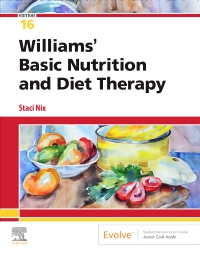

Williams' Basic Nutrition and Diet Therapy - Elsevier eBook on VitalSource, 16th Edition
Elsevier eBook on VitalSource
Now $75.67
Stay up to date on all the latest in nutrition care with Williams' Basic Nutrition & Diet Therapy, 16th Edition. This market-leading text provides concise, need-to-know coverage of hot topics, emerging trends, and cutting-edge research to ensure you are equipped to make informed decisions on patient nutrition in the clinical space. And with its conversational writing style, vivid illustrations, and wide array of reader-friendly features, you can easily understand how the concepts in the book can be applied in clinical practice. The text is broken out into four parts: an introduction to the basic principles of nutrition science, human growth and development needs, community nutrition, and clinical nutrition. Next Generation NCLEX® case studies and question types are also included in the text and on the companion Evolve website.
Newer Edition Available

Williams' Basic Nutrition & Diet Therapy - Elsevier E-Book on VitalSource
-
-
 Book-Organized: Nix Williams' Basics of Nutrition - Sherpath for NutritionSherpath Book-Organized
 -
 Elsevier Adaptive Quizzing for Williams' Basic Nutrition & Diet TherapyElsevier Adaptive Quizzing - Next Generation
 -

-
-
- Case studies with accompanying questions for analysis in the clinical care chapters focus your attention on related patient care problems
- Cultural Considerations boxes discuss how a patient's culture can affect nutritional concepts in practice
- Clinical Applications and For Further Focus boxes highlight timely topics and analyze concepts and trends in depth
- Bulleted chapter summaries review highlights from the chapter and help you see how the chapter contributes to the book's "big picture."
- Diet therapy guidelines include recommendations, restrictions, and sample diets for major clinical conditions
- Drug-Nutrient Interactions boxes highlight important safety information and cover topics such as nutritional supplements for athletics, drugs interfering with vitamin absorption, and over-the-counter weight loss aids
- Key terms and definitions clarify terminology and concepts critical to your understanding and application of the material
-
- NEW! Next Generation NCLEX® case studies and question types are included in the text and on the companion Evolve website
- NEW! Easy-to-follow writing style utilizes a more lively and direct conversation tone to make material easier to understand
- NEW! Updated references reflect the studies and statistics published in the most current scientific literature
- NEW! Incorporation of the new Nutrition Care Process model grounds you in the systematic approach to providing high-quality nutrition care with regard to nutrition assessment, diagnosis, intervention, and evaluation
- NEW! Coverage of the new Physical Activity Guidelines for Americans ensures you are versed in the latest recommendations
-
PART 1: Introduction to Basic Principles of Nutrition Science
1. Food, Nutrition, and Health
2. Carbohydrates
3. Fats
4. Proteins
5. Digestion, Absorption, and Metabolism
6. Energy Balance
7. Vitamins
8. Minerals
9. Water and Electrolyte Balance
PART 2: Nutrition Throughout the Life Cycle
10. Nutrition During Pregnancy and Lactation
11. Nutrition During Infancy, Childhood, and Adolescence
12. Nutrition for Adults: The Early, Middle, and Later Years
PART 3: Community Nutrition and Health Care
13. Community Food Supply and Health
14. Food Habits and Cultural Patterns
15. Weight Management
16. Nutrition and Physical Fitness
PART 4: Clinical Nutrition
17. Nutritional Care
18. Gastrointestinal and Accessory Organ Problems
19. Coronary Heart Disease and Hypertension
20. Diabetes Mellitus
21. Kidney Disease
22. Surgery and Nutritional Support
23. Nutritional Support in Cancer and AIDS -
-
Ways of Reading
- The appearance of the text and page layout can be modified according to the capabilities of the reading system (font family and font size, spaces between paragraphs, sentences, words, and letters, as well as color of background and text)
- This e-publication is accessible to the full extent that the file format and types of content allow, on a specific reading device, by default, without necessarily including any additions such as textual descriptions of images or enhanced navigation
- No information about nonvisual reading is available
-
Conformance
- No information is available
-
Navigation
- Table of contents to all chapters of the text via links
- Page list to go to pages from the print source version
-
Rich Content
- No information is available
-
Hazards
- No information is available
-
Product Content
- No information is available
-
Legal Considerations
- No information is available
-
Additional Accessibility Information
- Page breaks included from the original print source
- For readers with color vision deficiency, use of color (e.g., in diagrams, graphics and charts, in prompts, or on buttons inviting a response) is not the sole means of graphical distinction or of conveying information
- E-publication includes basic navigation (usually less detailed than TOC-based navigation)
- Where links, controls or buttons are included in the content, the purpose or functionality of each link, control or button is apparent from the associated text alone - or where it is unclear, separate link, control or button descriptions are provided
- All (or substantially all) textual matter is arranged in a single logical reading order (including text that is visually presented as separate from the main text flow, e.g., in boxouts, captions, tables, footnotes, endnotes, citations, etc.). Non-textual content is also linked from within this logical reading order. (Purely decorative non-text content can be ignored).
- The language of the text has been specified (e.g., via the HTML or XML lang attribute) to optimise text-to-speech (and other alternative renderings), both at the whole document level and, where appropriate, for individual words, phrases or passages in a different language.
-
Ways of Reading

 as described in our