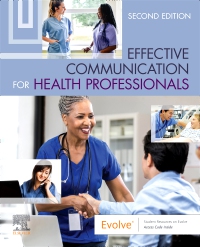

Effective Communication for Health Professionals - Elsevier eBook on VitalSource, 2nd Edition
Elsevier eBook on VitalSource
Now $53.89
Ensure you have the skills to effectively communicate with patients and other healthcare professionals! With its easy-to-read style, Effective Communication for Health Professionals, 2nd edition, is loaded with useful tips and exercises to help you learn the universal (and necessary) practice of communication. This full-color second edition reflects current therapeutic techniques, including Communication Guidelines feature boxes, Words at Work dialogue boxes, added case studies, and all-new content exploring the most current communication tools in the modern health care setting. In addition, interactive exercises on the Evolve companion website encourages you to practice therapeutic communication techniques in real-life situations.
-
- NEW! Chapter devoted to cross-cultural communication promotes understanding of care in a diverse workplace
- NEW! Chapter on diseases and disorders discusses communication with patients experiencing specific physical and mental illnesses and disorders.
- NEW and UNIQUE! Words at Work dialogue boxes demonstrate actual conversations between healthcare workers and clients.
- UPDATED! Content reflects the most current communication tools for the modern healthcare setting.
- NEW! Full-color design and art program promote engagement.
- NEW and UNIQUE! Communication Guidelines boxes direct you to best practices for the effective exchange of information.
- NEW! Additional Taking the Chapter to Work case studies demonstrate real-life communication pitfalls and successes.
-
- NEW! Nora AI - an AI-powered learning assistant exclusive to Elsevier ebooks on VitalSource's Bookshelf® platform - offers built-in AI learning support that provides personalized answers based on content from the Elsevier ebook
- UNIQUE! Interactive activities on accompanying Evolve site include a variety of application exercises such as scenarios with voice mail messages and patient/caregiver interviews
- Easy-to-read style provides practical information, hints, and tips
- Test Your Communication IQ boxes provide you with a short self-assessment test at the beginning of each chapter
- Spotlight on Success boxes provide you with useful, practical tips for improving workplace habits and communication
- Expanding Critical Thinking boxes provide actual case examples and activities with useful tips to help you apply what you’ve learned to practice
- Legal Eagle boxes provide useful tips that focus on honesty, as well as ethical and legal communication between patients and healthcare workers
- End-of-chapter questions and exercises help you to use knowledge learned from topics presented in the chapter
-
1. Communicating in Health Care
2. Gathering Information
3. Educating Patients
4. Communicating with Diverse Patient Groups
5. Communicating Through Barriers
6. Communicating Through Illnesses and Disorders
7. Communicating Through the Grief Process
8. Communicating in the Workplace
9. Documenting Patient CareAppendix A Answers to Checking Your Comprehension
-
-
Ways of Reading
- The appearance of the text and page layout can be modified according to the capabilities of the reading system (font family and font size, spaces between paragraphs, sentences, words, and letters, as well as color of background and text)
- This e-publication is accessible to the full extent that the file format and types of content allow, on a specific reading device, by default, without necessarily including any additions such as textual descriptions of images or enhanced navigation
- No information about nonvisual reading is available
-
Conformance
- No information is available
-
Navigation
- Table of contents to all chapters of the text via links
- Page list to go to pages from the print source version
-
Rich Content
- No information is available
-
Hazards
- No information is available
-
Product Content
- No information is available
-
Legal Considerations
- No information is available
-
Additional Accessibility Information
- Page breaks included from the original print source
- For readers with color vision deficiency, use of color (e.g., in diagrams, graphics and charts, in prompts, or on buttons inviting a response) is not the sole means of graphical distinction or of conveying information
- E-publication includes basic navigation (usually less detailed than TOC-based navigation)
- Where links, controls or buttons are included in the content, the purpose or functionality of each link, control or button is apparent from the associated text alone - or where it is unclear, separate link, control or button descriptions are provided
- All (or substantially all) textual matter is arranged in a single logical reading order (including text that is visually presented as separate from the main text flow, e.g., in boxouts, captions, tables, footnotes, endnotes, citations, etc.). Non-textual content is also linked from within this logical reading order. (Purely decorative non-text content can be ignored).
- The language of the text has been specified (e.g., via the HTML or XML lang attribute) to optimise text-to-speech (and other alternative renderings), both at the whole document level and, where appropriate, for individual words, phrases or passages in a different language.
-
Ways of Reading



 as described in our