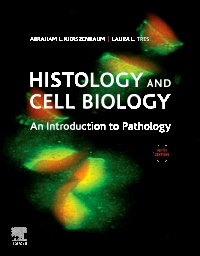

Histology and Cell Biology: An Introduction to Pathology Elsevier eBook on VitalSource, 5th Edition
Elsevier eBook on VitalSource
-
- Features new content on cancer immunotherapy, satellite cells and muscle repair, vasculogenesis and angiogenesis in relation to cancer treatment, and mitochondria replacement therapies
- Presents new material on ciliogenesis, microtubule assembly and disassembly, chromatin structure and condensation, and X chromosome inactivation, which directly impact therapy for ciliopathies, infertility, cancer, and Alzheimer’s disease
- Provides thoroughly updated information on gestational trophoblastic diseases, molecular aspects of breast cancer, and basic immunology, including new illustrations on the structure of the T-cell receptor, CD4+ cells subtypes and functions, and the structure of the human spleen
- Uses a new, light green background throughout the text to identify essential concepts of histology – a feature requested by both students and instructors to quickly locate which concepts are most important for beginning learners or when time is limited. These essential concepts are followed by more detailed information on cell biology and pathology
- Contains new Primers in most chapters that provide a practical, self-contained integration of histology, cell biology, and pathology – perfect for clarifying the relationship between basic and clinical sciences
- Identifies clinical terms throughout the text and lists all clinical boxes in the table of contents for quick reference
- Helps students understand the links between chapter concepts with concept mapping animations on Student Consult™ – an outstanding supplement to in-class instruction
- Student Consult™ eBook version included with purchase. This enhanced eBook experience allows you to search all of the text, figures, and references from the book on a variety of devices
-
PART I BASIC TISSUES AND INTEGRATED CELL BIOLOGY AND GENERAL PATHOLOGY
1. EPITHELIUM
2. EPITHELIAL GLANDS
3. CELL SIGNALING
4. CONNECTIVE TISSUE
5. OSTEOGENESIS
6. BLOOD AND HEMATOPOIESIS
7. MUSCLE TISSUE
8. NERVOUS TISSUE
9. SENSORY ORGANS: VISION AND HEARING
PART II ORGAN SYSTEMS: PROTECTION OF THE BODY
10. IMMUNE-LYMPHATIC SYSTEM
11. INTEGUMENTARY SYSTEM
PART III ORGAN SYSTEMS: BLOOD CIRCULATORY SYSTEMS
12. CARDIOVASCULAR SYSTEM
13. RESPIRATORY SYSTEM
14. URINARY SYSTEM
PART IV ORGAN SYSTEMS: THE ALIMENTARY SYSTEM
15. UPPER DIGESTIVE SEGMENT
16. LOWER DIGESTIVE SEGMENT
17. DIGESTIVE GLANDS
PART V ORGAN SYSTEMS: THE ENDOCRINE SYSTEM
18. NEUROENDOCRINE SYSTEM
19. ENDOCRINE SYSTEM
PART VI ORGAN SYSTEMS: THE REPRODUCTIVE SYSTEM
20. SPERMATOGENESIS
21. SPERM TRANSPORT AND MATURATION
22. FOLLICLE DEVELOPMENT AND THE MENSTRUAL CYCLE
23. FERTILIZATION, PLACENTATION, AND LACTATION -
-
Ways of Reading
- The appearance of the text and page layout can be modified according to the capabilities of the reading system (font family and font size, spaces between paragraphs, sentences, words, and letters, as well as color of background and text)
- This e-publication is accessible to the full extent that the file format and types of content allow, on a specific reading device, by default, without necessarily including any additions such as textual descriptions of images or enhanced navigation
- No information about nonvisual reading is available
-
Conformance
- No information is available
-
Navigation
- Table of contents to all chapters of the text via links
- Page list to go to pages from the print source version
-
Rich Content
- No information is available
-
Hazards
- No information is available
-
Product Content
- No information is available
-
Legal Considerations
- No information is available
-
Additional Accessibility Information
- Page breaks included from the original print source
- For readers with color vision deficiency, use of color (e.g., in diagrams, graphics and charts, in prompts, or on buttons inviting a response) is not the sole means of graphical distinction or of conveying information
- E-publication includes basic navigation (usually less detailed than TOC-based navigation)
- Where links, controls or buttons are included in the content, the purpose or functionality of each link, control or button is apparent from the associated text alone - or where it is unclear, separate link, control or button descriptions are provided
- All (or substantially all) textual matter is arranged in a single logical reading order (including text that is visually presented as separate from the main text flow, e.g., in boxouts, captions, tables, footnotes, endnotes, citations, etc.). Non-textual content is also linked from within this logical reading order. (Purely decorative non-text content can be ignored).
- The language of the text has been specified (e.g., via the HTML or XML lang attribute) to optimise text-to-speech (and other alternative renderings), both at the whole document level and, where appropriate, for individual words, phrases or passages in a different language.
-
Ways of Reading


 as described in our