ISBN:
9780323683883
Copyright:
2022
Publication Date:
07-19-2021
Page Count:
432
Imprint:
Saunders
List Price:
$37.99

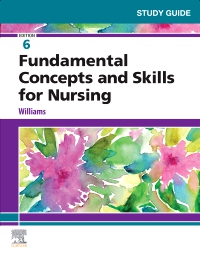
Study Guide for Fundamental Concepts and Skills for Nursing - Elsevier eBook on VitalSource, 6th Edition
by Patricia A. Williams, MSN, RN, CCRN
Elsevier eBook on VitalSource
ISBN:
9780323683883
Copyright:
2022
Publication Date:
07-19-2021
Page Count:
432
Imprint:
Saunders
List Price:
$37.99
Was
$37.99
Now $34.19
Or $0.00 with a valid access code
Reinforce your understanding of basic nursing concepts and skills! Corresponding to the chapters in Fundamental Concepts and Skills for Nursing, 6th Edition, this study guide provides the review and practice you need to master essential LPN/LVN knowledge. Engaging exercises and questions help you learn to apply the nursing process, set priorities, practice critical thinking, make good decisions, and communicate effectively. With this practical review, you will get more out of your textbook and prepare for success on the Next Generation NCLEX-PN® exam.
New Edition Expected Availability: 05-16-2025

Study Guide for Fundamental Concepts and Skills for Nursing - Elsevier E-Book on VitalSource
Elsevier eBook on VitalSource
ISBN: 9780443260575
-
- NEW! Updated exercises reflect content in the new edition of the Fundamental Concepts and Skills for Nursing textbook
- NEW! UNIQUE! Next Generation NCLEX Exam-style questions are included in every chapter, reflecting the Clinical Judgment Measurement Model, and include each of the five new approved question types: enhanced hotspot, cloze (drop down), matrix, extended multiple-response, and extended drag-and-drop question types
-
- Review Questions for the NCLEX-PN® Examination let you practice for the exam with multiple-choice and alternate item format questions based on real-life situations.
- Word Attack Skills offer practice in pronouncing difficult terms and phrases, with emphasis on stress and intonation
- Clinical Situations use realistic sample practice situations to stimulate critical thinking, clinical judgment, and practical application of nursing concepts
- Critical Thinking Activities provide nursing scenarios and questions to help build your problem-solving skills
- Developing Clinical Judgment activities help you meet the clinical practice objectives of the corresponding chapter
- Communication Exercises let you practice using realistic nurse-patient dialogues, and are especially useful when paired with a partner
- Cultural Points summarize issues and ask questions about customs that may differ across the cultures found in patient communities
- Grammar Points exercises offer a refresher on common grammatical errors, such as the use of the past tense in taking case histories
- Completion exercises boost your vocabulary by offering more opportunities to use key terms
- Priority Setting questions ask you to rank tasks in order of importance
- Short answer, identification, multiple-choice, and matching questions test and reinforce your knowledge of concepts conveyed in the text
- Application of the Nursing Process questions ask you to use critical thinking skills and apply the steps of the nursing process to real-life patient care
- Review of structure and function of the human body helps you remember what you learned in previous classes and how it applies to nursing
-
-
 Fundamental Concepts and Skills for Nursing - VSTElsevier eBook on VitalSource
-
-
1. Nursing and the Health Care System
2. Concepts of Health, Illness, Stress, and Health Promotion
3. Legal and Ethical Aspects of Nursing
4. The Nursing Process, Critical Thinking, and Clinical Judgment
5. Assessment, Nursing Diagnosis/Problem Identification, and Planning
6. Implementation and Evaluation
7. Documentation of Nursing Care
8. Communication and the Nurse-Patient Relationship
9. Patient Education and Health Promotion
10. Delegation, Leadership, and Management
11. Growth and Development: Infancy Through Adolescence
12. Adulthood and the Family
13. Promoting Healthy Adaptation to Aging
14. Cultural and Spiritual Aspects of Patient Care
15. Loss, Grief, and End-of-Life Care
16. Infection Prevention and Control: Protective Mechanisms and Asepsis
17. Infection Prevention and Control in the Hospital and Home
18. Safely Lifting, Moving, and Positioning Patients
19. Assisting with Hygiene, Personal Care, Skin Care, and the Prevention of Pressure Injuries
20. Patient Environment and Safety
21. Measuring Vital Signs
22. Assessing Health Status
23. Admitting, Transferring, and Discharging Patients
24. Diagnostic Tests and Specimen Collection
25. Fluid, Electrolyte, and Acid-Base Balance
26. Concepts of Basic Nutrition and Cultural Considerations
27. Nutritional Therapy and Assisted Feeding
28. Assisting with Respiration and Oxygen Delivery
29. Promoting Urinary Elimination
30. Promoting Bowel Elimination
31. Pain, Comfort, and Sleep
32. Complementary Health Approaches
33. Pharmacology and Preparation for Drug Administration
34. Administering Oral, Topical, and Inhalant Medications
35. Administering Intradermal, Subcutaneous, and Intramuscular Injections
36. Administering Intravenous Solutions and Medications
37. Care of the Surgical Patient
38. Providing Wound Care and Treating Pressure Injuries
39. Promoting Musculoskeletal Function
40. Common Physical Care Problems of the Older Adult
41. Common Psychosocial Care Problems of the Older Adult -
-
Ways of Reading
- The appearance of the text and page layout can be modified according to the capabilities of the reading system (font family and font size, spaces between paragraphs, sentences, words, and letters, as well as color of background and text)
- This e-publication is accessible to the full extent that the file format and types of content allow, on a specific reading device, by default, without necessarily including any additions such as textual descriptions of images or enhanced navigation
- No information about nonvisual reading is available
-
Conformance
- No information is available
-
Navigation
- Table of contents to all chapters of the text via links
- Page list to go to pages from the print source version
-
Rich Content
- No information is available
-
Hazards
- No information is available
-
Product Content
- No information is available
-
Legal Considerations
- No information is available
-
Additional Accessibility Information
- Page breaks included from the original print source
- For readers with color vision deficiency, use of color (e.g., in diagrams, graphics and charts, in prompts, or on buttons inviting a response) is not the sole means of graphical distinction or of conveying information
- E-publication includes basic navigation (usually less detailed than TOC-based navigation)
- Where links, controls or buttons are included in the content, the purpose or functionality of each link, control or button is apparent from the associated text alone - or where it is unclear, separate link, control or button descriptions are provided
- All (or substantially all) textual matter is arranged in a single logical reading order (including text that is visually presented as separate from the main text flow, e.g., in boxouts, captions, tables, footnotes, endnotes, citations, etc.). Non-textual content is also linked from within this logical reading order. (Purely decorative non-text content can be ignored).
- The language of the text has been specified (e.g., via the HTML or XML lang attribute) to optimise text-to-speech (and other alternative renderings), both at the whole document level and, where appropriate, for individual words, phrases or passages in a different language.
-
Ways of Reading
Was
$37.99
Now $34.19
Or $0.00 with a valid access code

 as described in our