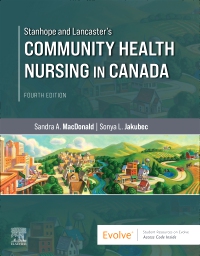

Community Health Nursing in Canada - Elsevier eBook on VitalSource, 4th Edition
Elsevier eBook on VitalSource
Now $79.19
Master the nurse’s role in health promotion for Canadian populations and communities! Stanhope and Lancaster's Community Health Nursing in Canada, 4th Edition covers the concepts and skills you need to know for effective, evidence-informed practice. It addresses individual, family, and group health as well as the social and economic conditions that can affect the health of a community. Concise, easy-to-read chapters include coverage of the latest issues, approaches, and points of view. Written by Canadian educators Sandra A. MacDonald and Sonya L. Jakubec in collaboration with Indigenous scholar Dr. R. Lisa Bourque Bearskin, this edition makes it even easier to apply nursing principles and strategies to practice.
New Edition Expected Availability: 02-01-2027

Stanhope and Lancaster's Community Health Nursing in Canada - Elsevier E-Book on VitalSource
-
- NEW! NGN-style case studies are provided on the Evolve companion website
- NEW! Thoroughly updated references and sources present the latest research, statistics, and Canadian events and scenarios, including the latest Community Health Nurses of Canada (CHNC) Canadian Community Health Nursing Standards of Practice (2019 edition)
- NEW! Expanded coverage of global health, global issues, and the global environment Is integrated throughout the book
- NEW! Revised Working with Working with People Who Experience Structural Vulnerabilities chapter views vulnerable populations through a social justice lens
- NEW! Enhanced content provides greater application to practice
- NEW! Further clarification of the differing roles of CHNs and PHNS is provided
-
- NEW! Nora AI - an AI-powered learning assistant exclusive to Elsevier ebooks on VitalSource's Bookshelf® platform - offers built-in AI learning support that provides personalized answers based on content from the Elsevier ebook
- UNIQUE! Evidence-Informed Practice boxes illustrate how to apply the latest research findings in community health nursing
- UNIQUE! Indigenous Health: Working with First Nations Peoples, Inuit, and Métis chapter details community health nursing in Indigenous communities
- UNIQUE! Determinants of Health boxes highlight the critical factors contributing to individual or group health
- Levels of Prevention boxes give examples of primary, secondary, and tertiary prevention related to community health nursing practice
- CHN in Practice boxes in each chapter provide unique case studies to help you develop your assessment and critical thinking skills
- How To boxes use real-life examples to provide specific, application-oriented information
- Ethical Considerations boxes provide examples of ethical situations and relevant principles involved in making informed decisions in community health nursing practice
- Cultural Considerations boxes present culturally diverse scenarios that offer questions for reflection and class discussion
- Chapter Summary sections provide a helpful summary of the key points within each chapter
-
-

-
 Elsevier Adaptive Quizzing for Stanhope and Lancaster's Community Health Nursing in Canada (eCommerce Version)Elsevier Adaptive Quizzing - Next Generation
 -

-

-
-
UNIT I: Background and Roles for Community Health Nursing
1. Community Health Nursing
2. The Evolution of Community Health Nursing in Canada
3. Community Health Nursing in Canada: Settings, Functions, and Roles
UNIT II: Community Health Foundations and Principles
4. Health Promotion
5. Evidence-Informed Practice in Community Health Nursing
6. Ethics in Community Health Nursing Practice
7. Diversity and Relational Practice in Community Health Nursing
8. Epidemiological Applications
9. Working With the Community
10. Health Program Planning and Evaluation
UNIT III: Stakeholders and Populations of Community Health Nursing Practice
11. Working With the Individual as Client: Health and Wellness Across the Lifespan
12. Working With Families
13. Working with Groups, Teams, and Partners
14. Indigenous Health: Working with First Nations People, Inuit, and Métis
15. Working with Working with People Who Experience Structural Vulnerabilities
UNIT IV: Specific Domains of Community Health Practice
16. Communicable and Infectious Disease Prevention and Control
17. Environmental Health
18. Disaster Management -
-
Ways of Reading
- The appearance of the text and page layout can be modified according to the capabilities of the reading system (font family and font size, spaces between paragraphs, sentences, words, and letters, as well as color of background and text)
- This e-publication is accessible to the full extent that the file format and types of content allow, on a specific reading device, by default, without necessarily including any additions such as textual descriptions of images or enhanced navigation
- No information about nonvisual reading is available
-
Conformance
- No information is available
-
Navigation
- Table of contents to all chapters of the text via links
- Page list to go to pages from the print source version
-
Rich Content
- No information is available
-
Hazards
- No information is available
-
Product Content
- No information is available
-
Legal Considerations
- No information is available
-
Additional Accessibility Information
- Page breaks included from the original print source
- For readers with color vision deficiency, use of color (e.g., in diagrams, graphics and charts, in prompts, or on buttons inviting a response) is not the sole means of graphical distinction or of conveying information
- E-publication includes basic navigation (usually less detailed than TOC-based navigation)
- Where links, controls or buttons are included in the content, the purpose or functionality of each link, control or button is apparent from the associated text alone - or where it is unclear, separate link, control or button descriptions are provided
- All (or substantially all) textual matter is arranged in a single logical reading order (including text that is visually presented as separate from the main text flow, e.g., in boxouts, captions, tables, footnotes, endnotes, citations, etc.). Non-textual content is also linked from within this logical reading order. (Purely decorative non-text content can be ignored).
- The language of the text has been specified (e.g., via the HTML or XML lang attribute) to optimise text-to-speech (and other alternative renderings), both at the whole document level and, where appropriate, for individual words, phrases or passages in a different language.
-
Ways of Reading

 as described in our