ISBN:
9780323694865
Copyright:
2026
Publication Date:
03-21-2025
Page Count:
944
Imprint:
Elsevier
List Price:
$185.99

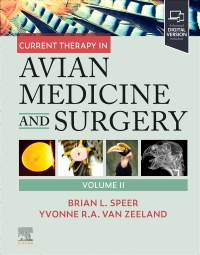
Current Therapy in Avian Medicine and Surgery Volume II - Elsevier eBook on VItalSource, 1st Edition
by Brian Speer, DVM, Dip ABVP (Avian practice), Dip ECZM (Avian) and Yvonne R.A. van Zeeland, DVM, MVR, PhD, Dip. ECZM (Avian, Small mammal)
Elsevier eBook on VitalSource
ISBN:
9780323694865
Copyright:
2026
Publication Date:
03-21-2025
Page Count:
944
Imprint:
Elsevier
List Price:
$185.99
Most review copies are eBooks – how fast!
A review copy request is most likely to be fulfilled as an eBook on VitalSource rather than a print product, unless no eBook is available. eBooks become available in as little as a few hours. Print products will take between 7 and 10 days to arrive. To request a print copy, please contact us through the Evolve Support Center for further assistance or contact your Elsevier Sales Rep.
Stay up to date with the latest advances in avian medicine! Current Therapy in Avian Medicine and Surgery, Volume II, brings a wealth of new information on the medical care of avian species with practical approaches to diagnosis and therapy of psittacines and other birds. With many of the topics not previously covered in the first volume, the two books are complementary to one another and provide any veterinarian with an interest in avian medicine, whether novice or expert, the latest advances in internal medicine, anesthesia, analgesia, and surgery. Sections dedicated to behavior and welfare, neonatology and pediatrics, conservation, and practice management explore important, but less commonly discussed aspects of avian practice. With contributions from globally recognized experts on avian medicine, this is a must-have resource for anyone seeking to enhance and expand their expertise and skills in avian healthcare, welfare, and conservation.
-
- With the exception of updates on relevant, current topics, the information presented in this volume predominantly includes material not previously covered in the first volume
- The many photographs, illustrations and comprehensive tables included in this volume visually highlight key concepts of current avian practice standards
- Sections on pediatrics, falconry, toucans and hornbills feature specific topics which are less comprehensively included in most references
- Focused sections on the respiratory system, the beak and skull, feathers, and feet offer detailed information on these particular anatomical regions
- Pharmacologic intervention and options are explored in-depth to allow for clinicians to gain an optimal understanding of how to best develop treatment plans for their patients
- NEW! An eBook version is included with print purchase. The eBook allows you to access all of the text, figures and references, with the ability to search, customize your content, make notes and highlights, and have content read aloud
- Current Therapy format provides up-to-date information about patient management of specific disorders, including innovations in therapy and the pros and cons of proposed treatments
- Coverage of a wide variety of bird species includes psittacines, pigeons, raptors, ratites, waterfowl, gallinaceous birds, and less common species
- More than 800 full-color images depict avian disease conditions, show management strategies and thought processes, and aid in formulating guidelines to care
- Summary tables simplify the lookup of key facts and treatment guidelines
- Appendices provide quick access to a current drug formulary, normal biological data, clinical pathologic reference ranges, and growth and feeding charts of neonatal birds
-
Section 1: Advances in Practice Management
1. Practice Management: Developing a Career as an Avian Veterinarian
Section 2: Establishing a Diagnosis
2. Common Imaging Modalities: Selecting the Right Modality and Getting the Most Out of Your Imaging
3. Thermal Imaging
4. The Value of Necropsy
Section 3: Therapeutic Intervention
5. Pharmacologic Intervention
6. Antimicrobial Agents
7. Antibacterial Drugs
8. Antifungal Therapy
9. Antiparasitic Drugs
10. Antiviral Drugs
Section 4: Infectious Disease Prevention
11. Interaction of Host, Agent, Environment, and Disease
12. Hygiene and Disinfection
13. Vaccination Strategies
Section 5: Updates on Infectious Diseases
14. Avian Bornavirus
15. Poxvirus
16. West Nile Virus and Other Flaviviruses
17. Campylobacteriosis
18. Chlamydiosis
19. Erysipelas In Wild Birds
20. Mycoplasmosis
21. Cryptococcosis
22. Trichomoniasis
23. Diplomonad Protozoal Diseases: Giardiasis, Spironucleosis
24. Histomoniasis
25. Cochlosomosis
Section 6: The Respiratory System
26. Respiratory Anatomy and Physiology
27. Diagnostic Work-Up of Respiratory Problems
28. Diseases of the Respiratory Tract
29. Surgery of the Respiratory Tract
30. Diagnostic Endoscopy, Endoscope-Assisted Therapy, and Endosurgery of the Avian Respiratory System
Section 7: Beaks, Feathers, and Feet
31. The Beak: Form, Function, and Problems
32. Feathers and Conditions of the Plumage
33. Pododermatitis
Section 8: The Trauma Patient
34. Triage and Stabilization
35. Pain Management Updates
36. Wound Management
37. Fracture Management
Section 9: Embryology, Neonatology, and Pediatrics
38. From Fertilization to Hatch: Egg and Embryonic Development
39. Natural Incubation
40. Artificial Incubation
41. Pediatrics
42. Raptor Incubation and Pediatrics
43. Incubation and Pediatrics of Columbiformes
44. Toucan Neonatology and Pediatrics
45. Neonatology of Precocial Birds
Section 10: Advances in Welfare
46. Minimizing Stress and Fear During the Physical Examination
47. Strategic Use of Enrichment: What, When, and How
Section 11: Conservation and Wildlife Management
48. Anthropogenic and Environmental Threats to Avian Wildlife: Introduction
49. Biotoxins
50. Hazards Related to Man-Made Structures: Buildings, Noise, Electric Power
51. Petroleum Products
52. Anthropogenic Toxins
53. Wildfires
54. Wild Birds, Cats, and One Health
Section 12: Medicine of Specific Taxonomic Groups
55. Falconry: Past, Present, and Future
56. Toucans, Hornbills, Aracaris
Appendices
1. Table of Common Drugs and Approximate Doses
2. Normal Clinical Pathologic Data
3. Normal Biological Data
4. Chick Growth Data -
-
Ways of Reading
- The appearance of the text and page layout can be modified according to the capabilities of the reading system (font family and font size, spaces between paragraphs, sentences, words, and letters, as well as color of background and text)
- This e-publication is accessible to the full extent that the file format and types of content allow, on a specific reading device, by default, without necessarily including any additions such as textual descriptions of images or enhanced navigation
- All content can be read as read aloud speech or dynamic braille
- Has alternative text descriptions for images
-
Conformance
- The publication contains a conformance statement that it meets the EPUB Accessibility 1.1, WCAG 2.1, Level AA standard. Please see https://bornaccessible.benetech.org/certified-publishers/ for further details of our compatibility testing.
- The certifier's credential is https://bornaccessible.benetech.org/certified-publishers/
- For detailed accessibility information, see Elsevier's website at https://www.elsevier.com/about/accessibility
- For queries regarding accessibility information, contact [email protected]
- The publication was certified on 19-03-2026
-
Navigation
- Table of contents to all chapters of the text via links
- Index with links to referenced entries
- Page list to go to pages from the print source version
-
Rich Content
- Math formulas in accessible format (MathML)
- Information-rich images are described by extended descriptions
-
Hazards
- The publication contains no hazards
-
Product Content
- Content includes any type of illustrations.
- The primary content is text.
- Content includes a significant number of actionable (clickable) web links to external content, downloadable resources, supplementary material, etc.
- Content includes a significant number of actionable (clickable) cross-references, hyperlinked notes and annotations, or with other actionable links between largely textual elements (e.g., quiz/test questions, 'choose your own ending', etc.).
- Content includes additional textual content such as an interview, feature article, essay, bibliography, quiz/test, other background material, or text that is not included in a primary or 'unenhanced' version.
- Content includes photographs, whether in a plate section / insert or not.
- Content includes figures, diagrams, charts and/or graphs, including other 'mechanical' (i.e. non-photographic) illustrations.
- Content includes narrative animation, e.g., cartoon, animatic or CGI animation (usually includes sound).
- Content includes images displayed in a specific order for the purpose of graphic storytelling or giving information (e.g. graphic novels, comics and manga). May include text integrated into the image (as speech and thought bubbles, textual 'sound' effects, captions etc.).
- At least some text - including text within other images - is 'text as an image' (i.e., a picture of text).
- Product includes actionable (clickable) links to external interactive content.
-
Legal Considerations
- No information is available
-
Additional Accessibility Information
- Content is enhanced with ARIA roles to optimize organization and facilitate navigation
- Page breaks included from the original print source
- For readers with color vision deficiency, use of color (e.g., in diagrams, graphics and charts, in prompts, or on buttons inviting a response) is not the sole means of graphical distinction or of conveying information
- The body text is presented with a contrast ratio of at least 4.5:1 (or 3:1 for large/heading text)
- Ultra-high contrast between text and background
- E-publication includes basic navigation (usually less detailed than TOC-based navigation)
- Where links, controls or buttons are included in the content, the purpose or functionality of each link, control or button is apparent from the associated text alone - or where it is unclear, separate link, control or button descriptions are provided
- All (or substantially all) textual matter is arranged in a single logical reading order (including text that is visually presented as separate from the main text flow, e.g., in boxouts, captions, tables, footnotes, endnotes, citations, etc.). Non-textual content is also linked from within this logical reading order. (Purely decorative non-text content can be ignored).
- Where interactive content is included in the product, controls are provided (e.g., for speed, pause and resume, reset) and labelled to make their use clear.
- The language of the text has been specified (e.g., via the HTML or XML lang attribute) to optimise text-to-speech (and other alternative renderings), both at the whole document level and, where appropriate, for individual words, phrases or passages in a different language.
-
Ways of Reading

Most review copies are eBooks – how fast!
A review copy request is most likely to be fulfilled as an eBook on VitalSource rather than a print product, unless no eBook is available. eBooks become available in as little as a few hours. Print products will take between 7 and 10 days to arrive. To request a print copy, please contact us through the Evolve Support Center for further assistance or contact your Elsevier Sales Rep.

 as described in our