ISBN:
9780323695565
Copyright:
2021
Publication Date:
04-29-2020
Page Count:
736
Imprint:
Elsevier
List Price:
$83.99

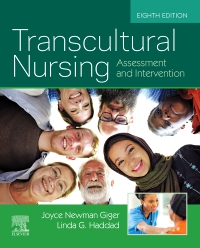
Transcultural Nursing - Elsevier eBook on VitalSource, 8th Edition
by Joyce Newman Giger, EdD, RN, APRN, BC, FAAN and Linda Haddad
Elsevier eBook on VitalSource
ISBN:
9780323695565
Copyright:
2021
Publication Date:
04-29-2020
Page Count:
736
Imprint:
Elsevier
List Price:
$83.99
Was
$83.99
Now $58.79
Or $0.00 with a valid access code
Provide quality care for clients from culturally diverse backgrounds! Transcultural Nursing, 8th Edition shows you how to apply assessment and intervention strategies to individuals from a variety of different cultures. Based on Giger and Davidhizer’s unique transcultural model, this text helps you design culturally sensitive care with use of the six key aspects of cultural assessment: communication, time, space, social organization, environmental control, and biologic variations. Written by nursing educators Joyce Newman Giger and Linda G. Haddad, Transcultural Nursing shows how an understanding of cultural variations and individual patient needs will help you provide safe and effective care.
New Edition Expected Availability: 08-20-2024

Transcultural Nursing - Elsevier E-Book on VitalSource
Elsevier eBook on VitalSource
ISBN: 9780443122927
-
- NEW co-author Dr. Linda Haddad is an internationally recognized cultural scholar who has taught nursing around the globe, has acted as an advisor and coordinator for the World Health Organization, and has published over 30 scholarly articles on nursing with a focus on understanding the cultural implication to care.
- UPDATED! Cultural chapters are completely revised to reflect the shifting experiences of cultural groups in our society.
-
- UNIQUE! The six key aspects of cultural assessment each receive a full chapter of coverage, allowing you to also apply the Transcultural Assessment Model to cultures not covered in the text.
- Case studies and critical decision-making questions help you apply the assessment framework to practice.
- 23 chapters on specific cultural groups apply this assessment model to the clients most commonly encountered in United States health care settings, with nearly all chapters written by contributors who are part of that ethnic group.
- Client care plans in culture-specific chapters show how to apply principles to the needs of individuals.
- Review questions reinforce your understanding of cultural principles, with answers found in the back of the book.
- Discussions of spirituality throughout the text provide a holistic, integrated approach to culture, beliefs, and assessment.
-
PART ONE: FRAMEWORK FOR CULTURAL ASSESSMENT
1. Introduction to Transcultural Nursing
2. Communication
3. Space
4. Social Organization
5. Time
6. Environmental Control
7. Biological Variations
PART TWO: APPLICATION OF ASSESSMENT AND INTERVENTION TECHNIQUES TO SPECIFIC CULTURAL GROUPS
8. African Americans
9. Mexican Americans
10. Navajos (Diné)
11. Appalachians
12. American Eskimos: Th Yup'ik and Inupiat
13. Japanese Americans
14. Afghans and Afghan Americans
15. Russian Americans
16. Chinese Americans
17. Filipino Americans
18. Vietnamese Americans
19. East Indian Hindu Americans
20. Haitian Americans
21. Jewish Americans
22. Korean Americans
23. French Canadians of Quebec Origin
24. Puerto Ricans
25. Nigerian Americans
26. Ugandan Americans
27. Jordanian Americans
28. Cuban Americans
29. Amish Americans
30. Irish Americans
Appendix A: Answer Key for Review Questions
Index -
-
Ways of Reading
- The appearance of the text and page layout can be modified according to the capabilities of the reading system (font family and font size, spaces between paragraphs, sentences, words, and letters, as well as color of background and text)
- This e-publication is accessible to the full extent that the file format and types of content allow, on a specific reading device, by default, without necessarily including any additions such as textual descriptions of images or enhanced navigation
- No information about nonvisual reading is available
-
Conformance
- No information is available
-
Navigation
- Table of contents to all chapters of the text via links
- Page list to go to pages from the print source version
-
Rich Content
- No information is available
-
Hazards
- No information is available
-
Product Content
- No information is available
-
Legal Considerations
- No information is available
-
Additional Accessibility Information
- Page breaks included from the original print source
- For readers with color vision deficiency, use of color (e.g., in diagrams, graphics and charts, in prompts, or on buttons inviting a response) is not the sole means of graphical distinction or of conveying information
- E-publication includes basic navigation (usually less detailed than TOC-based navigation)
- Where links, controls or buttons are included in the content, the purpose or functionality of each link, control or button is apparent from the associated text alone - or where it is unclear, separate link, control or button descriptions are provided
- All (or substantially all) textual matter is arranged in a single logical reading order (including text that is visually presented as separate from the main text flow, e.g., in boxouts, captions, tables, footnotes, endnotes, citations, etc.). Non-textual content is also linked from within this logical reading order. (Purely decorative non-text content can be ignored).
- The language of the text has been specified (e.g., via the HTML or XML lang attribute) to optimise text-to-speech (and other alternative renderings), both at the whole document level and, where appropriate, for individual words, phrases or passages in a different language.
-
Ways of Reading
Was
$83.99
Now $58.79
Or $0.00 with a valid access code

 as described in our