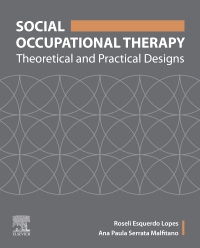

Social Occupational Therapy Elsevier E-Book on VitalSource, 1st Edition
Elsevier eBook on VitalSource
Ground your students in the social issues surrounding occupational therapy practice with Social Occupational Therapy: Theoretical and Practical Designs. Written by Roseli Esquerdo Lopes and Ana Paula Serrata Malfitano, this groundbreaking text offers a global view of the role of occupational therapy and the potential contributions of occupational therapists to their societies — specifically in social services and with populations in situations of social vulnerability. Theoretical and practical chapters examine both occupational therapy and social challenges, and the text’s emphasis on human rights and social issues reflects the World Federation of Occupational Therapists Minimum Standards for the Education of Occupational Therapists. It’s the unique perspective needed to fully prepare today’s students to tackle the social aspects of occupational therapy and respond to social field issues, including education, culture, justice, welfare, and work, as well as health.
-
- Worldview of social occupational therapy reinforces the importance of the field and underscores the growing practice and theoretical field for global occupational therapy.
- In-depth analysis of social issues is incorporated throughout the text along with a detailed analysis of the potential contributions of occupational therapists to their societies.
- Focus on the social role of occupational therapy highlights the role of occupational therapy as a social profession and prepares students to respond to social field issues, including education, culture, justice, welfare, and work, as well as health.
- Theoretical and practical chapters talk about occupational therapy and social challenges.
- Emphasis on human rights and social issues reflects the World Federation of Occupational Therapists Minimum Standards for the Education of Occupational Therapists.
-
-
 Social Occupational TherapyPaperback
-
-
Foreword
Presentation
Section I: Conceptual Outlines: Colors and Textures
1. Citizenship, Rights, and Social Occupational Therapy
2. Social Occupational Therapy in Brazil: A Historical Synthesis of the Constitution of a Field of Knowledge and Practice
3. Occupational Therapy and Socioeconomic Processes
4. Occupational Therapy: Social, Cultural? Diverse and Multiple!
5. Social Context and Social Action: Generalizations and Specificities in Occupational Therapy
6. Occupational Therapy in the Context of Social Protection Expansion
7. Occupational Therapy and Social Assistance: Building a Critical Thinking About the Field
8. The Theory of Communicative Action: A Theoretical-Methodological Contribution to Social Occupational Therapy
9. Citizenship and Cultural Diversity in Management of Cultural Policies
10. Traditional Peoples and Communities: Traditional Occupation as a Theme of Social Occupational Therapy
11. School and Youth — Contributions of Social Occupational Therapy
12. Social Occupational Therapy, Offenses and School: Complex Plots in Fragile Relations
13. Social Occupational Therapy and the Eradication of Child Labor in Brazil: The Challenge of Articulating Social Protection and Autonomy
14. Informing Social Occupational Therapy: Unpacking the ‘Social’ Using Critical Social Theory
15. Occupational Therapy on the Move: On Contextualizing Citizenships and Epistimicide
Section II: Sketches and Scenarios
Theoretical-Practical Sketches and Contemporary Scenarios: The METUIA/UFSCar Experience in Social Occupational Therapy
16. Resources and Technologies in Social Occupational Therapy: Actions with Poor Urban Youth
17. Social Occupational Therapy in School: Experiences with a Student Association
18. The Caravan for the Promotion of Rights: Disseminating and Discussing the Child and Adolescent Statute (CAS) in Schools
19. Youth and Education: The Path Constituted by the Non-Place
20. Paths of Life and the Marks of the Juvenile Justice System
21. Social Occupational Therapy and the Support Contextures: An Experience Beyond Formal Devices
22. Poor Youth and the City: Violated Rights, Denied Spaces
23. Overcoming Invisibility: Carla's Story
24. Social Occupational Therapy, Gender and Sexuality
25. Activity Workshops: Exploring the Use of Digital Media by Brazilian Youths
26. Under and Between Trees: Social Occupational Therapy in a Public Square
27. The Planting Has Become a Plantation: Germinating Relationships to Sow Ties -
-
Ways of Reading
- The appearance of the text and page layout can be modified according to the capabilities of the reading system (font family and font size, spaces between paragraphs, sentences, words, and letters, as well as color of background and text)
- This e-publication is accessible to the full extent that the file format and types of content allow, on a specific reading device, by default, without necessarily including any additions such as textual descriptions of images or enhanced navigation
- No information about nonvisual reading is available
-
Conformance
- No information is available
-
Navigation
- Table of contents to all chapters of the text via links
- Page list to go to pages from the print source version
-
Rich Content
- No information is available
-
Hazards
- No information is available
-
Product Content
- No information is available
-
Legal Considerations
- No information is available
-
Additional Accessibility Information
- Page breaks included from the original print source
- For readers with color vision deficiency, use of color (e.g., in diagrams, graphics and charts, in prompts, or on buttons inviting a response) is not the sole means of graphical distinction or of conveying information
- E-publication includes basic navigation (usually less detailed than TOC-based navigation)
- Where links, controls or buttons are included in the content, the purpose or functionality of each link, control or button is apparent from the associated text alone - or where it is unclear, separate link, control or button descriptions are provided
- All (or substantially all) textual matter is arranged in a single logical reading order (including text that is visually presented as separate from the main text flow, e.g., in boxouts, captions, tables, footnotes, endnotes, citations, etc.). Non-textual content is also linked from within this logical reading order. (Purely decorative non-text content can be ignored).
- The language of the text has been specified (e.g., via the HTML or XML lang attribute) to optimise text-to-speech (and other alternative renderings), both at the whole document level and, where appropriate, for individual words, phrases or passages in a different language.
-
Ways of Reading

 as described in our