ISBN:
9780323697415
Copyright:
2021
Publication Date:
09-03-2020
Page Count:
432
Imprint:
Mosby
List Price:
$92.99

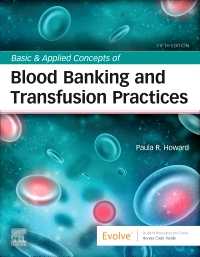
Basic & Applied Concepts of Blood Banking and Transfusion Practices - Elsevier eBook on VitalSource, 5th Edition
by Paula R. Howard, MPH, MS, MLS(ASCP)SBB
Elsevier eBook on VitalSource
ISBN:
9780323697415
Copyright:
2021
Publication Date:
09-03-2020
Page Count:
432
Imprint:
Mosby
List Price:
$92.99
Was
$92.99
Now $65.09
Or $0.00 with a valid access code
Make complex blood banking concepts easier to understand with Basic & Applied Concepts of Blood Banking and Transfusion Practices, 5th Edition. Combining the latest information in a highly digestible format, this approachable text helps you easily master all areas of blood banking by utilizing common theory, clinical scenarios, case studies, and critical-thinking exercises. With robust user resources and expanded content on disease testing and DNA, it’s the effective learning resource you need to successfully work in the modern lab.
New Edition Expected Availability: 01-06-2025

Basic & Applied Concepts of Blood Banking and Transfusion Practices - Elsevier eBook on VitalSource
Elsevier eBook on VitalSource
ISBN: 9780443118593
-
- NEW! Completely updated content prepares you to work in today’s clinical lab environment
- NEW! Additional information on disease testing covers diseases such as Zika and others of increased importance
- NEW! Expanded content on DNA covers the latest developments in related testing
- NEW! Enhanced user resources on the Evolve companion website now include expanded case studies in addition to the existing review questions
-
- NEW! Nora AI - an AI-powered learning assistant exclusive to Elsevier ebooks on VitalSource's Bookshelf® platform - offers built-in AI learning support that provides personalized answers based on content from the Elsevier ebook
- Coverage of advanced topics such as transplantation and cellular therapy, the HLA system, molecular techniques and applications, automation, electronic cross-matching, and therapeutic apheresis make the text more relevant for 4-year MLS/CLS programs
- Illustrated blood group boxes provide the ISBT symbol, number, and clinical significance of antibodies at a glance
- Robust chapter pedagogy helps break down this difficult subject with learning objectives, outlines, key terms with definitions, chapter summaries, critical thinking exercises, study questions, and case studies
-
Part I: Quality and Safety Issues
1. Quality Assurance and Regulation of the Blood Industry: Safety Issues in the Blood Bank
Part II: Foundations: Basic Sciences and Reagents
2. Immunology: Basic Principles and Applications in the Blood Bank
3. Blood Banking Reagents: Overview and Applications
4. Genetic Principles in Blood Banking
Part III: Overview of the Major Blood Groups
5. ABO and H Blood Group Systems and Secretor Status
6. Rh Blood Group System
7. Other Red Cell Blood Group Systems, Human Leukocyte Antigens, and Platelet Antigens
Part IV: Essentials of Pretransfusion Testing
8. Antibody Detection and Identification
9. Compatibility Testing
10. Blood Bank Automation for Transfusion Services
Part V: Clinical Considerations in Immunohematology
11. Adverse Complications of Transfusions
12. Hemolytic Disease of the Fetus and Newborn
Part VI: Blood Collecting and Testing
13. Donor Selection and Phlebotomy
14. Testing of Donor Blood
Part VII: Blood Component Preparation and Transfusion Therapy
15. Blood Component Preparation and Therapy
16. Transfusion Therapy in Selected Patients -
-
Ways of Reading
- The appearance of the text and page layout can be modified according to the capabilities of the reading system (font family and font size, spaces between paragraphs, sentences, words, and letters, as well as color of background and text)
- This e-publication is accessible to the full extent that the file format and types of content allow, on a specific reading device, by default, without necessarily including any additions such as textual descriptions of images or enhanced navigation
- No information about nonvisual reading is available
-
Conformance
- No information is available
-
Navigation
- Table of contents to all chapters of the text via links
- Page list to go to pages from the print source version
-
Rich Content
- No information is available
-
Hazards
- No information is available
-
Product Content
- No information is available
-
Legal Considerations
- No information is available
-
Additional Accessibility Information
- Page breaks included from the original print source
- For readers with color vision deficiency, use of color (e.g., in diagrams, graphics and charts, in prompts, or on buttons inviting a response) is not the sole means of graphical distinction or of conveying information
- E-publication includes basic navigation (usually less detailed than TOC-based navigation)
- Where links, controls or buttons are included in the content, the purpose or functionality of each link, control or button is apparent from the associated text alone - or where it is unclear, separate link, control or button descriptions are provided
- All (or substantially all) textual matter is arranged in a single logical reading order (including text that is visually presented as separate from the main text flow, e.g., in boxouts, captions, tables, footnotes, endnotes, citations, etc.). Non-textual content is also linked from within this logical reading order. (Purely decorative non-text content can be ignored).
- The language of the text has been specified (e.g., via the HTML or XML lang attribute) to optimise text-to-speech (and other alternative renderings), both at the whole document level and, where appropriate, for individual words, phrases or passages in a different language.
-
Ways of Reading

Was
$92.99
Now $65.09
Or $0.00 with a valid access code

 as described in our