
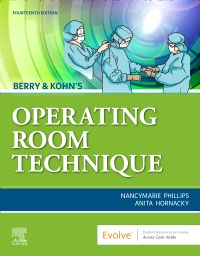

Berry & Kohn's Operating Room Technique - Elsevier eBook on VitalSource, 14th Edition
Elsevier eBook on VitalSource
Now $112.63
**Selected for Doody’s Core Titles® 2024 with "Essential Purchase" designation in Perioperative**
Easily learn how to apply basic surgical principles and techniques with Berry & Kohn’s Operating Room Technique, 14th Edition. For over 50 years, this highly readable text has been trusted to clearly cover the "nuts and bolts" of surgical techniques in a step-by-step format. Expert authors Nancymarie Phillips and Anita Hornacky emphasize the importance of teamwork throughout, with practical strategies and examples of how cooperation among perioperative caregivers contributes to positive patient care outcomes. With a strong focus on the physiologic, psychologic, and spiritual considerations of perioperative patients, this extensively updated new edition gives you the knowledge you need to plan and implement comprehensive, individualized care.
Newer Edition Available

Berry & Kohn's Operating Room Technique - Elsevier E-Book on VitalSource
-
- Detailed information on the fundamentals of perioperative nursing and surgical technology roles enhance students’ understanding of basic surgical principles and techniques.
- Emphasis on teamwork among perioperative caregivers encourages cooperation in attaining positive patient care outcomes.
- In-depth discussions of patients with special needs related to age or health status help students learn how to develop a plan of care tailored to the unique care needs of all patients.
- Focus on the physiologic, psychologic and spiritual considerations of patients gives students the knowledge they need to plan and implement comprehensive, individualized care.
- Vivid high-quality illustrations reflect the latest in perioperative procedures and provide key safety information.
- Coverage of both inpatient and ambulatory procedures highlights key considerations for each settings as well as for individual surgical procedures.
- Chapter outlines with page numbers, chapter objectives, and key terms and definitions help students quickly find important information and focus study time.
- Enhanced TEACH manual and extensive Evolve resources maximize classroom learning.
- Step-by-step coverage of the foundations of surgical techniques enables students to effectively apply basic principles to practice.
- Updated tables and boxes call attention to the most important concepts from the text.
- References highlight the evidence-based practice approach used throughout the text.
-
- NEW! Updated evidence-based content reflects the 2019 AORN Guidelines for Perioperative Practice and covers: recommendations for attire; revisions in sterilization and instrument processing; FDA standards, recalls, and approvals; CDC updated screening data; current technology and instrumentation; prevention and treatment of surgical infection; recommendations for perioperative patient care, documentation, and hand-over; updated surgical facility requirements; and more.
- NEW! Current recommendations for the comprehensive surgical checklist have also been incorporated in the text.
- NEW! Updated practice examination has been added to the perioperative education and learning activities.
- NEW! Explanation of PNDS provides students with a solid understanding of the Perioperative Nursing Data Set.
- NEW! Legal and ethical implications for practice ground students in the importance of proper skill performance and thoughtful decision-making.
-
Section 1: Fundamentals of Theory and Practice
1. Perioperative Education
2. Foundations of Perioperative Patient Care Standards
3. Legal, Regulatory, and Ethical IssuesSection 2: The Perioperative Patient Care Team
4. The Perioperative Patient Care Team and Professional Credentialing
5. The Surgical First Assistant
6. Administration of Perioperative Patient Care ServicesSection 3: The Patient as a Unique Individual
7. The Patient: The Reason for Your Existence
8. Perioperative Pediatrics
9. Perioperative GeriatricsSection 4: The Perioperative Environment
10. Physical Facilities
11. Ambulatory Surgery Centers and Alternative Surgical Locations
12. Care of the Perioperative Environment
13. Potential Sources of Injury to the Caregiver and the PatientSection 5: Surgical Asepsis and Sterile Technique
14. Surgical Microbiology and Antimicrobial Therapy
15. Principles of Aseptic and Sterile Technique
16. Appropriate Attire, Surgical Hand Hygiene, Gowning and Gloving
17. Decontamination and Disinfection
18. SterilizationSection 6: Surgical Instrumentation and Equipment
19. Surgical Instrumentation
20. Specialized Surgical EquipmentSection 7: Preoperative Patient Care
21. Preoperative Preparation of the Patient
22. Diagnostics, Specimens, and Oncologic ConsiderationsSection 8: Pharmacology and Anesthesia
23. Surgical Pharmacology
24. Anesthesia: Techniques and AgentsSection 9: Intraoperative Patient Care
25. Coordinated Roles of the Scrub Person and the Circulating Nurse
26. Positioning, Prepping, and Draping the Patient
27. Physiologic Maintenance and Monitoring of the Perioperative PatientSection 10: Surgical Site Management
28. Surgical Incisions, Implants, and Wound Closure
29. Wound Healing and HemostasisSection 11: Perianesthesia and Postprocedural Patient Care
30. Postoperative Patient Care
31. Potential Perioperative ComplicationsSection 12: Surgical Specialties
32. Endoscopy and Robotic-Assisted Surgery
33. General Surgery
34. Gynecologic and Obstetric Surgery
35. Urologic Surgery
36. Orthopedic Surgery
37. Neurosurgery of the Brain and Peripheral Nerves
38. Spinal Surgery
39. Ophthalmic Surgery
40. Plastic and Reconstructive Surgery
41. Otorhinolaryngologic and Head and Neck Surgery
42. Thoracic Surgery
43. Cardiac Surgery
44. Vascular Surgery
45. Organ Procurement and Transplantation -
-
Ways of Reading
- The appearance of the text and page layout can be modified according to the capabilities of the reading system (font family and font size, spaces between paragraphs, sentences, words, and letters, as well as color of background and text)
- This e-publication is accessible to the full extent that the file format and types of content allow, on a specific reading device, by default, without necessarily including any additions such as textual descriptions of images or enhanced navigation
- No information about nonvisual reading is available
-
Conformance
- No information is available
-
Navigation
- Table of contents to all chapters of the text via links
- Page list to go to pages from the print source version
-
Rich Content
- No information is available
-
Hazards
- No information is available
-
Product Content
- No information is available
-
Legal Considerations
- No information is available
-
Additional Accessibility Information
- Page breaks included from the original print source
- For readers with color vision deficiency, use of color (e.g., in diagrams, graphics and charts, in prompts, or on buttons inviting a response) is not the sole means of graphical distinction or of conveying information
- E-publication includes basic navigation (usually less detailed than TOC-based navigation)
- Where links, controls or buttons are included in the content, the purpose or functionality of each link, control or button is apparent from the associated text alone - or where it is unclear, separate link, control or button descriptions are provided
- All (or substantially all) textual matter is arranged in a single logical reading order (including text that is visually presented as separate from the main text flow, e.g., in boxouts, captions, tables, footnotes, endnotes, citations, etc.). Non-textual content is also linked from within this logical reading order. (Purely decorative non-text content can be ignored).
- The language of the text has been specified (e.g., via the HTML or XML lang attribute) to optimise text-to-speech (and other alternative renderings), both at the whole document level and, where appropriate, for individual words, phrases or passages in a different language.
-
Ways of Reading


 as described in our