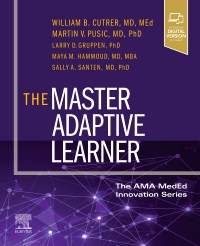
ISBN:
9780323711142
Copyright:
2020
Publication Date:
10-30-2019
Page Count:
224
Imprint:
Elsevier
List Price:
$55.99

The Master Adaptive Learner Field Book Elsevier E-Book on VitalSource, 1st Edition
by William Cutrer, MD, MEd, Martin Pusic, MD, PhD, Larry D Gruppen, PhD, Maya M. Hammoud, MD, MBA and Sally A. Santen, MD, PhD
Elsevier eBook on VitalSource
ISBN:
9780323711142
Copyright:
2020
Publication Date:
10-30-2019
Page Count:
224
Imprint:
Elsevier
List Price:
$55.99
Tomorrow’s best physicians will be those who continually learn, adjust, and innovate as new information and best practices evolve, reflecting adaptive expertise in response to practice challenges. As the first volume in the American Medical Association’s MedEd Innovation Series, The Master Adaptive Learner is an instructor-focused guide covering models for how to train and teach future clinicians who need to develop these adaptive skills and utilize them throughout their careers.
-
- Explains and clarifies the concept of a Master Adaptive Learner: a metacognitive approach to learning based on self-regulation that fosters the success and use of adaptive expertise in practice
- Contains both theoretical and practical material for instructors and administrators, including guidance on how to implement a Master Adaptive Learner approach in today’s institutions
- Gives instructors the tools needed to empower students to become efficient and successful adaptive learners
- Helps medical faculty and instructors address gaps in physician training and prepare new doctors to practice effectively in 21st century healthcare systems
- One of the American Medical Association Change MedEd initiatives and innovations, written and edited by members of the ACE (Accelerating Change in Medical Education) Consortium – a unique, innovative collaborative that allows for the sharing and dissemination of groundbreaking ideas and projects
- Expert Consult™ eBook version included with purchase. This enhanced eBook experience allows you to search all of the text, figures, and references from the book on a variety of devices
-
-
 The Master Adaptive LearnerPaperback
-
-
1. Who is the Master Adaptive Learner?
2. How does Master Adaptive Learning Advance Expertise Development?
3. The Master Adaptive Learner: A Conceptual Model?
4. What are the four critical personal characteristics that support the Master Adaptive Learning process?
5. Which cognitive processes are involved in the Master Adaptive Learner process?
6. What is the role of self-assessment in the Master Adaptive Learner model?
7. How do you measure the Master Adaptive Learner?
8. How and where do I teach my students about the Master Adaptive Learner model?
9. How will the Master Adaptive Learner process work in the classroom?
10. How will the Master Adaptive Learner process work at the bedside?
11. How Does Master Adaptive Learning Interact with the Learning Environment?
12. How can I best support Master Adaptive Learners using coaching?
13. Can the Master Adaptive Learner process help the struggling learner?
14. How Can the Master Adaptive Learner Model Advance Leadership Development?
15. How Can the Master Adaptive Learner Model and Health Systems Science Collaborate to Improve Health Care?
16. How does Master Adaptive Learning ensure optimal pathways to clinical expertise? -
-
Ways of Reading
- The appearance of the text and page layout can be modified according to the capabilities of the reading system (font family and font size, spaces between paragraphs, sentences, words, and letters, as well as color of background and text)
- This e-publication is accessible to the full extent that the file format and types of content allow, on a specific reading device, by default, without necessarily including any additions such as textual descriptions of images or enhanced navigation
- No information about nonvisual reading is available
-
Conformance
- No information is available
-
Navigation
- Table of contents to all chapters of the text via links
- Page list to go to pages from the print source version
-
Rich Content
- No information is available
-
Hazards
- No information is available
-
Product Content
- No information is available
-
Legal Considerations
- No information is available
-
Additional Accessibility Information
- Page breaks included from the original print source
- For readers with color vision deficiency, use of color (e.g., in diagrams, graphics and charts, in prompts, or on buttons inviting a response) is not the sole means of graphical distinction or of conveying information
- E-publication includes basic navigation (usually less detailed than TOC-based navigation)
- Where links, controls or buttons are included in the content, the purpose or functionality of each link, control or button is apparent from the associated text alone - or where it is unclear, separate link, control or button descriptions are provided
- All (or substantially all) textual matter is arranged in a single logical reading order (including text that is visually presented as separate from the main text flow, e.g., in boxouts, captions, tables, footnotes, endnotes, citations, etc.). Non-textual content is also linked from within this logical reading order. (Purely decorative non-text content can be ignored).
- The language of the text has been specified (e.g., via the HTML or XML lang attribute) to optimise text-to-speech (and other alternative renderings), both at the whole document level and, where appropriate, for individual words, phrases or passages in a different language.
-
Ways of Reading

 as described in our