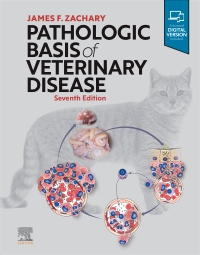

Pathologic Basis of Veterinary Disease - Elsevier eBook on VitalSource, 7th Edition
Elsevier eBook on VitalSource
**Selected for 2026 Doody's Core Titles as an Essential Purchase in Veterinary Medicine**
Choose the #1 veterinary textbook on general pathology and the pathology of organ systems! Pathologic Basis of Veterinary Disease, 7th Edition helps your students use the latest scientific and medical information to understand and diagnose animal disorders. Focusing on dogs, cats, horses, cattle, sheep, goats, and pigs, this reference illustrates and explores the pathogeneses of animal diseases, how cells and tissues respond to injury, and the morphology (lesions) of injury. New to this edition is basic coverage of tumor, inflammatory, and microbial cytology. An enhanced eBook version included with every new print purchase includes access to a complete, fully searchable version of the text, an image collection, and much more – available on a variety of devices.
-
- NEW! Coverage of the cytomorphology and histomorphology of tumors, inflammatory cells and exudates, and microbes commonly seen in the practice of veterinary medicine
- NEW! Coverage of a procedure used to collect specimens for cytologic evaluation
- NEW! Pathogenesis Pathways flowcharts designed to arrange each step of a disorder in chronologic, mechanistic order
-
- NEW! Coverage of the comparative cytomorphology and histomorphology of tumors, inflammatory cells and inflammatory exudates, and microbes commonly seen in the practice of veterinary medicine
- NEW! Procedure for collecting specimens for cytologic evaluation
- NEW! Pathogenesis Pathways flowcharts that arrange each step of a disorder in a chronologic mechanistic order
- Clear, up-to-date illustrations and explanations of the macroscopic (gross) and microscopic lesions resulting from diseases occurring in domestic animals
- Complete coverage of both general pathology and the pathology of organ systems that includes the latest research, practice, and diagnostic information on disease mechanisms, pathogenesis, and lesions
- Clear explanations of disease mechanisms that describe cell, tissue, and organ system responses to injury and infection
- Easy-to-follow organization for each systemic disease chapter including a brief review of the study of diseases that occur in specific tissues, organs, and organ systems, with basic principles related to anatomy, structure, and function, followed by congenital and functional abnormalities and discussions of infectious disease responses, helping students apply principles to veterinary practice
- More than 2,100 full-color illustrations featuring color photographs, schematics, flow charts, and diagrammatic representations of disease processes as well as summary tables and boxes, making it easier to understand difficult concepts
- Content on cellular and organ system pathology updated throughout the book, with expanded coverage of genetics and disease
- Key Readings Index in each chapter with page numbers for key topics
- Essential Concept boxes in each General Pathology chapter break down complicated topics that are critical to understanding lesions and pathogeneses
- More than 20 recognized experts deliver the most relevant information for the practitioner, student, or individual preparing for the American College of Veterinary Pathologists’ board examination
- An enhanced eBook is included with new print purchase, featuring the complete, fully searchable text plus an image collection; the text, tables, and boxes linked to the website that are cited throughout the book; ten new appendices that focus on veterinary diagnostic pathology, postmortem examination, interpretation of lesions, and more; plus an established appendix of photographic techniques used in veterinary diagnostic pathology
-
Section I Opener Art
1. Mechanisms and Morphology of Cellular Injury, Adaptation, and Death
2. Vascular Disorders and Thrombosis
3. Inflammation and Healing
4. Mechanisms of Microbial Infections
5. Diseases of Immunity
6. Neoplasia and Tumor Biology
Section II Opener Art
7. Alimentary System and the Peritoneum, Omentum, Mesentery, and Peritoneal Cavity
8. Hepatobiliary System and Exocrine Pancreas
9. Respiratory System, Thoracic Cavities, Mediastinum, and Pleurae
10. Cardiovascular System and Lymphatic Vessels
11. The Urinary System
12. Endocrine System
13. Bone Marrow, Blood Cells, and the Lymphoid/Lymphatic System
14. Nervous System
15. Skeletal Muscle
16. Bones, Joints, Tendons, and Ligaments
17. The Integument
18. Female Reproductive System and Mammae
19. Male Reproductive System
20. The Ear
21. The Eye -
-
Ways of Reading
- The appearance of the text and page layout can be modified according to the capabilities of the reading system (font family and font size, spaces between paragraphs, sentences, words, and letters, as well as color of background and text)
- This e-publication is accessible to the full extent that the file format and types of content allow, on a specific reading device, by default, without necessarily including any additions such as textual descriptions of images or enhanced navigation
- All content can be read as read aloud speech or dynamic braille
- Has alternative text descriptions for images
-
Conformance
- The publication contains a conformance statement that it meets the EPUB Accessibility 1.1, WCAG 2.1, Level AA standard. Please see https://bornaccessible.benetech.org/certified-publishers/ for further details of our compatibility testing.
- The certifier's credential is https://bornaccessible.benetech.org/certified-publishers/
- For detailed accessibility information, see Elsevier's website at https://www.elsevier.com/about/accessibility
- For queries regarding accessibility information, contact [email protected]
- The publication was certified on 19-03-2026
-
Navigation
- Table of contents to all chapters of the text via links
- Index with links to referenced entries
- Page list to go to pages from the print source version
-
Rich Content
- Math formulas in accessible format (MathML)
- Information-rich images are described by extended descriptions
-
Hazards
- The publication contains no hazards
-
Product Content
- The primary content is text.
- Content includes a significant number of actionable (clickable) web links to external content, downloadable resources, supplementary material, etc.
- Content includes a significant number of actionable (clickable) cross-references, hyperlinked notes and annotations, or with other actionable links between largely textual elements (e.g., quiz/test questions, 'choose your own ending', etc.).
- Content includes additional textual content such as an interview, feature article, essay, bibliography, quiz/test, other background material, or text that is not included in a primary or 'unenhanced' version.
- Content includes photographs, whether in a plate section / insert or not.
- Content includes figures, diagrams, charts and/or graphs, including other 'mechanical' (i.e. non-photographic) illustrations.
- Content includes narrative animation, e.g., cartoon, animatic or CGI animation (usually includes sound).
- Content includes images displayed in a specific order for the purpose of graphic storytelling or giving information (e.g. graphic novels, comics and manga). May include text integrated into the image (as speech and thought bubbles, textual 'sound' effects, captions etc.).
- At least some text - including text within other images - is 'text as an image' (i.e., a picture of text).
- Product includes actionable (clickable) links to external interactive content.
-
Legal Considerations
- No information is available
-
Additional Accessibility Information
- Content is enhanced with ARIA roles to optimize organization and facilitate navigation
- Page breaks included from the original print source
- For readers with color vision deficiency, use of color (e.g., in diagrams, graphics and charts, in prompts, or on buttons inviting a response) is not the sole means of graphical distinction or of conveying information
- The body text is presented with a contrast ratio of at least 4.5:1 (or 3:1 for large/heading text)
- Ultra-high contrast between text and background
- E-publication includes basic navigation (usually less detailed than TOC-based navigation)
- Where links, controls or buttons are included in the content, the purpose or functionality of each link, control or button is apparent from the associated text alone - or where it is unclear, separate link, control or button descriptions are provided
- All (or substantially all) textual matter is arranged in a single logical reading order (including text that is visually presented as separate from the main text flow, e.g., in boxouts, captions, tables, footnotes, endnotes, citations, etc.). Non-textual content is also linked from within this logical reading order. (Purely decorative non-text content can be ignored).
- Where interactive content is included in the product, controls are provided (e.g., for speed, pause and resume, reset) and labelled to make their use clear.
- The language of the text has been specified (e.g., via the HTML or XML lang attribute) to optimise text-to-speech (and other alternative renderings), both at the whole document level and, where appropriate, for individual words, phrases or passages in a different language.
-
Ways of Reading



 as described in our