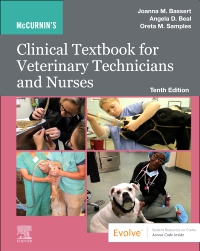

McCurnin's Clinical Textbook for Veterinary Technicians and Nurses Elsevier eBook on VitalSource, 10th Edition
Elsevier eBook on VitalSource
Now $116.99
Master all the animal care duties of a veterinary technician! McCurnin's Clinical Textbook for Veterinary Technicians and Nurses, 10th Edition provides a solid foundation in every aspect of veterinary technology, including care of small and large animals, birds, reptiles, and small mammals. Procedure boxes offer step-by-step guidelines to performing key tasks, and use of the veterinary technician practice model helps to improve your critical thinking and decision-making skills. Written by vet tech experts Joanna Bassert, Angela Beal, and Oreta Samples, this illustrated guide prepares you for success on the Veterinary Technician National Exam (VTNE®) and in clinical practice.
New Edition Expected Availability: 04-28-2025

McCurnin's Clinical Textbook for Veterinary Technicians and Nurses Elsevier eBook on VitalSource
-
- 2017 winner of the William Holmes McGuffey Longevity Award ("McGuffey") from the Text & Academic Authors Association (TAA), which recognizes textbooks and learning materials whose excellence has been demonstrated over time
- Case presentations provide real-life scenarios, so students can practice critical thinking and decision-making skills
- Step-by-step instructions show students how to perform dozens of procedures, making information easy to access in emergency and clinical situations
- More than 1,000 full-color photographs and line drawings depict veterinary technology concepts and techniques
- Chapter outline, learning objectives, and key terms begin each chapter, focusing study on need-to-know material
- Technician Notes highlight key points relating to the role of the veterinary technician
- Coverage of large animal care is integrated throughout the book, including medical records, dentistry, physical examination, surgical instrumentation, surgical assistance, emergency care, and euthanasia, as well as separate Large Animal chapters
- Comprehensive chapters on pharmacology, pain management, restraint, and veterinary oncology provide a broader understanding of the responsibilities of a technician
- Coverage of zoonotics is threaded throughout each chapter, describing how a disease may affect the host, how it is spread, how it is treated, and the necessary safety precautions
- Care of Birds, Reptiles, and Small Mammals chapter describes care and treatment of these increasingly popular pets
- Student workbook reinforces understanding with review questions, case presentations, and clinical applications, as well as photo-based quizzes and other student exercises. Available separately
-
-
 Elsevier Adaptive Quizzing for McCurnin's Clinical Textbook for Veterinary Technicians (eCommerce Version)Elsevier Adaptive Quizzing - Next Generation
 -
 Workbook for McCurnin's Clinical Textbook for Veterinary Technicians Elsevier eBook on VitalSourceElsevier eBook on VitalSource
 -

-
-
Part 1: Veterinary Technology: An Overview
1. Introduction to Veterinary Nursing and Technology: Its Laws and Ethics
2. Veterinary Practice Management
3. Veterinary Medical Records
4. Occupational Health and Safety in Veterinary Hospitals
Part 2: Patient Management and Nutrition
5. Animal Behavior
6. Restraint and Handling of Animals
7. History and Physical Examination
8. Preventive Health Programs
9. Animal Nutrition
10. Animal Reproduction
Part 3: Clinical Sciences
11. Hematology and Cytology
12. Clinical Chemistry, Serology, and Urinalysis
13. Parasitology
14. Clinical Microbiology
15. Diagnostic Imaging
16. Basic Necropsy Procedures
Part 4: Medical Nursing
17. Diagnostic Sampling and Therapeutic Techniques
18. Small Animal Medical Nursing
19. Large Animal Medical Nursing
20. Veterinary Oncology
21. Neonatal Care of Puppies, Kittens, and Foals
22. Care of Birds, Reptiles, and Small Mammals
23. Rehabilitation and Alternative Medical Nursing
Part 5: Emergency and Critical Care
24. Fluid Therapy and Transfusion Medicine
25. Emergency and Critical Care Nursing
26. Toxicology
27. Wound Management and Bandaging
Part 6: Anesthesia, Analgesia, and Pharmacology
28. Pharmacology and Pharmacy
29. Pain Management
30. Veterinary Anesthesia
Part 7: Surgical Nursing
31. Surgical Instruments and Aseptic Technique
32. Surgical Assistance and Suture Material
33. Small Animal Surgical Nursing
34. Large Animal Surgical Nursing
35. Veterinary Dentistry
Part 8: End of Life
36. Geriatric and Hospice Care: Supporting the Aged and Dying Patient
37. The Human-Animal Bond and Euthanasia -
-
Ways of Reading
- The appearance of the text and page layout can be modified according to the capabilities of the reading system (font family and font size, spaces between paragraphs, sentences, words, and letters, as well as color of background and text)
- This e-publication is accessible to the full extent that the file format and types of content allow, on a specific reading device, by default, without necessarily including any additions such as textual descriptions of images or enhanced navigation
- No information about nonvisual reading is available
-
Conformance
- No information is available
-
Navigation
- Table of contents to all chapters of the text via links
- Page list to go to pages from the print source version
-
Rich Content
- No information is available
-
Hazards
- No information is available
-
Product Content
- No information is available
-
Legal Considerations
- No information is available
-
Additional Accessibility Information
- Page breaks included from the original print source
- For readers with color vision deficiency, use of color (e.g., in diagrams, graphics and charts, in prompts, or on buttons inviting a response) is not the sole means of graphical distinction or of conveying information
- E-publication includes basic navigation (usually less detailed than TOC-based navigation)
- Where links, controls or buttons are included in the content, the purpose or functionality of each link, control or button is apparent from the associated text alone - or where it is unclear, separate link, control or button descriptions are provided
- All (or substantially all) textual matter is arranged in a single logical reading order (including text that is visually presented as separate from the main text flow, e.g., in boxouts, captions, tables, footnotes, endnotes, citations, etc.). Non-textual content is also linked from within this logical reading order. (Purely decorative non-text content can be ignored).
- The language of the text has been specified (e.g., via the HTML or XML lang attribute) to optimise text-to-speech (and other alternative renderings), both at the whole document level and, where appropriate, for individual words, phrases or passages in a different language.
-
Ways of Reading

 as described in our